

What Gujarat 2002 Tells Us About 'Rashtra', 'Dharma' and a Hobbes Turned Upside Down


When I think, in the spirit of introspection, about the accountability of (and to) people over the 20 years since 2002, I am convinced that, instead of preserving or adding to whatever balance there was saved in the books after the freedom movement and the framing of the constitution, our tendency has been to waste it away. What is more, an ideology and its distorted logic have come to grow around this tendency, aided by spin doctors.
Many of us chose to look at the whole – repeat, whole – chronology of the events at Godhra and later across the state as a sort of civil war inspired by the two-nation theory, albeit in a vague, undefined way. The question, above all, was simply that of the rule of law. It was not about the Newton-inspired justification of action and reaction, but about an elected government following the norms of governance. It should not have been about mobs taking law in their hands or those in power aiding them in this exercise, but about the state upholding the law and ensuring it is respected by all. But shasan (rule) and anushasan (discipline) were replaced by duhshasan (misrule) and nihshasan (absence of rule).
Also read: Why Gujarat 2002 Is So Easy to Forget
Happily, for the government, a section of citizens then indulged in frivolous and fallacious arguments over secularism and nationalism. But when was it not the responsibility of the government to stop someone out to maim, burn and kill someone else? Those of us who, as citizens, sought to underline our secular ethos and constitutional traditions were branded anti-nationals and terrorists, whereas those who indulged in barbarous crimes were praised as great nationalists.
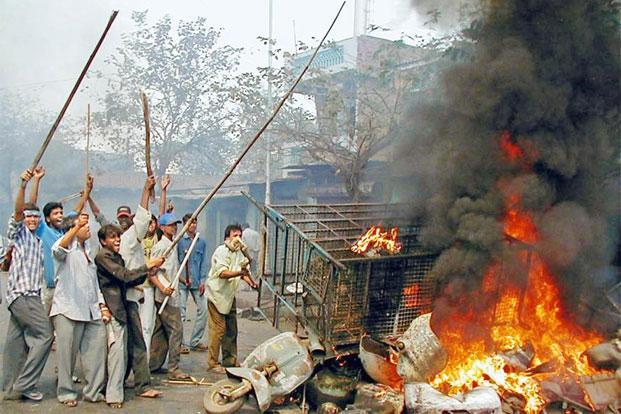
2002 Gujarat riots. Photo: Reuters/Files.
Recalling Justice J.S. Verma would not be out of place here. In 1995, as a Supreme Court judge, he had given the judgment terming Hindutva as “a way of life”, something L.K. Advani never tired of quoting. But, as the head of the National Human Rights Commission, when he visited Ahmedabad in 2002, he must have realised the full extent of the dangers inherent in that way of life as practised in politics. It is a historical fact that he insisted on full and fair investigations into human rights violations on an unprecedented scale.
These investigations, however, suffered not only from the ideological turn given to them but also from the limitations of our institutions. The office of the public prosecutor, a colonial invention, had been in any case an instrument of the state power, and in Gujarat, it had become all the more so. Many of the public prosecutors dealing with the cases of the 2002 communal riots were directly or indirectly associated with the Vishwa Hindu Parishad (VHP). When the state swears by an ideology and public prosecutors in the court are from the VHP, the fate of justice leaves little to imagination. This is not to say that justice was not delivered at all. No disrespect is meant for the judiciary either. Only that what followed was rather shocking for anybody harbouring hopes based merely on the promise of the constitution.
It has been more than six decades since I first read, as a student of political science, Thomas Hobbes’ Leviathan. Hobbes found the legitimacy of the state in its function of providing an institutional system of governance in place of the "state of nature", which is the law of the jungle. Bereft of an organised state, Hobbes believed the life of man is "solitary, poor, nasty, brutish and short". His notion of the state was expected to remedy this absence of life-sustaining values. Instead, for days and weeks 20 years ago, the state itself was gleefully absent. Putting Hobbes upside down, the state itself was striving to legitimise what Hobbes called "the war of all against all".
Also read: How Gujarat 2002 Turned India Into a Nation of Pathological Liars
As a citizen, apart from this introspection occasioned by the 20th anniversary of the birth of that political reality, there is another point worth mentioning. When the rule of law is made subservient to an ideology, a substantial segment of our citizens is denied – in real terms – participation in political and administrative processes.
Rights activist J.S. Bandukwala, who passed away last month, in his later years often spoke to me of his anguish that the Muslim youth has to build their careers by first acknowledging the reality of this denial. Bandukwala, after studying nuclear physics in the US, could have pursued further research there, but he chose to return to his hometown, Vadodara. Alongside his lifelong battle for human rights and for human dignity, he also spent his time and energy in educating Muslim youth and guiding them in building better futures. But this denial from common and equal participation, which hurt Bandukwala, not merely limits career options for the Muslim youth it also turns a segment of our society into non-citizens.
When we add them to those already placed on the margins by the economy, those left out of ‘development’ (or left out *because* of ‘development’), our nation seems headed in a dangerous direction. No matter where we arrive after that journey, we will remain only as strong as the weakest link among us.
As constituents of our civil society, our introspection and our concerns are about the possible ways to strengthen the weakest links to strengthen the whole chain, and not about petty equations like the BJP versus Congress. Yet, the national security advisor sees in this endeavour a threat "the new frontiers of war".
When we think through the most basic of self-evident truths, we realise that there are two signifiers about which the current regime's misconception is taking us away from true freedom, true self-rule of the people. They are 'rashtra' and 'dharma' – nation and religion. The current rulers fail to understand that it was a narrow, and narrow-minded, understanding of ‘nation’ that divided this country. They are not much bothered either about the divisions the same distorted definition is promoting today. As for ‘dharma’, the less said would be the better.
Rather than straitjacketing the nation on the basis of one religion or ethnicity, we need to return to a vision of communities living together and flourishing while respecting the boundaries set by the constitution – whether you call it constitutional nationalism or civic nationalism.
Note: Translated by A.U.M. from the editorial of the March 1, 2022 edition of Nireekshak, a Gujarati journal.
Prakash N. Shah, a Gandhian activist jailed during the Emergency, served as editor of the Gujarati daily Jansatta, but the culmination of the Ayodhya campaign in 1992 prompted him to found the Movement for Secular Democracy in Ahmedabad. Now the president of the Gujarati Sahitya Parishad, he edits the journal Nireekshak, which has been among the few voices in Gujarat standing up for constitutional values.
This article went live on March second, two thousand twenty two, at forty minutes past four in the afternoon.The Wire is now on WhatsApp. Follow our channel for sharp analysis and opinions on the latest developments.


