

When Ravan Triumphs in Ayodhya


January 22, 2024, was a historic day. It was a very sad day, but a historic day nonetheless.
It was a sad day because along with the idol of the Maryada Purushottam in Ayodhya was also enshrined a new idea of India. An idea that recognises only one native, authentic, and legitimate version of India and views every other culture, belief, religion, and morality as interlopers to be at best tolerated and at worse put in their placed.
As M. S. Golwalkar put it, "...in this country, Hindustan, the Hindu Race with its Hindu Religion, Hindu Culture and Hindu Language, (the natural family of Sanskrit and her off- springs) complete the Nation concept…in Hindustan exists and must needs exist the ancient Hindu nation and naught else but the Hindu Nation. All those not belonging to the national i.e. Hindu Race, Religion, Culture and Language, naturally fall out of the pale of real 'National' life." In this Idea of India, adherents of this one India have first and absolute right over her destiny.
The rest, in M. S. Golwalkar’s chilling words, “…(minorities) in Hindusthan must either adopt the Hindu culture and language, must learn to respect and hold in reverence Hindu religion, must entertain no idea but those of the glorification of the Hindu race and culture, i.e., of the Hindu nation and must lose their separate existence to merge in the Hindu race, or may stay in the country, wholly subordinated to the Hindu Nation, claiming nothing, deserving no privileges, far less any preferential treatment – not even citizen's rights”.
In this idea of India, the majority may use any means they choose to impose their desire upon the rest of us. This bulldozing of multiplicities and the dominance of the majority is regarded not just as legitimate but indeed patriotic, which brings us to the greatest tragedy of all. It is an idea of India, that dwarfs the spiritual universe of its people. It produces petty bullies full of fear, hate, insecurity, and suspicion who find validation in kicking their fellow countrymen in the teeth. The products of this idea of India can be true to neither their religion nor their nation nor indeed to their own full potential as human beings. The temple may have been dedicated to Ram, but it is Ravan who seems to have triumphed in Ayodhya.
Jan 22 was also a historic day. It was historic because this idea of India was celebrated that day not by a marginal group of private individuals or organizations but by the Indian state, its elected leadership and nearly every institution and domain with social power. In fact, it is the few who refused to celebrate the day that found themselves at the margins. It is this collective celebration of the powerful that made the event a consecration of a new idea of India. The elected government, the Prime Minister, the administrative machinery made the construction of the edifice their personal project. The judiciary legitimized the project with its judgement and most of the media dedicated itself to the breathless celebration and a bevy of celebrities lent their prestige and respectability to the event. Even the armed forces joined the party by showering the venue with flowers. But the ultimate consecration was in the popular imagination, visible in the form of florescent pinkish-orange flags that took over our public spaces. These were not the pennants of fervent devotees. They were instead the standards of conquerors showing the rest of us our place in the new dispensation.
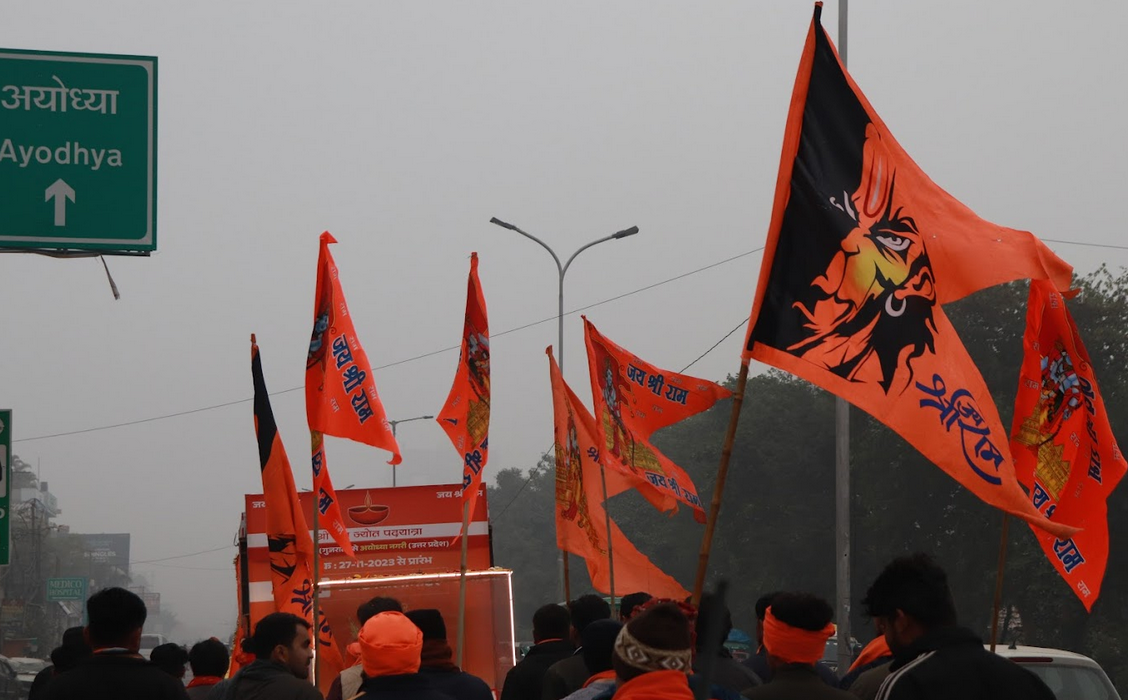
On the road to Ayodhya. Photo: Ananta Jain
Those of us who disagree with this idea of India have responded to the events in Ayodhya in a variety of ways.
One approach has been to deny that the day was sad at all. It welcomes and celebrates the construction of the edifice in Ayodhya reserving its criticism only for the manner in which the ceremony was conducted. Rather than object to the fact that a riotous mob broke laws, violated human decency and mangled the national fabric to destroy a mosque and make way for the temple, it objects only to who was invited and who presided over the consecration. This is akin to criticizing the décor of a building constructed on stolen land. Would the project have been any more legitimate if it was conducted in strict accordance with scriptures without a BJP leader or flag in sight?
Another view denies that the day was historic at all. It sees the event at Ayodhya as just another in a string unconstitutional acts rather than as the consummation of a long project to establish a new order. It takes refuge in the existence of the Constitution without recognizing that the Constitution itself has been usurped and confined to the pages it is written on. It holds hope in electoral arithmetic without recognising that a change in government does not necessarily imply a change in the order of things. It tiptoes around the venom that has seized our national consciousness and hopes that a variety of side narratives can somehow dilute the poison. But that is a denial of the challenge that stands before us today.
There is a compelling logic for these positions. They come from the desire to preserve an existence in the new political mainstream so that we may survive to fight another day. But they come at the price of accepting and unwillingly legitimizing the new order. A price that I find too much to pay.
I propose another position. It is to call out and stand firm against the madness that has seized the Nation. This position requires us to recognize the human, constitutional, and spiritual tragedy that is the event in Ayodhya. It requires us to reject the idea that what happened at Ayodhya represents divinity, justice, or patriotism in any form whatsoever. It requires us to reject the cheap counterfeit being peddled in Ayodhya as being Hinduism or the worship of Ram. It requires us to reject the idea that vengeance perpetrated upon our countrymen of today for the sins, real and imagined, of their co-religionists of the past can in any way be called justice. It requires us to reject the idea that what is wrong by any standard of humanity becomes right because a compromised justice system and a bevy of celebrities say it to be so.
This position also requires us to acknowledge that Ayodhya is more than just another event but is in fact the harbinger of a new, sinister idea of our nationhood. It requires us to recognise that the struggle is for something much greater than the outcome of one election, it is a struggle for how India understands itself and its purpose. This is a task that will be long and very often lonely. But most of all it requires us to stand publicly and somewhat outnumbered but without despair, anger or fear for what we believe to be true.
We in this position could indeed find ourselves to be irrelevant to the ‘mainstream’ of the new order, but in the exile of this irrelevance lies the possibility, no matter how remote, of becoming relevant in a politics of our choosing than in playing the domesticated roles in a politics we do not believe in. We could also be accused of standing against the tide of history. But in that resistance lies the possibility, no matter how remote, of writing a history of our own. Jai Jagat.
Sachin Rao is a Congress Worker.
This article went live on January thirtieth, two thousand twenty four, at thirty minutes past eight in the evening.The Wire is now on WhatsApp. Follow our channel for sharp analysis and opinions on the latest developments.


