

Ghost Villages and Choking Cities: How Our Countrysides are Falling Silent


Senior Hindi poets in the early years of freedom like Maithili Sharan Gupt and Sumitranandan Pant wrote gushingly about the pristine beauty of India’s country side. Their poems had deep philosophical thoughts on life and death, religious beliefs and memories of historical battles, warlords and romances that they heard from farmers even as they carried out their tedious everyday tasks.
In prose, however, Suryakant Tripathi Nirala and other greats – Munshi Premchand, Chandradhar Sharma Guleri, Shivpoojan Sahay and Phanishwar Nath Renu – were far less sentimental. Novels like Godan, Dehati Duniya and Maila Anchal speak of poverty stricken villages divided along brutal caste/class and gender hierarchies. They also hint clearly at a growing desire among the young to escape to cities that spell freedom from the squalor of farming life.
Things looked rosy if you were a city-based gentleman farmer and visited your ancestral home occasionally for festivities and leisure. Their successive generations have mostly sold the land at huge profits but harbour romantic dreams about holding on to their cultural roots. They have avidly grabbed the hype the state has actively been promoting of late, as countryside as the heart of both Sanatan Dharma and age-old Hindu traditions.
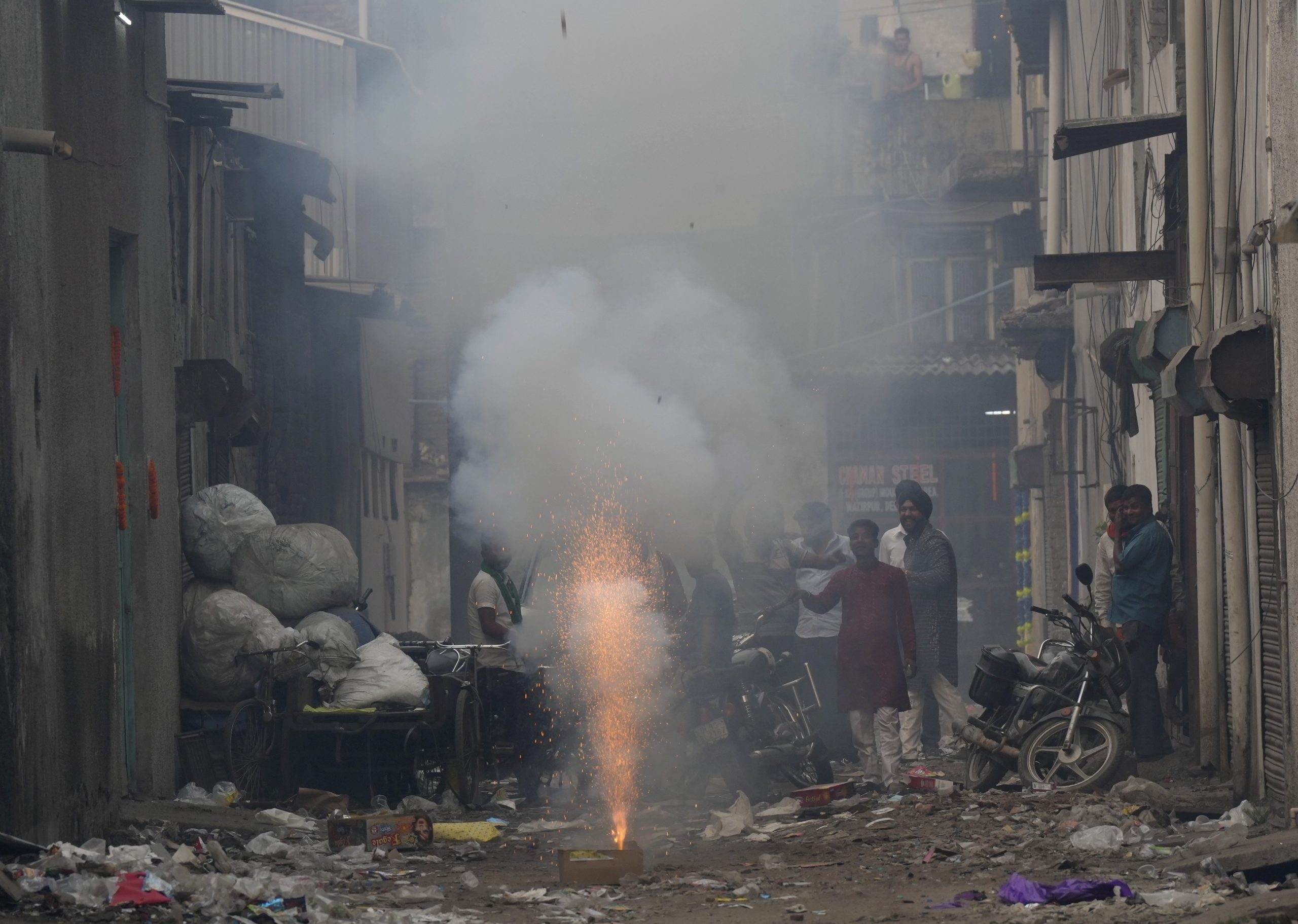
People light firecrackers as part of Diwali festival celebrations, even as pollution levels surged across Delhi-NCR, with Wazirpur recording severe air quality in New Delhi on October 21, 2025. Photo: PTI/Shahbaz Khan
So with Diwali over and pollution on the rise, most Delhiites start thinking of spending quality time in a country house or rented villa in the hills or a beach in Goa or a shikara in Kashmir or Kerala. The rest choke, cough and wheeze through the winters in India’s polluted metros and save money to buy expensive air purifiers and write letters to editors about the need to do ‘some thing’.
The blame for the environmental pollution is usually laid at the door of the state governments of agriculturally-rich states who do not or can not stop their farmers from burning the post-harvest stubble that creates and sends vast waves of smoke towards nearby cities like Delhi. The overbuilt regions themselves continue to contribute to the atmospheric rot. Successive governments ignore dysfunctional real-time air pollution monitoring networks, illegal constructions, illegal factories dumping hazardous chemicals in the rivers that make the waters unfit for consumption or even bathing, filling up of old water bodies to build multi storied buildings.
Also read: A Diwali Of Epic Proportions: Delhi Pollution This Year Was Highest Compared To Last Four Years
This year in the name of upholding an age-old Hindu tradition, the courts vacated a stay on citizens burning firecrackers during Diwali celebrations. This was loudly applauded by usual suspects in Delhi that deemed the ban as an infringement of the religious freedoms of the majority community and blamed the neighbouring states for burning farming waste and filling the NCR region with smog.
In the media the jury is still out on the role played by Haryana and Punjab. All this while those who can are fleeing the smog laden capital city. Many of the lobbyists for environmental and wildlife protection have bought or at least rented comfortable pads to spend time away from the polluted mega cities. Rural areas in the tourism zones are thriving on tourism throughout the year.

Illustration: Pariplab Chakraborty
Our fair-weather tourists who fill their cloud storages with attractive pictures of their rural sojourns, do not have much to say about the agricultural side of local rural activities that are increasingly disappearing with the gentrification of the countryside. Banning building activity along fragile mountains or upon river beds sounds close to a dangerously violent revolutionary idea to state governments raking in money from yatras and adventure sports and trekkers.
Cosy homes and home stays with fireplaces overlooking peaceful forests for purchase or rental that we see on our laptops, do not tell the whole story. Everywhere in India, furious growth of unplanned rural tourism is triggering human-animal clashes. Panthers, elephants, wild boars and even aggressive simians are losing their forest dwellings and paths even in protected zones. So they roam in search of food and shelter towards outer limits of major towns close by and they are chased periodically and released in forests bordering villages and they eventually become ferocious and predatory.
In the villages bordering forests you hear of animal bands attacking humans and domestic cattle daily. Once upon a time the villagers here could harvest substantial crops of maize, potatoes , and kidney beans (rajmah), along with various coarse grains. No more. Severely restrained by the wildlife protection Act, the villagers are usually handed some fire crackers by forest officials and assured that their loud booms would drive away the attacking hordes. It has not worked.
When an age old way of rural life is slowly being effaced in the name of ‘development’ much of the planning done in urban centres misses a vital point. Rigidly traditional societies eager to get out of poverty may agree to change from tending farms to becoming glamorous tourist hubs. Their age-old economic systems too will mutate when rosy dreams of lucrative jobs and multiple incomes are flashed repeatedly before the public.
But as the countryside gives up centuries’ old ways of life to settle to the new patterns and new kalesh (conflict), they have begun to realise only some of them with ‘connections’ in the ruling political party can benefit. Most others who are outside the power circuits and had not reflected on how all these new roads and hotels and power plants and yatras might ultimately lead to the erosion of their own distinct cultural identity, miss out more than they had dreamt of. Their only option then is to look back in regret and accept the death of old networks of kinship, work and neighbourhood.
This is why while roads are widened and new facilities stream in the area, most families have chosen to migrate. Ghost villages are a common sight in the hills now. Raini, the village where the famous “Chipko” movement was born, is today a ghost village abandoned by villagers after they repeatedly suffered floods in their area that followed a merciless deforestation for “development.”
Back in Delhi the milling Chhath crowds along a highly polluted Jamuna river begin to gather soon after the Pujo idol immersion groups have departed. In them we see how India’s country life now is a social rather than geographic entity. The Chhath or Pujo or Ganesh Visarjan crowds are a class of migrants from Uttarakhand, Bihar, Bengal, Odisha or Chhattisgarh. Delhi pushed them out of their villages first and has now handed them a bunch of suburbs of unbelonging as permanent exiles forever fearing being ousted as ‘outsiders’.
Mrinal Pande is a writer and veteran journalist.
Saakhi is a Sunday column from Mrinal Pande, in which she writes of what she sees and also participates in. That has been her burden to bear ever since she embarked on a life as a journalist, writer, editor, author and as chairperson of Prasar Bharti. Her journey of being a witness-participant continues.
This article went live on October twenty-sixth, two thousand twenty five, at fifty minutes past one in the afternoon.The Wire is now on WhatsApp. Follow our channel for sharp analysis and opinions on the latest developments.


