

Looking for the Spirit of Durga


Today is Saptami. Shashthi is past us. And with that, the countdown has begun. Durga will soon leave her mother’s home and return to her husband, Shiva. From Mahalaya to Shashthi, the days are filled with the joy of a daughter’s homecoming. After that, one must begin gathering the strength to face the inevitability of her departure.
Durga Puja, for me, is inseparable from childhood memories. In those mornings, my mother – Ammi – would bathe and sit for the Chandi Path. The old copy of the Durga Saptashati, worn thin by decades of turning its pages in this season, always lay before her. With her eyes closed in recitation, her face bore a tremor of devotion. Droplets of water would cling to her thick hair after her bath, glistening, as she sat absorbed. What private conversation she held with the goddess at that time, we never knew. All this unfolded in a corner of our small house in Siwan, with hibiscus flowers always brought for the ritual.
Later, as the home of my elder brother and his wife in Chandigarh grew, Ammi’s gods found their own space there. In the final months of her life, when they built a house of their own, she was given an entire room for her deities. Her pantheon kept expanding. We would tease her, saying that Ammi’s celestial family of gods have kept growing. Even Ram found his place there, but only much later. Durga remained central. Through the years, During Puja, Ammi's recitations continued. The incense and its fragrance altered the atmosphere of the house. It cleansed the ordinariness of life with its sanctity.
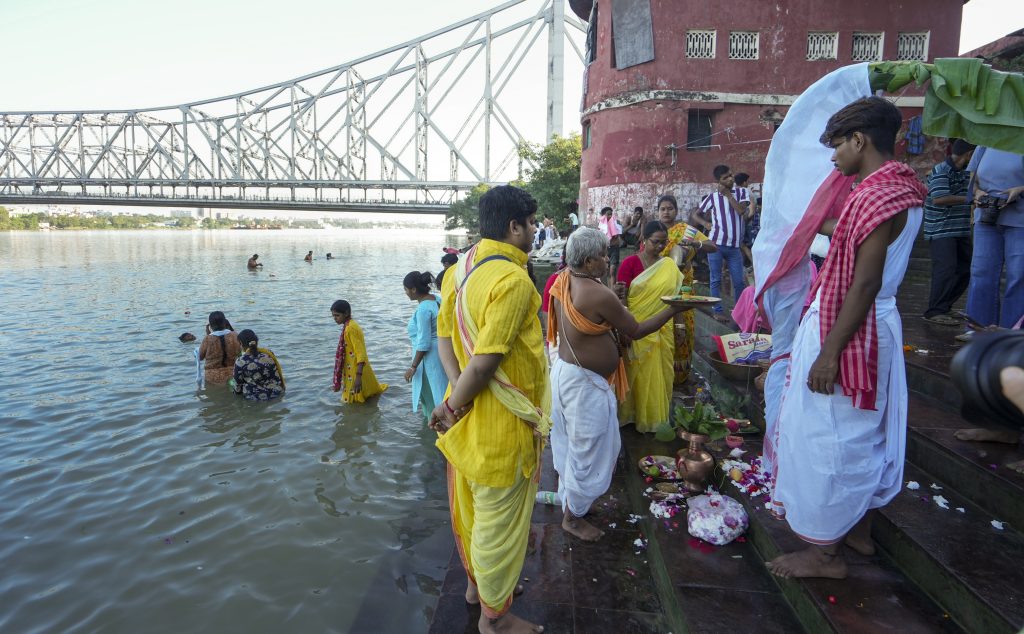
People perform a traditional ritual with a banana tree at the Ganga River bank on the occasion of Maha Saptami during Durga Puja festivities, Kolkata, West Bengal, Monday, Sept. 29, 2025. Photo: PTI Photo/Manvender Vashist Lav.
In Siwan, the celebrations were grand too, but in our eyes they were was always something special about the puja in Deoghar. Often, during holidays, when we went to our parental home there, we would walk from pandal to pandal, comparing the goddess in each. Every Durga had a distinct personality, every face its own expression. She was, of course, Mahishasuramardini – the one who vanquishes the Mahishasur – but more than that, we saw her as Uma, the daughter of Mena. In the pandals of Deoghar, some devotees did the ‘path’ or reading from the first day itself. On Ashtami and Navami, watching their tears fall as they read astonished us as children. The thought of the goddess – daughter Durga – returning to her husband’s home unsettled them so deeply. In our childhood, this evoked curiosity. Later, it became an occasion to think about surrender, about the transformations through faith.
Ammi, too, would always go to the pandal. The sound of the dhak, the smoke of incense, the rhythmic dance of people holding dhunuchi (a clay burner) – all of it stirred the body with thrill. Ammi’s solitary worship was not enough; she needed this collectivity too. There was no conflict between the personal and the collective in her devotion. Yet Durga Puja was never only about prayer and worship. It was also a celebration of dance, music, drama, and of people coming together. It was a time of Bijoya Milan, of renewing ties.
Durga is Shakti. And so, sacrifice is inevitable. How could Navami pass without receiving the sacrificial offering? Our Durga was not vegetarian. And yet, the act of sacrifice was never seen as violence.
The Puja was a weave of solitude and collectivity. The awareness of one’s smallness, and yet the exaltation of being in relation to Durga. Between the two, there was no contradiction. In those ten days, sanctity and grandeur acquired a rhythm. Which is why, on Dashami, when Durga was immersed and we returned home, it was with a sense of loss – as if a rhythm had been broken. As the incense smoke faded, the mystery of those ten days dissolved with it.
Perhaps, so that the departure was not too sudden, the journey from Dashami to Kali Puja was created. Kali evokes terror, but she too, was never the mother of violence.
Durga and Kali were both characters in a vast narrative. And in that narrative, ordinary human beings sought a place for themselves. The Puja was but a means of entering that story. To rise above one’s littleness, to free oneself from inadequacy, to imagine a larger force – are these not marks of our humanity? Humanity is made only in relation to the greater. And this demands humility. It is humility that prepares us to bear the sublime.
On this morning of Saptami in Delhi, I sit thinking: It’s been years since the pre-dawn of Mahalaya was filled with that sonorous chant, a sacred thread connecting our little transistor to the voices from Dhaka, then Kolkata, then Patna. We would huddle around it, the recitation of the Chandi Path weaving a universe of the sacred, preparing the ground for the Mother’s arrival.
But now, a different silence. A void not of the festival's natural end, but of its essence having fled.
What has happened to our Puja?
The airwaves and newspapers, once carrying hymns, now bring a daily dispatch of poison. From Mahalaya itself, a different chant begins – not of invocation, but of exclusion and hatred. News of markets purging Muslims, of Garba turning into a pretext for violence, of livelihoods destroyed in the name of dietary purity. The Puja, whose very core is the celebration of the Divine Feminine as power and compassion, has been weaponised. It has become a ritual of asserting majoritarian dominance, a spectacle of our own collective descent into pettiness and brutality.
Those who claim to be the Goddess's devotees are, in fact, her greatest desecrators. They are drunk on the arrogance of power, building a collective not of devotion, but of a chilling, soulless inhumanity. They have hollowed out the ritual, replacing its heart with the stone of hatred.
And one is left with agonising questions. Does the Mother see this travesty? Does she watch as her name is used to torment her own children, for are we not all her children? Can she not revoke the worship of those whose hearts are filled with nothing but contempt for the very essence of her being—the power that nurtures, protects, and embraces all?
Why would she even return? Why would she grace a society so bereft of intimacy, so chillingly indifferent to the suffering of its own, a society that has made its worship a mockery of everything she stands for?
The familiar anchors are gone. Ammi and Babuji are now mere silhouettes in memory. And Durga? She feels distant, too. They have taken her spirit. What remains are mere idols. Beautiful, empty shells, behind which a great, crushing emptiness looms.
The puja has begun. But I am still looking for the spirit of the Goddess I knew.
Apoorvanand teaches Hindi at Delhi University.
This article went live on September twenty-ninth, two thousand twenty five, at eighteen minutes past seven in the evening.The Wire is now on WhatsApp. Follow our channel for sharp analysis and opinions on the latest developments.


