
No Longer a Toy Story
Rahul Maganti


Real journalism holds power accountable
Since 2015, The Wire has done just that.
But we can continue only with your support.
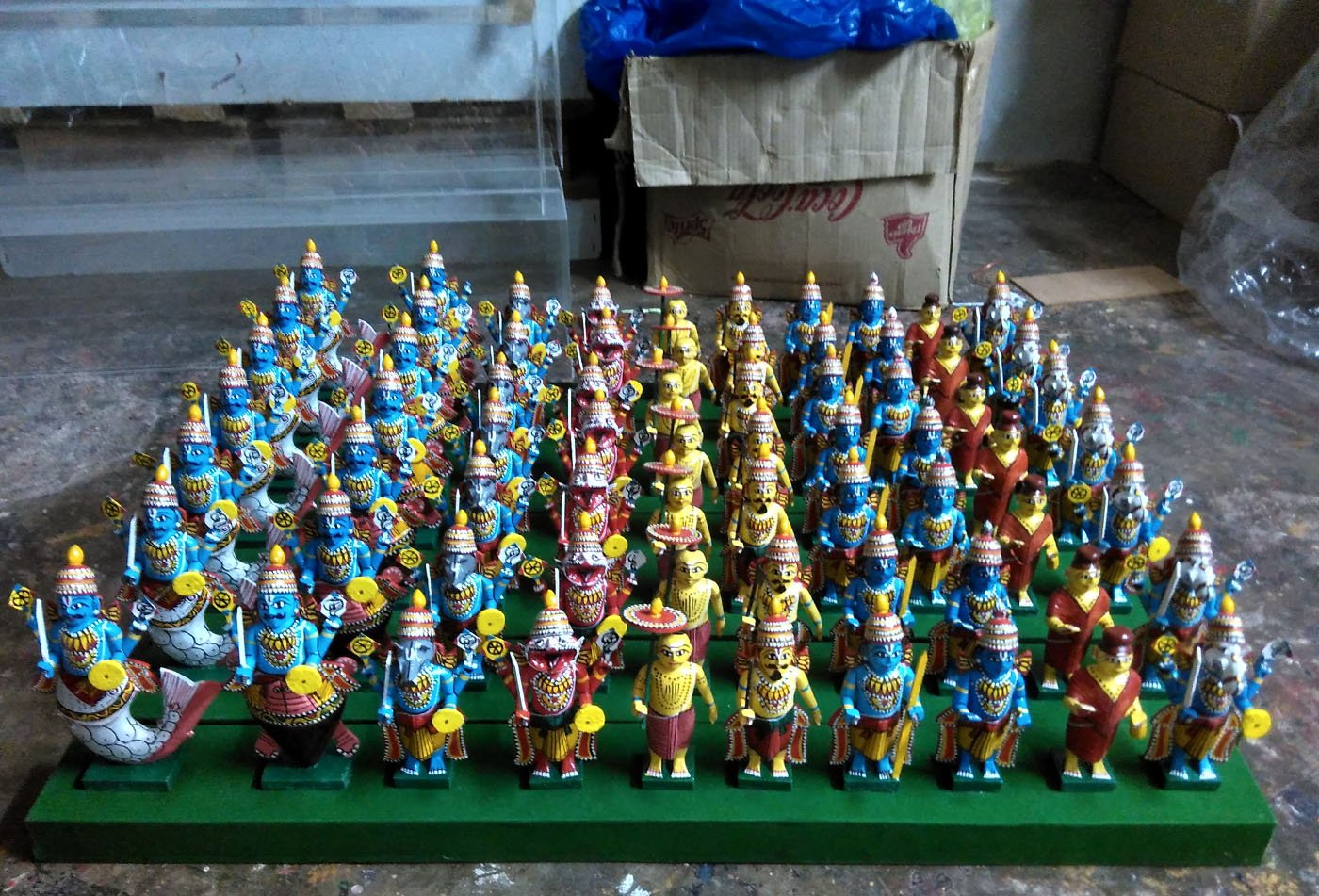
Toy-makers in Kondapalli village of Andhra Pradesh have been making wooden toys for generations, but now fear that their signature craft may not survive beyond the decade.
Toy makers in Kondapalli village of Andhra Pradesh have been making toys for generations but now fear that their craft may not survive for much longer. Credit: Rahul Maganti
Kondapalli: Korella Venkatachari’s three-room house is strewn with toys on the floor; paint containers lie in one corner and unused wood in another. “I have been carving toys for 28 years,” he says, proudly.
Venkatachari is amongst the 229 toy-makers of Kondapalli (‘village of hills’, roughly translated) in Krishna district of Andhra Pradesh, a village flanked by the lush green eastern ghats and the Narla Tata Rao Thermal Power Station.
He and the other artisans have been making signature Kondapalli toys for generations. His entire family does this work. He carves the wood, his wife Jyothi paints the toys. Their 18-year-old daughter Mounika dropped out of school after Class 10 and now helps her parents.
Left: Wooden bullock carts and elephants outside a toy shop in Kondapalli. Right: A workshop used by the artisans. Credit: Rahul Maganti
The road in the village that leads to the Reddy dynasty fort is filled with houses and shops where the toys are made and sold. Most of the artisans make the toys at home, with all the members of the family sharing the work. A few mass-production workshops in Kondapalli also employ the toy-makers on daily wages to craft, carve and paint. Most of the toys are sold in wholesale on orders from cultural platforms like Shilparamam in Hyderabad.
Venkayya, 80, who has been making toys for 57 years, says, “We generally make what we see and what we relate to in everyday life. The most prominent of the toys here are bullock carts, and animals like cows, peacocks and others. We also make toys of mythological and fictional characters. But what I love is depicting the things and people I see every day.”
Kondapalli’s toy tradition dates back a few hundred years. In the 16th century, Anavema Reddy invited around ten to twelve families, all wooden handicrafts specialists from Rajasthan, to his court, says Nageshwar Rao, 37, a toy-maker. “All these families from the Nakarshalu community migrated to Kondapalli.” The Reddy kings, impressed by their skill, patronised the artisans and asked them to stay there forever. “They were offered the soft poniki wood from the Eastern Ghats as raw material for the toys. We still get the wood from these ghats,” he says.
The office of the cooperative society started by the artisans and (right) data about toy-makers in the village. Credit: Rahul Maganti
Over the centuries, the skill moved beyond the Nakarshalu community, and it is no longer a caste-specific occupation. Members of various communities and castes, including Padmashali, Kamsali, Vishwabrahmin, now work in the Kondapalli toy industry. Records of the Mutually Aided Cooperative Society (MACS), established in 2002 by the artisans, show that in February 2017, of the 229 toy-makers in the village, 107 are men and 122 women. Of these, 53 are Dalits, 128 are from Other Backward Classes, 26 are Muslim, and 22 are from other, landed castes.
“Interest [or circumstances] and not caste, is the parameter for anyone to learn this craft,” says Rajya Lakshmi, 33, who has been painting toys for 18 years. “When I was in Class 10, my family was not able to manage on the earnings of my parents [both toy-makers]. I am the eldest daughter and I had to discontinue my studies. Many of us were forced to enter the toy industry as there are hardly any other employment opportunities around. Here, generally, if children are not doing well in studies or if the financial condition of the family is bad, they are employed in the toy industry. Boys are taught to carve and the girls, to paint.”
The finished toys are often old in stores in cities. Right: Rajya Lakshmi painting wooden Ganesh figurines. Credit: Rahul Maganti
Like Rajya Lakshmi, many other children have dropped out of school to make toys. P. Sathyabhama, 33, has been painting toys since she was 13, after completing Class 7. She is a daily wage worker in a workshop owned by Udayagiri Sesha Rao, secretary of the MACS. “I was paid Rs 5 while I was learning 20 years ago. I earn Rs 100 a day now. After painting from 10 am to 6 pm I go back home, stitch a jacket or two which earns me around Rs 50, attend to my daughters and husband, cook, and complete the household chores. It is midnight when I get to rest my back. I wake up at 5:30 am to again start the day.
Durga, who works with Sathyabhama, says, “We are forced to work for 365 days because no work means no food that day. We only take off on those days when there is an emergency or any health issue.”
This article went live on June fourth, two thousand seventeen, at zero minutes past seven in the evening.The Wire is now on WhatsApp. Follow our channel for sharp analysis and opinions on the latest developments.