

Thousands Pray at Sufi Shrine for End to Record-Breaking Heat in Kashmir


Chrari Sharief (Budgam): Under a blazing sun and surrounded by a sea of people, Ghulam Nabi, 60, stretched his arms skywards and made an impassioned plea: “Ya Allah, Kasheeri Traav Rahmat-e-Baraan” (Oh God, shower your blessings on Kashmir).
Behind him, a man in the crowd chanted, ‘Zimmevar’ (in-charge), to which some 3,000 men, women and children responded in unison with ‘Alamdar’ (flag-bearer).
“Oh Allah, we have come here to seek your mercy. We have sinned but you are merciful. For the sake of Alamdar, please forgive our transgressions,” Nabi, a farmer, wept, bringing tears to the eyes of some people around him.
Alamdar is a sobriquet used by Kashmiris to refer to Noor-ud-Din (RA), one of their most revered Sufi saints who is credited to have spread Islam in rural Kashmir in the 14th and 15 centuries. He is buried along with his disciples in a major shrine in the historic town of Chrari Sharif in central Kashmir.
On the scorching afternoon of Sunday, July 28, a crowd gathered outside the shrine for a special ceremony to pray for an end to the prevailing dry conditions.
Kashmir experienced record heat during the summer of this year, which not only led to rapidly shrinking water bodies and a significant drop in production from hydroelectric projects, but also cast a dark shadow over Kashmir’s agricultural sector, the lifeline of the region's economy.
Bashir Ahmad Bashir, chairman of the Kashmir Valley Fruit Growers Cum Dealers Union, said that most of the fruit orchards depend on rain to stay healthy. He said that the ongoing heat condition has undercut the efficacy of pesticides, leading to increased diseases which has also led to heavy fall and undersized and poor quality fruit.
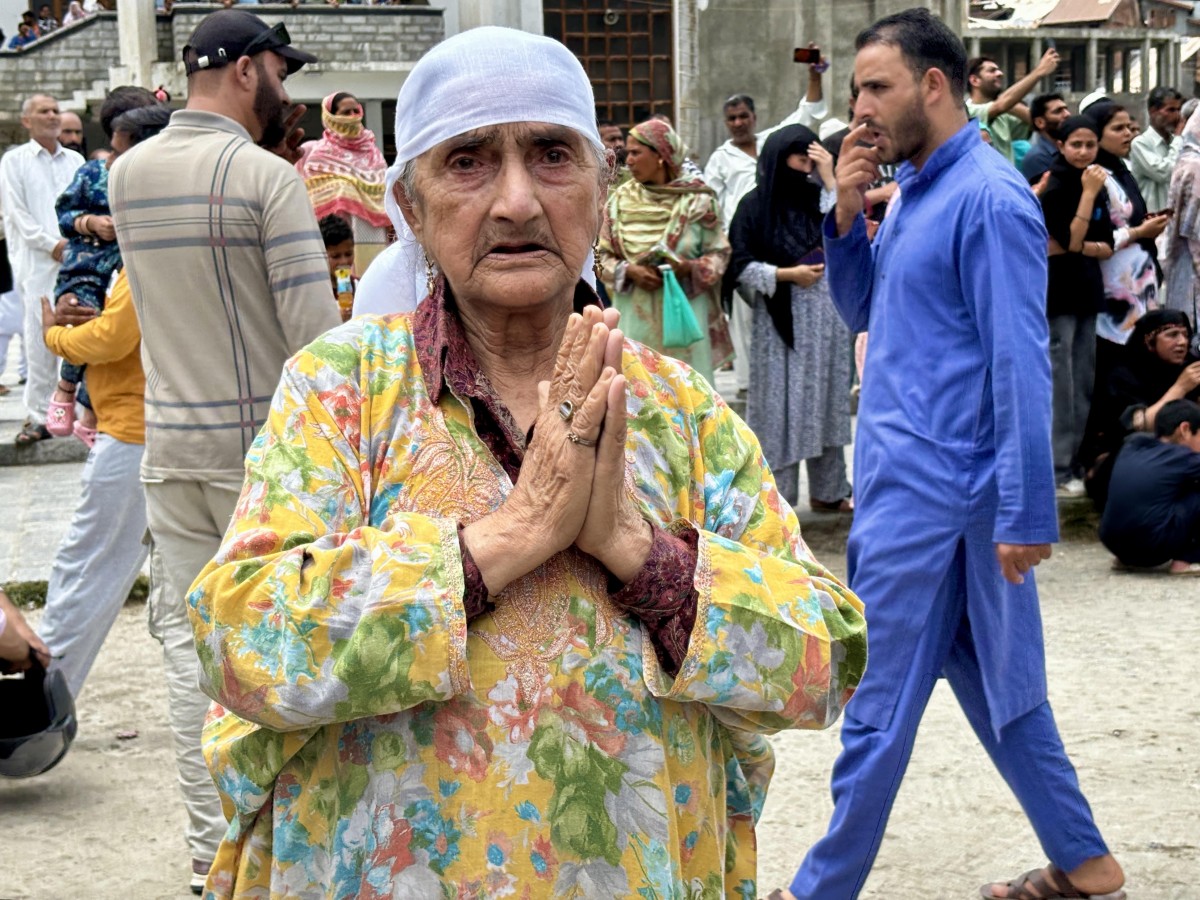
An elderly Kashmiri woman making an impassioned appeal for an end to the prevailing drought conditions in Kashmir. Photo: Jehangir Ali
“If the dry spell doesn’t end soon, not only will the fruit yield suffer but it will also impact the trees in the long run. I have got several dozen calls from farmers who complain of mature trees drying up in orchards,” Bashir told The Wire.
In recent years, Kashmir's climate has undergone dramatic temperature changes. This year's winter was recorded as the driest and warmest in five decades. The summer capital Srinagar recorded its hottest May day this year, with the winter capital Jammu cooler in July than the summer capital!
With meteorologists predicting a largely rainless July, several hundred men, women and children, most of them elderly and barefoot, participated in the ceremony at the shrine. As has been the tradition, the townspeople had put up stalls at different places to help the devotees keep up with the scorching summer heat.
An age-old Kashmiri tradition, the prayer ceremony, which lasts several hours, is divided into different sessions which includes a two-km barefoot walk by the devotees on the tarmac road winding along the hilly town from the point where the shrine of the Sufi saint comes into sight when approached from Srinagar.
“In the past, some people would walk barefoot from faraway places to the shrine. However, most of us have lost interest in these traditions in recent years because we tend to believe in the superiority of western culture, which is tragic,” said Nasir-ul-Islam, a local preacher.
As several hundred curious onlookers and worshippers gathered on the shrine grounds on Sunday (July 28), a brief prayer session took place, led by Younis Haji, one of the shrine's guardians.
After the prayer session, the devotees circumambulated around the shrine seven times, led by a ‘mahagun’ (king or a human with many attributes) who waved a flag (alam) perched on a long pole as the faithful followed him.
Once the circumambulation was complete, the faithful stopped in front of the shrine’s main door and formed an imaginary circle for the artists, who wore special costumes, to perform “dambael”, a ritual dance said to have been inspired by the Persian poet and mystic Jalal-u-Din Muḥammad Rumi’s“The Order of the Whirling Dervishes”.
During dambael, a play was also performed in which “mahagun”, the main character, has his wife kidnapped by one of the play's three jokers, who represent the sun or the clouds, depending on whether people have come to pray for rain or the end of rain. At the end of the play, the wife is rescued from the joker’s clutches, signifying the end of misery.
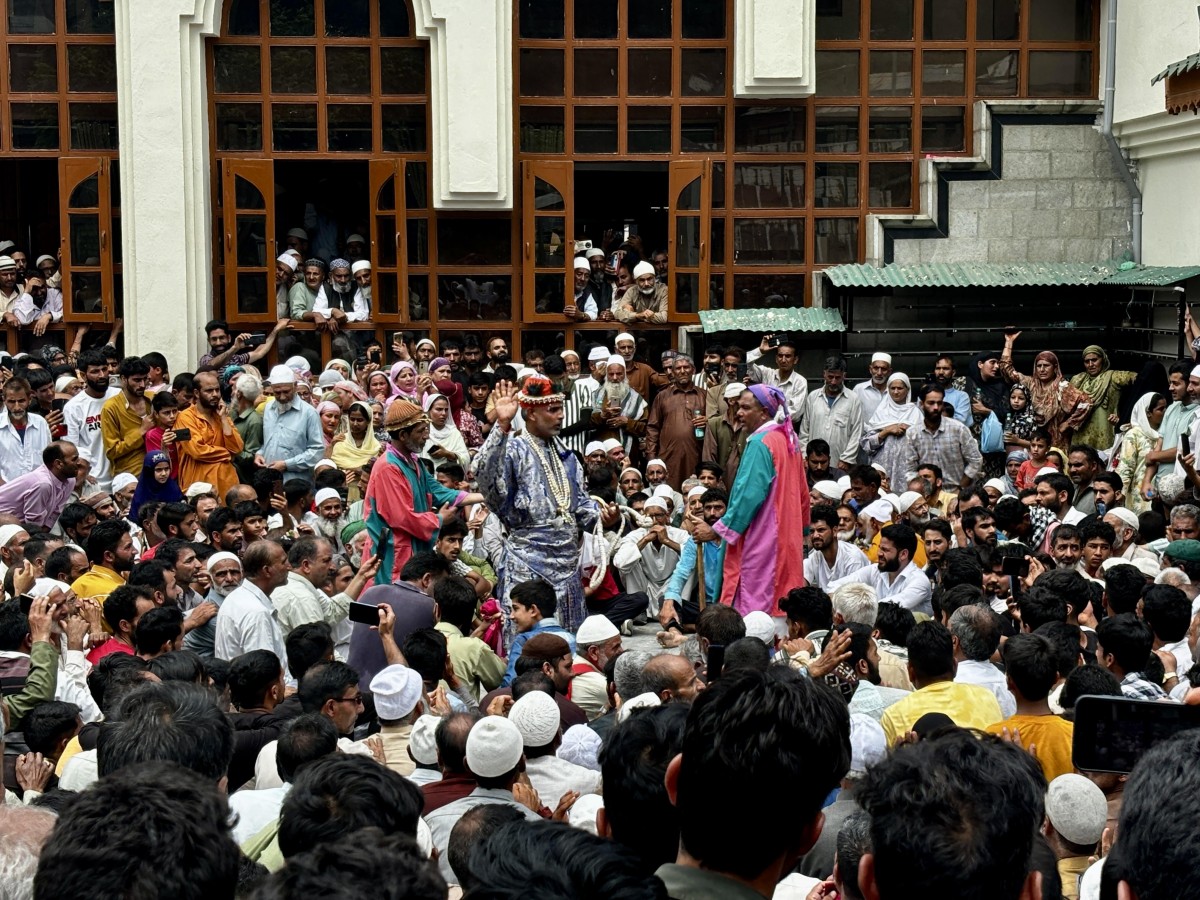
Several hundred people including children and women gathered at the shrine on Sunday to participate in the special prayers. Photo: Jehangir Ali
Many Kashmiris who follow the Salafi strain of Sufi Islam, berate the special prayers and the performance by artists as anti-Islam. However, Kashmir historian and satirist Zaheer Ahmad Zaheer said that Dambael has been enacted on social and cultural gatherings in Kashmir for centuries.
“These traditions are part of our rich cultural heritage. Sadly, some people denigrate these traditions as anti-Islam when in fact they have nothing to do with religion,” Zarief said.
Suhail Farooq, 19, was among the artists who staged the performance at the shrine. He said that dambael has been a part of Kashmir’s culture for centuries.
“The prayer ceremony starts at four small shrines of Sufi saints in Wathoora. The devotees also pay obeisance at one more shrine in Chadoora before arriving in the town of Chrari Sharif. It has been part of our history,” Farooq said, adding that he has also performed at the National School of Drama in New Delhi.
After dambael, the devotees hiked a nearby hill in the town called Nafulteng where a special prayer called ‘Naful’ was offered. According to Islamic tenets, Muslims are decreed to offer Naful for extra blessings. The Sufi saint, who was inspired by the Rishi order, also used to offer his ‘Naful’ on the same hill when he resided in the town before his death in 1438.
“There are four Urdu alphabets in the word Rishiyat (Rishi order) which mean ‘riyazat’ (worship), shariat (Islamic law), yaksaan (unity) and tariqat (proper way). If we follow all these principles, then there will be no suffering. This special prayer is one of the ways to show our devotion to Allah,” said Lateef Ahmad, an apple farmer who had come from Chadoora to attend the prayers.
This article went live on July twenty-ninth, two thousand twenty four, at forty minutes past eleven in the morning.The Wire is now on WhatsApp. Follow our channel for sharp analysis and opinions on the latest developments.


