

Ahead of Jaishankar Meet, Rubio Concedes Indian Unease but Backs Deeper US-Pak Ties


New Delhi: US Secretary of State Marco Rubio on October 25 defended Washington’s closer engagement with Pakistan despite concerns in New Delhi, insisting it did not come at the expense of America’s partnership with India.
Speaking to reporters while en route Doha, Rubio acknowledged that India was “concerned for obvious reasons because of the tensions that have existed between Pakistan and India historically,” but maintained that the US had to engage with multiple partners in pursuit of shared interests.
“We see an opportunity to expand our strategic relationship with Pakistan,” he said. “I don’t think anything we’re doing with Pakistan comes at the expense of our relationship or friendship with India, which is deep, historic, and important.”
Rubio said Washington’s outreach to Islamabad had begun even before the recent India-Pakistan border conflict. “I had already reached out to them and said, look, we are interested in rebuilding an alliance, a strategic partnership with you,” he said. “We’ve had a long history of partnering with Pakistan on counter-terror and things of that nature. We’d like to expand it beyond that, if possible, understanding that there’ll be some difficulties and some challenges.”
As part of this revived engagement, the United States and Pakistan signed an agreement to develop and export rare earth minerals, seen as a key strategic component of Washington’s efforts to reduce dependence on China for critical supply chains. According to reports in Dawn, the first shipment of rare earth materials under the deal was dispatched from Pakistan to the United States last month.
The US secretary of state’s comments come as he is expected to meet Jaishankar on the sidelines of the ASEAN and East Asia Summits in Kuala Lumpur. They had also met last month on the sidelines of the UN General Assembly meeting in New York.
Economic ties under strain
New Delhi has been watching closely as Islamabad appears to be getting back into Washington’s good books. In June, US President Donald Trump had hosted a lunch for Field Marshal Asim Munir – the first time a serving Pakistan army chief had made a personal meeting with the US president.
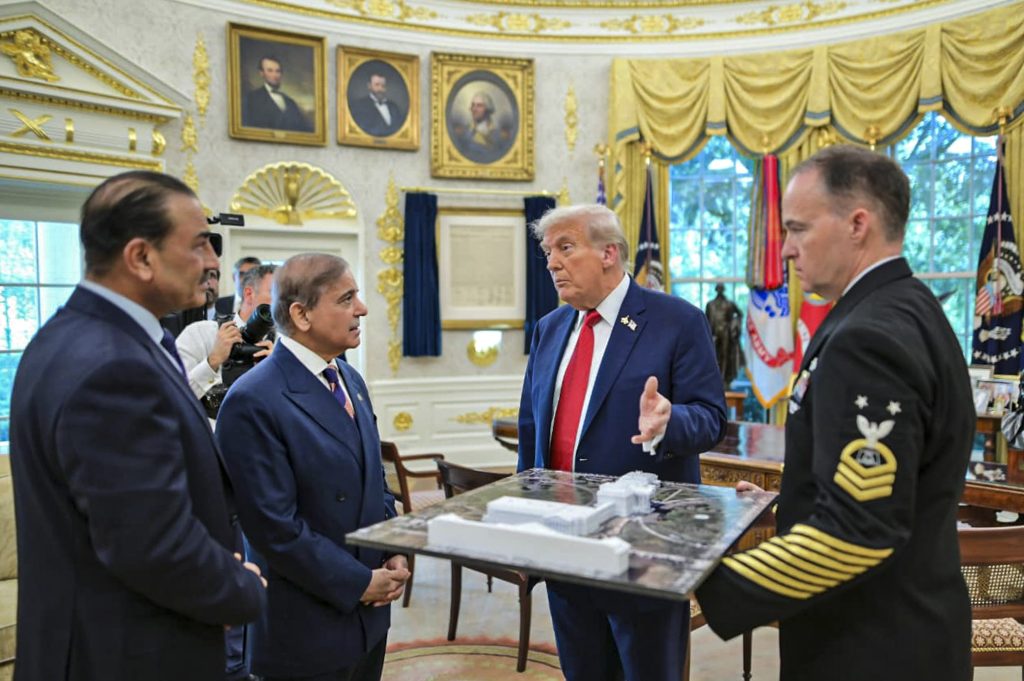
File image. In this image received by PTI on Sept. 26, 2025, US President Donald Trump during a meeting with Pakistan Prime Minister Shehbaz Sharif and Field Marshal Asim Munir at the White House, in Washington, DC, USA. Photo: Via PTI.
The meeting came soon after Trump claimed credit for personally brokering the ceasefire between India and Pakistan in May, following hostilities triggered by India’s Operation Sindoor. A ceasefire was announced on May 10, ending days of strikes and counterstrikes after the April 22 terrorist attack in Pahalgam that killed 26 civilians.
Trump has since repeatedly taken credit for the truce, mentioning it publicly more than 50 times and suggesting he deserves a Nobel Peace Prize for preventing another war.
New Delhi has rejected both the “ceasefire” terminology and Trump’s claim, describing it as only a temporary cessation of hostilities. India has also maintained that the pause followed a request from Pakistan’s military, not US mediation.
Munir returned to the White House in September, accompanying Prime Minister Shahbaz Sharif – the first formal meeting between a Pakistani premier and a US president in six years. At the Gaza peace summit in Egypt, Sharif was the only foreign leader called upon by Trump to speak, during which he again endorsed the idea of a Nobel Peace Prize for the US president.
Modi declined an invitation to travel to Kuala Lumpur to take part in the Asean summits, which is being attended by President Trump.
Apart from Pakistan, India’s economic ties with Washington have come under strain, with Trump imposing some of the highest tariffs on Indian goods. As part of this policy, the Trump administration has levied a 25% tariff on Indian exports as a penalty for New Delhi’s continuing purchases of Russian oil, in addition to an earlier identical “reciprocal” levy linked to trade imbalances.
'I’m not negotiating trade deals'
Earlier this month, Trump claimed that Prime Minister Narendra Modi had assured him India would stop buying oil from Russia. Asked about the remark, the Ministry of External Affairs neither confirmed nor denied such an assurance, but said India was already “diversifying” its sourcing, seen as a signal that New Delhi is gradually reducing dependence on Moscow for crude supplies.
On October 23, the US Treasury Department announced sanctions on Russian oil majors Rosneft and Lukoil, along with several subsidiaries, effective November 21. Reliance Industries, which has a long-term supply agreement with Rosneft, said it was “recalibrating” its Russian oil purchases and would be “fully aligned to Government of India guidelines.”
Asked whether India might have to scale back its Russian oil imports to secure a broader trade deal with Washington, Rubio said New Delhi had already shown interest in diversifying its energy portfolio.
“India only needs so much oil,” he said. “So, if they diversified their portfolio, the more they buy it from us, the more they’ll buy it from someone else.” He added that India’s desire to broaden its oil sources predated current discussions.
Rubio declined to comment on ongoing negotiations, saying, “I’m not negotiating trade deals, so I’m not going to speak on that. But I know they’ve already expressed a desire to diversify their oil portfolio, even before all of this came up.”
He also described India as a trusted partner, saying the two countries were “working through some broader trade issues” but would “always be allies and friends.”
This article went live on October twenty-sixth, two thousand twenty five, at fifty-three minutes past nine at night.The Wire is now on WhatsApp. Follow our channel for sharp analysis and opinions on the latest developments.


