

Engagement Can’t Be Endorsement: Six Problems With Modi Government's Taliban Embrace


New Delhi: The recent visit of Taliban foreign minister Amir Khan Muttaqi to New Delhi, marked by the exclusion of women journalists from his press conference, the display of the Taliban flag and the controversial presence of a Bamiyan Buddha painting in the background, represents a significant departure from India's constitutional values and democratic principles. While geopolitical pragmatism has its place in foreign policy, this validation of Taliban ideology reveals deeper problems in the Modi government's approach that merit serious examination.
Normalising gender apartheid on Indian soil
In a first in independent India’s history, women journalists were barred from attending the Taliban foreign minister's press conference at the Afghan Embassy in New Delhi. This wasn't just a diplomatic meeting behind closed doors; it was a public-facing event where the Taliban's systematic exclusion of women was imported onto Indian territory. This represents a troubling normalisation of the Taliban’s gender apartheid practices. By allowing the exclusion of women journalists from the press conference, the Modi government effectively legitimised Taliban's misogynistic policies on Indian soil.
While engaging with the Taliban may have strategic rationale, allowing them to operationalise their discriminatory practices in India crosses a line from pragmatic engagement to active facilitation. The Modi government should have insisted on basic standards – such as women's participation in diplomatic events – as preconditions for enhanced engagement.
Undermining India's constitutional values
India's Constitution guarantees equality regardless of gender via Article 14 (equality before law) and Article 15 (prohibition of discrimination on grounds of sex) and has a proud history – however imperfectly realised – of women's participation in public life.
Permitting a foreign delegation to impose gender-discriminatory rules at an official event in the Indian capital directly contradicts these founding principles of independent India. This isn't realism; it's capitulation. True realism would involve setting clear red lines: “You can meet with us, but you cannot violate our constitutional norms on our soil.”
India's founders envisioned a nation where diverse communities could coexist under a secular democratic framework. Legitimising regimes that fundamentally reject these values sends troubling signals about the government's own commitment to constitutional principles.
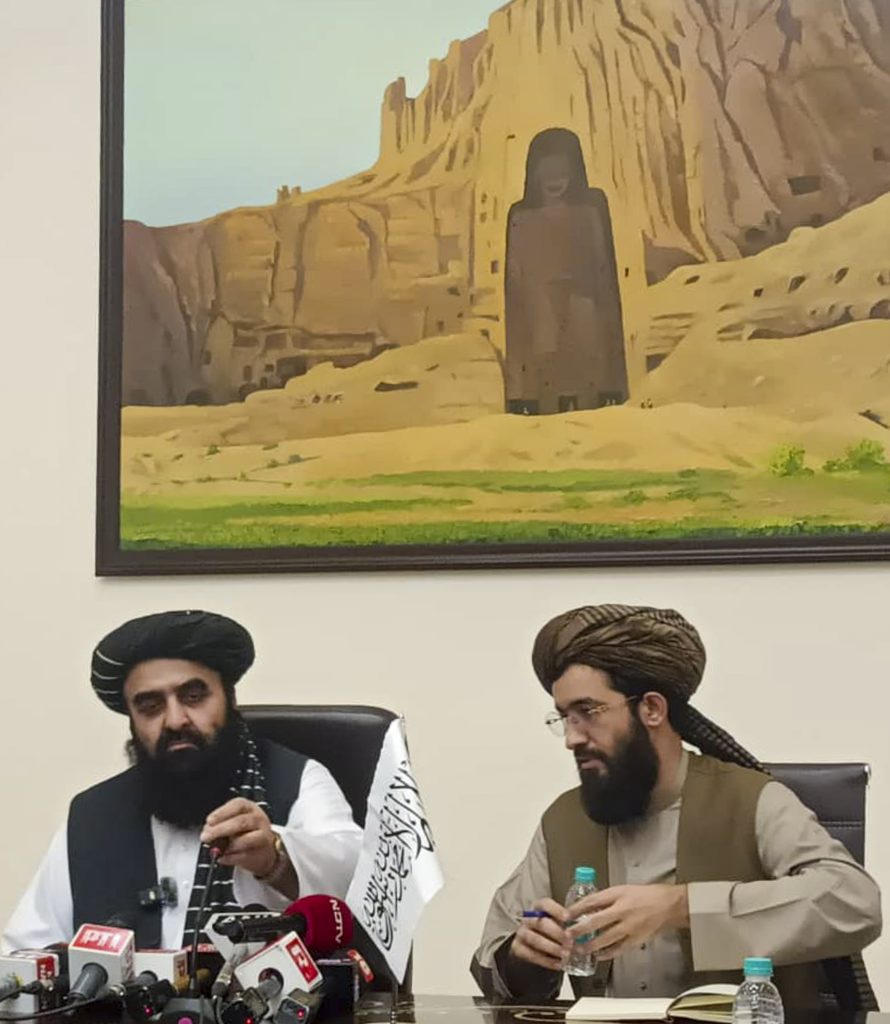
Minister of Foreign Affairs of Afghanistan Amir Khan Muttaqi addresses a press conference, in New Delhi, Friday, Oct. 10, 2025. Photo: PTI/Manash Bhuyan.
Bamiyan statue painting an ironic backdrop
The presence of the Bamiyan Buddha painting behind Muttaqi during the press conference ended up as a particularly troubling reminder of the smashing of the magnificent Buddha statues when the Taliban held charge there earlier. The painting, left on the wall by the previous regime, now served to mock India cosying up to the Taliban in front of it. The Taliban’s infamous destruction of the ancient Bamiyan Buddha statues in 2001, was an act condemned globally as cultural genocide.
There had been parallels drawn earlier of the Bamiyan Buddha statues being smashed to the razing of the Babri Masjid nine years earlier in Ayodhya, an act the present regime in India is very proud of. Now – for a country like India with such deep civilisational ties to Buddhist heritage and historical connections to Afghanistan’s pre-Islamic heritage – the backdrop took on a symbolic, if twisted meaning.
The Pakistan trap
The Modi government's Taliban policy appears largely driven by the desire to counter Pakistani influence in Afghanistan. While Pakistan-centric calculations are understandable given historical rivalries, viewing every regional issue through this binary lens represents strategic myopia rather than sophisticated realism. This reactive posture is strategically myopic. Afghanistan's future matters to India for reasons far beyond Pakistan, such as trade routes, regional stability, counterterrorism, cultural ties and the treatment of minorities.
The deteriorating Taliban-Pakistan relationship certainly presents opportunities for India, but capitalising on these should not require abandoning core principles or legitimising extremist governance models. By making every decision contingent on Pakistani anxieties, India surrenders the initiative and becomes predictable. Worse, it may be strengthening a regime that could ultimately create far more problems for India than Pakistan ever could.
Instrumentalising ultra-conservative Islamism
The Taliban engagement raises uncomfortable questions about whether the Modi government is instrumentalising ultra-conservative Islamist imagery as part of a broader strategy to demonise Indian Muslims. By normalising relations with a regime that represents the most extreme form of political Islam, the Hindutva regime may be seeking to create false equivalencies between Indian Muslims and Taliban-style extremism. This approach mirrors historical patterns where Hindutva organisations have used foreign Islamic regimes or historical Muslim rulers to justify discrimination against Indian Muslims. The strategy involves creating an ‘other’ against which Hindutva can define itself, using external symbols of Islamic extremism to stigmatise domestic Muslim communities.
By normalising the most extreme interpretation of Islam on the world stage while simultaneously painting Indian Muslims as potential security threats domestically, does this not create a political narrative that conflates ordinary Indian Muslim citizens with extremist ideology? This is both morally reprehensible and strategically counterproductive, potentially alienating India's own Muslim population and undermining social cohesion. It also ignores the reality that Indian Muslims have consistently rejected extremist ideologies and maintained their commitment to secular democratic values.
Legitimising authoritarian extremism
By rolling out the red carpet for Muttaqi, including upgrading India's Kabul mission to full embassy status, the Modi government has effectively provided de facto recognition to one of the world's most repressive regimes. The Taliban has systematically dismantled women's rights, imposed gender apartheid, and created what human rights organisations term a system of institutionalised oppression. This engagement goes beyond pragmatic diplomacy; it provides the Taliban with crucial legitimacy at a time when they desperately seek international recognition.
True realism recognises that legitimising extremist regimes can have long-term destabilising effects that ultimately undermine the very interests such policies seek to protect. Sophisticated statecraft involves finding ways to advance national interests while maintaining moral credibility and constitutional consistency. India could have pursued selective engagement focused on humanitarian issues, counter-terrorism cooperation, and economic interests without providing the Taliban with the legitimacy that comes from full diplomatic protocols.
In sum, the Modi government's Taliban engagement represents a troubling departure from India's constitutional values and strategic wisdom. While regional geopolitics requires flexible responses, abandoning core principles in pursuit of narrow tactical advantages ultimately weakens India's position as a democratic exemplar and regional leader. The challenge moving forward is developing a more sophisticated approach that advances Indian interests while maintaining fidelity to the constitutional values that define the nation's identity and foundational vision.
Note: This article has been edited since publication to make it clearer that the earlier regime had put the Bamyan Buddha painting in place.
This article went live on October eleventh, two thousand twenty five, at forty-three minutes past twelve at noon.The Wire is now on WhatsApp. Follow our channel for sharp analysis and opinions on the latest developments.


