

Modi Asks SCO Members to ‘Not Hestitate’ in Criticising Countries That Sponsor Cross-Border Terrorism


New Delhi: With an eye on Pakistan – and China, Indian Prime Minister Narendra Modi said that member states of the Shanghai Cooperation Organisation (SCO) should “not hesitate” in criticising “some countries” that use cross-border terrorism as state policy.
The SCO has never been the platform for airing bilateral issues, but national agendas were certainly highlighted in the public remarks of leaders at their annual meeting on Tuesday, July 4. While the Indian PM spoke about countering terrorism, Pakistan Prime Minister Shehbaz Sharif asserted that religious minorities were being marginalised by some states, Russian President Vladimir Putin raised the Ukraine war and Chinese President Xi Jinping reiterated the position against ‘camps’ in geopolitics.
The 23rd meeting of heads of the SCO council was chaired by India, but held in virtual mode – a surprise announcement made only a month ago.
While Indian officials have repeated that “lots of factors” have gone into making this decision, none of them, including the external affairs minister and the foreign secretary, have spelt out those ‘factors’.
“I hope that we will be able to hold the next meeting in person. It looks like the pandemic is over,” said Belarussian president Alexander Lukashenko, throwing a bit of shade. The WHO announced that COVID-19 was no longer a global public health emergency on May 5. Last year’s SCO summit, as well as the dozens of SCO meetings chaired by India in the past several months, were held physically.
Iran formally became the ninth member of the Eurasian regional group, while Belarus has formally begun the year-long process to become the 10th member. The most recent expansion of the SCO took place in 2017, when India and Pakistan were brought into the club.
Further, the United Arab Emirates, Kuwait, Myanmar, and the Maldives were welcomed as dialogue partners.
In his remarks at the virtual summit, Modi underlined that “some countries [use] cross-border terrorism as an instrument of their policies”. He said “SCO should not hesitate to criticise such countries. There should be no room for double standards on such a serious issue”. His remarks were interpreted as an attack on Pakistan, whose territory has been the launchpad for previous terror incidents in India, as well as, China for stopping the sanctioning of Pakistan-based terrorists by the UN Security Council.
Modi also suggested that there should be an increase in cooperation to deal with terror financing and called for strengthening SCO’s Regional Anti-Terrorism Structure (RATS).
Stating that there should be more active steps to prevent the spread of radicalisation, he said that the joint statement on radicalisation issued at the end of the summit “is a symbol of our shared commitment”.
Out of India’s four proposed thematic documents, only two were accepted by SCO, one of which was about countering radicalisation and the other about digital transformation.
The New Delhi Declaration’s paragraphs on terrorism were near-identical to last year’s joint statement issued in Uzbekistan. There was no explicit naming of terror groups like Jaish-e-Mohammad and Lashkar-e-Taiba as featured in bilateral diplomatic documents, which is usually one of the key objectives for Indian negotiators in international fora.
Other leaders also bring up national agendas
Pakistan Prime Minister Sharif also took on India when he asserted that “diplomatic point-scoring must be avoided by all countries and said that all forms of terrorism, including State terrorism, must be condemned”.
“There is no justification for killing people. Also, the religious minorities should not be marginalised in the garb of political agenda,” he said. Sharif did not take names, but the Pakistani government has not shied away from alleging that the Modi government targets Muslims for electoral campaigns.
Among the leaders, only the Russian President directly talked about the conflict in Ukraine, claiming that it was the result of an eight-year-long project by the West to create a hostile state on its border.
He asserted that Russia was “confident and will continue to resist external pressure, sanctions and provocations”.
This was Putin’s first international outing since the aborted mutiny of June 24. He seemed to have obliquely referred to the attempt by a private army of mercenaries to topple the military leadership in his remarks by expressing thanks to SCO member states who conveyed their support for the Russian leadership in "defending the constitutional order, lives and security of its citizens”.
The Indian government has to still publicly comment on the Wagner Group’s attempted coup, but Putin had claimed earlier to have received “understanding and supporting” for his actions in a conversation with the Indian leader.
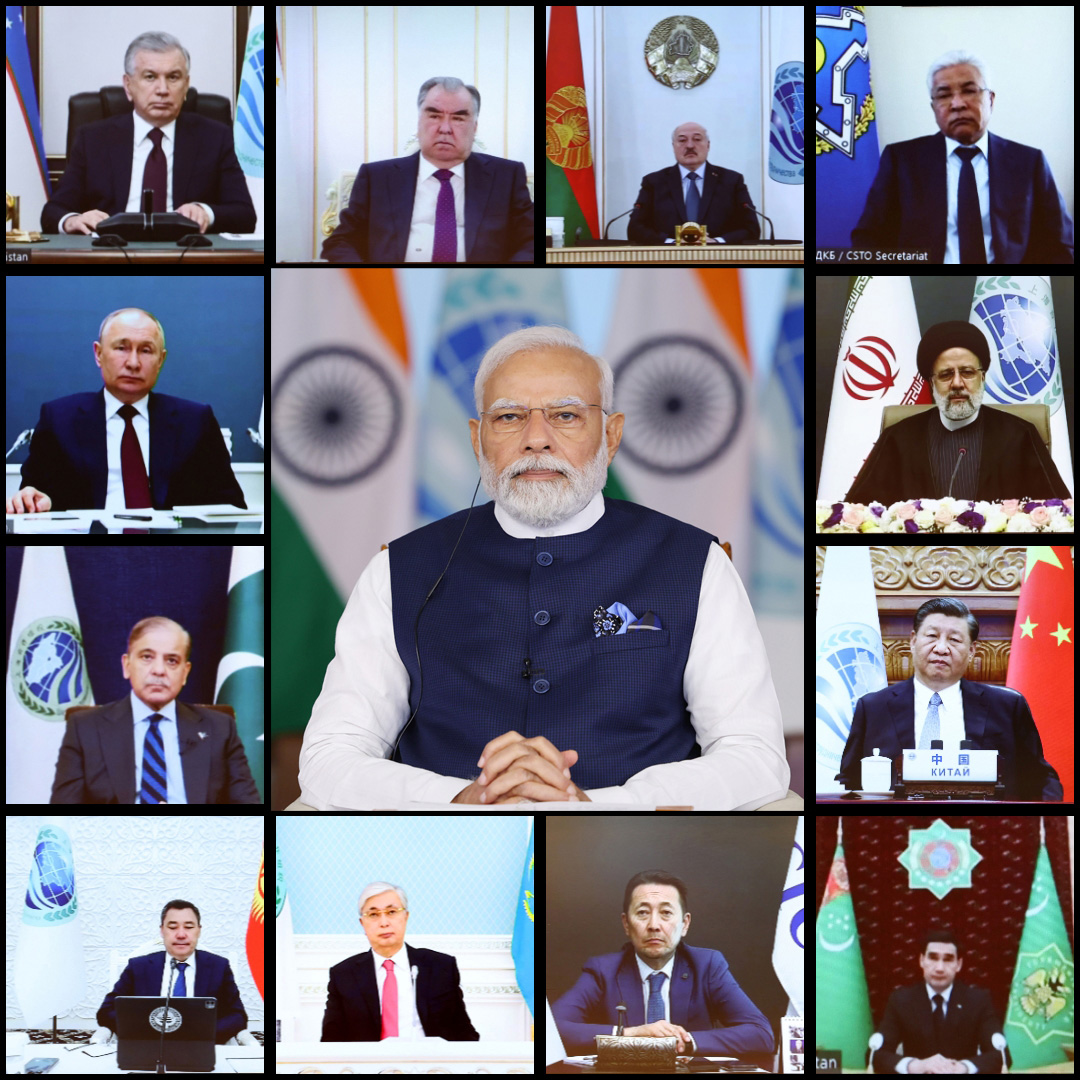
Prime Minister Narendra Modi and the heads of other SCO states. Photo: PIB
The New Delhi Declaration described the current state of the world as “entering a new era of rapid technological development that requires an increase in the effectiveness of global institutions”.
These changes are happening at a time when was more inter-dependence as well as multiple poles of power. “At the same time, threats and challenges are becoming more and more complex, destructive and dangerous, existing conflicts are aggravating and new conflicts are emerging,” it said.
Meanwhile, Chinese President Xi Jinping asserted that the SCO should formulate “foreign policies independently” keeping in mind the “long-term interests of [the] region”.
“We must be highly vigilant against external forces inciting a 'new cold war' in the region and creating [a] confrontation between camps, resolutely oppose any country's interference in internal affairs and instigation of "colour revolutions" for any reason, and firmly hold the future and destiny of our country's development and progress in our own hands,” he said.
Xi’s mention of ‘camps’ was a reiteration of China’s official position against the Quad, which includes the United States, Australia, Japan and fellow SCO member state, India.
For India, the two main objectives for being part of SCO are to participate in shaping regional security policies, as well as to boost connectivity with Central Asia.
Modi hoped that with Iran’s membership, there would be better utilisation of Chabahar port. “The International North-South Transport Corridor can become a safe and easy way for the landlocked countries of Central Asia to reach the Indian Ocean. We should realise its full potential,” he said.
He also reiterated that connectivity projects should respect the “sovereignty and territorial integrity of member states”. India, again, was the only member to not endorse China’s Belt and Road Initiative in the Declaration.
This article went live on July fourth, two thousand twenty three, at two minutes past ten at night.The Wire is now on WhatsApp. Follow our channel for sharp analysis and opinions on the latest developments.


