

RSS Lobbying In US Via Firm Also Representing Pakistan Sparks Political Row


New Delhi: The Rashtriya Swayamsevak Sangh (RSS) has hired a prominent American lobbying firm that is also on the payroll of the government of Pakistan, a move that has ignited a major political controversy in India and raised questions about the Hindu nationalist organisation’s international ambitions and financial transparency.
An investigative report by the US-based news outlet Prism found that the RSS initiated a well-funded lobbying campaign in Washington D.C. early this year. According to lobbying disclosures filed with the US government, the firm Squire Patton Boggs (SPB) was paid $330,000 during the first three quarters of 2025 to represent the RSS's interests before the US Senate and House of Representatives.
The revelation's political impact was magnified by SPB's concurrent role as a lobbyist for Islamabad. A separate report in the New York Times detailed how a recent multi-million dollar lobbying blitz by Pakistan, which included SPB, coincided with a significant policy shift in its favour from the Donald Trump administration, including a tariff reduction from 29% to 19%. During the same period, the US increased tariffs on India to 50%.
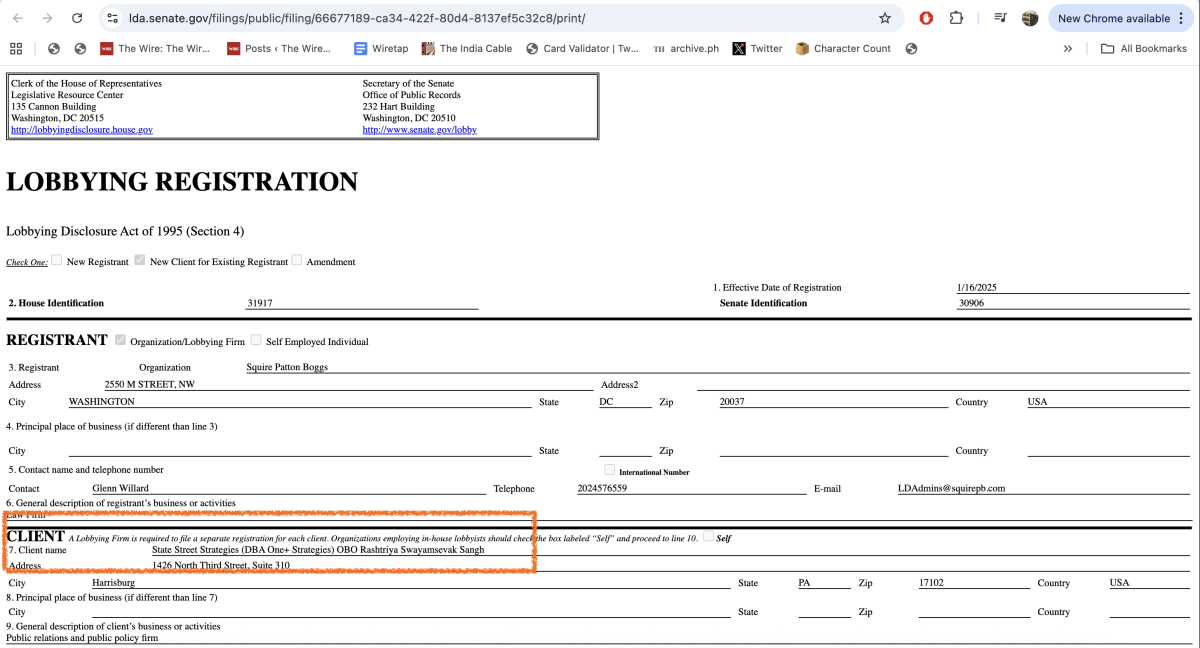
Source: https://lda.senate.gov/filings/public/filing/66677189-ca34-422f-80d4-8137ef5c32c8/print/
The connection was quickly flagged in India, where this convergence of interests prompted a sharp rebuke from the opposition. Congress MP and general secretary Jairam Ramesh accused the RSS of acting against India's interests.
“Now, we learn that the RSS has spent a significant amount of money to engage one of Pakistan’s official lobbying arms — the American law firm Squire Patton Boggs … to espouse its interests in the US,” Ramesh posted on X. “This is hardly the first time that the RSS — with its long tradition of betraying the freedom movement, opposing Mahatma Gandhi and Dr. Ambedkar, and attacking the Constitution and the national flag of India — has betrayed national interest. It is a pseudo-nationalist outfit.”
Ramesh also linked the RSS's foreign expenditure to the ongoing debate over its legal status in India. “A few days ago, the RSS chief Mohan Bhagwat acknowledged that the RSS isn’t a registered organisation and that it does not pay taxes,” he noted.
The comment refers to a November 9 interaction in Bengaluru where RSS sarsanghchalak Bhagwat addressed why the organisation remains ‘unregistered’. “The Indian government has banned us thrice. What did they ban if we are not recognised? The courts have called us as a body of individuals,” Bhagwat had said.
His statement drew a response from Karnataka minister Priyank Kharge, who questioned the group's alleged lack of financial accountability.
Questions over US lobbying laws
The Prism investigation also highlighted legal and transparency concerns among foreign influence experts in the US.
SPB registered its work for the RSS under the Lobbying Disclosure Act (LDA) of 1995. However, multiple experts told Prism that the arrangement should likely have been filed under the more stringent Foreign Agents Registration Act (FARA) of 1938.
FARA requires detailed public disclosures of all meetings, communications and materials shared with officials, whereas the LDA has far less onerous requirements. Experts argued that because the ultimate client is a foreign organisation – the RSS – seeking to influence “US-India bilateral relations” per the registration form listing SPB as an indirect client of the Sangh, a FARA registration would be more appropriate.
The report details an exchange illustrating the lobbyists’ reticence on the matter. On January 16, SPB lobbyist Bradford Ellison contacted Audrey Truschke of Rutgers University, an academic who has researched the Hindu Right, to “understand your perspective on the RSS’s history.” Truschke replied: “Please let me know your status under FARA for this advocacy work.” She told Prism she never received a response.
Truschke later said on X that “It's new for India's far-right paramilitary RSS to directly lobby on Capitol Hill. It's bad news for America. And it may well be illegal under US law.”
A broad network
The lobbying disclosures reveal a complex client structure, listing the client not as the RSS directly, but as “State Street Strategies doing business as the lobbying firm One+ Strategies on behalf of the RSS,” Prism pointed out.
One+ Strategies was co-founded by Bob Shuster, whose brother, former Republican congressman Bill Shuster, is one of the four SPB lobbyists on the RSS account.
In June, Bill Shuster, his brother Bob and SPB's Ellison visited the RSS headquarters in Nagpur, where they attended a training camp. They were accompanied by Walter Russell Mead, a columnist for the Wall Street Journal, and Bill Drexel, a specialist on US-India relations, both fellows at the right-leaning Hudson Institute think tank.
The lobbying forms also name Vivek Sharma, a Massachusetts-based executive chair of Cohance Lifesciences, as an entity contributing over $5,000 and participating in or supervising the lobbying activities. Sharma is also associated with the RSS-linked Ekal Vidyalaya Foundation (USA).
‘An organisation on steroids’
Dinesh Narayanan, an investigative journalist and author of the book RSS and the Making of a Deep Nation, said the move to hire professional lobbyists signals a major shift in the organisation’s global strategy.
“If this is true, it’s like having a pracharak on hire for what is known in the organisation as “sampark” or high-level networking. It is uncharacteristic of the RSS and betrays a sense of urgency to expand. The second sarsanghchalak, M.S. Golwalkar, had this favourite dictum for the pracharak method: ‘make haste slowly’. This move appears to be an organisation on steroids,” Narayanan told The Wire.
He explained that while the RSS has long engaged the Indian diaspora, this represents a more direct approach to influencing foreign power centres.
“A more focussed global expansion was kicked off in 2025 as part of the centenary initiatives. While the Vishwa Vibhag [international wing] has been active among the diaspora, Nagpur has been directly reaching out to influential people abroad and RSS emissaries have been travelling overseas extensively, interacting with think-tanks and opinion makers,” he added.
According to SPB's registration, the specific lobbying issue is listed as “US-India bilateral relations”, while in later quarterly filings it was listed as “[introducing] the [RSS] to US officials”.
When asked what perceptions the RSS might be trying to counter, Narayanan said: “The RSS believes that its methods and objectives are often misunderstood, especially by the English-speaking intelligentsia. But the report detailing the task of the lobbyist is listed as US-India bilateral relations. That appears to be more forward-looking than dissecting the past.”
For the RSS, which celebrates its centenary in 2025 and serves as the ideological parent of the ruling Bharatiya Janata Party, this campaign is seen as part of a larger push for global legitimacy. Narayanan views the effort as a clear reflection of the organisation’s ultimate ambitions.
“The RSS is arguably the most influential voluntary organisation in India today with its pracharaks heading the national and several state governments, but that is a relatively recent phenomenon. I’m not sure the RSS is in a position yet to project strength globally. It is no secret that it has global ambitions and hiring a lobbyist to network with the movers and shakers of the US, a superpower, shows that it is not leaving no stone unturned in that quest. After all, the organisation’s ambition is to be Vishwaguru or teacher to the world,” he said.
After the Prism's investigation was published, RSS's Akhil Bharatiya Prachar Pramukh Sunil Ambekar denied that the RSS has engaged any lobbying firm.
“Rashtriya Swayamsevak Sangh works in Bharat and has not engaged any lobbying firm in United States of America," Ambekar posted on X.
“Rashtriya Swayamsevak Sangh works in Bharat and has not engaged any lobbying firm in United States of America”
- Sunil Ambekar
Akhil Bharatiya Prachar Pramukh , RSS@editorvskbharat— Sunil Ambekar (@SunilAmbekarM) November 13, 2025
However, the RSS's denial runs thin when seen against the official filings published under the Lobbying Disclosure Act, which are available for public scrutiny.
This article went live on November thirteenth, two thousand twenty five, at thirty-one minutes past ten at night.🚨 The RSS is lying. Here's the proof.
After our investigation was published, an RSS spokesperson attempted to deny the Hindu far-right organization’s lobbying efforts in the United States.
Here's a thread showing all the evidence that disproves the RSS’s denial. It includes… pic.twitter.com/YFqECucF6C
— Meghnad Bose (@MeghnadBose93) November 15, 2025
The Wire is now on WhatsApp. Follow our channel for sharp analysis and opinions on the latest developments.


