

Growth Recession: Does India Need a Business Cycle Dating Committee?


A recent slowdown in GDP has triggered talk of whether the Indian economy faces a possible growth recession. The conventional definition of a recession, which economists use, is two or more quarters of declining real GDP.
But have you wondered how a macroeconomist identifies the trough or peaks in a business cycle or obtains the period of recession or expansion in an economy? Most of them use a dating algorithm known as the Bry & Boschan method, named after Gerhard Bry and Charlotte Boschan who developed it in 1971.
This algorithm follows certain rules – for instance, a peak is always followed by a trough and vice-versa. Other rules include that the duration of expansion or recession should be at least six months. Turning points within the six-month period of beginning or at the end of the sample time series data are eliminated and so on. This methodology was subsequently revised by Don Harding and Adrian Pagan in 2002 (known as Harding-Pagan algorithm).
An illustration of the Harding-Pagan algorithm for the Indian IIP series (2004-05) (from April 2005 to January 2017) is shown below:
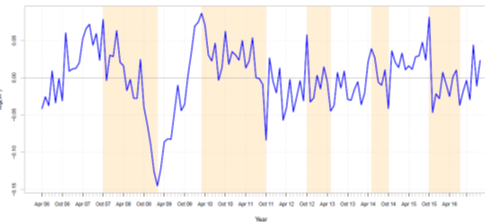
Figure 1: Dating of old IIP series (from April 2005 to January 2017) using Harding-Pagan Algorithm
The background highlighted shows the recession phase observed using the old IIP series (2004-05) (a recession is shown as the duration from peak to trough) in the Indian economy. The diagram shows that the old IIP series (2004-05) was already undergoing a downturn beginning from October 2015 before demonetisation happened in November 2016.
Also read: India is Now in Classic Stagflation Territory
These algorithms help us understand in understanding the amplitude of business cycles in the expansion and recession phase. Apart from this, it also helps in understanding the asymmetricity in recessions and expansions (It helps in answering questions such as have a duration of recessions increased as compared to expansion or vice-versa). There are other alternative approaches available as well but the above approach is the most common approach which macroeconomist use.
However lately, economists have raised concerns about using these algorithms for developing countries like India since they argue that business cycles in these countries behave differently than their developed counterparts. While it’s true that these algorithms were primarily designed for developed countries, the biggest drawback is that they are unable to differentiate between recessions.
No two recessions are similar. For instance, what most macroeconomists and governments all over the world are concerned about is how well employment recovers from a recession. Consider the following case of the US. The graph shows the percentage change in total nonfarm employment since the start of each recession.
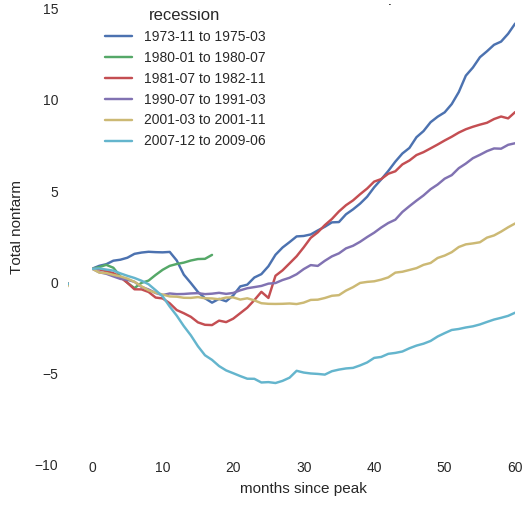
Figure 2: percentage change in total nonfarm employment since the start of each recession. Source: Astrocyte Research, 2017
The diagram clearly shows that before the 1990s, job recovery was strong but after that, it’s been weak. In the recessions in 1973-75 and 1981-82, total nonfarm employment started picking up strongly after 15-18 months. Economists are concerned that the US economy has of late experienced a jobless recovery—when economic activity experiences growth but the unemployment rate remains high. One reason might be that the changing nature of jobs after the 1990s along with factors such as organisational restructuring, labour market mismatch, industrial reallocation and so on.
It is very difficult in the case of India to say how well employment has recovered recently when compared to the 1990s. Is India like the US also experiencing a jobless recovery? To answer such questions becomes challenging as there is no unanimity among different recession and expansion dates.
In India, we depend on individual studies for dating business cycles. Also, the government should make unemployment data available from time to time.
Also read: Explained: The Slowdown in India’s Consumption Growth Story
One solution to this problem could be forming a Business Cycle Dating Committee (BCDC) on the lines of the National Bureau of Economic Research (NBER) & Centre for Economic Policy Research (CEPR) which does the job of dating the business cycles for the US & Euro Area respectively.
The job of the BCDC could be to maintain the chronology of business cycles in India. The committee can identify various turning points which act as a reference point for the construction of coincident, leading and lagging indicators for the Indian economy. It can also maintain and subsequently revise the leading, lagging & coincident indicators from time to time as data for new indicators become available. It would help understand the changing nature of the Indian economy.
The Reserve Bank of India (RBI) set up a working group of economic indicators in (2002) under R.B. Barman which proposed a standing committee for business cycle analysis. Its job would be similar to the business cycle dating committee.
Creating a BCDC will help in maintaining transparency and strengthening the information base for the Indian economy. Most importantly, it would bring greater clarity on the impact of employment during and after a growth recession in a far more enlightening way than what we currently have now.
Mayank Gupta is a research scholar working in the area of Econometrics & Statistics at Mumbai School of Economics and Public Policy.
This article went live on December eighteenth, two thousand nineteen, at thirty minutes past one in the afternoon.The Wire is now on WhatsApp. Follow our channel for sharp analysis and opinions on the latest developments.


