

India Inc Calls For Relief, But How to Separate the Crybabies From Those In Need of Help?


Typewriters, radios, transistors, tape-recorders and the like were once privileged possessions of a typical Indian household. Today, they are rarely found in any house. These products have been truly consigned to the deep pages of history. A typical youth, perhaps, will have no idea of the existence of these products in the distant past. They held relevance for a certain period and, when the context changed, they simply disappeared.
Nearer home in Chennai, we had typewriter-maker companies like Halda, Hindustan Teleprinters, Hindustan Photo Films and the like. These were iconic names and shining jewels in the industrial landscape of Tamil Nadu, but have since long gone.
Their exit, notwithstanding the cry babies, was inevitable. More recently, the advent of smartphones virtually led to traditional telephone companies sinking into deep despair. ‘Free’ Whatsapp voice calls across national borders also put mobile service providers in a jam. All these hold a lesson or two – they all underline the crucial fact that change is the only constant.
Significantly, change today is happening at a far greater speed. The speed with which it occurs leaves very little time for policy-makers and business enterprises alike to prevaricate.
Also read: Why are Resident Indians Remitting More Money Abroad Than Ever Before?
Ground reality
Setting the current blame game aside, the rapidly evolving ground situation in the economy begs a no-nonsense, out-of-the-box response that is shorn of sentiment.
The nature of change and the government’s response to that change has also shifted. Governments used to solely be able to drive a shift in the economic course with their policies. But trade boundaries across nations have reconfigured in the wake of globalisation.
Later, innovation came to the forefront and led to an overhaul of the business landscape in the country. Of late, we are also witnessing a re-orientation in consumer preferences.
This new-age consumer thinking has begun to redefine the study of the practical economy, pushing the pundits to refresh their understanding.
Cry babies?
The two industries most stricken by problems are India’s automobile and housing sectors, both of which are encircled by new challenges. Still trying to figure out the enormity of the situation, these two industries, often considered the principal drivers behind the growth of the economy, aren't able to fathom a solution to the engulfing problem.
The auto sector, which is seeing a steep and steady decline in sales month after month, has been crying from the rooftops and sending SOS-es at regular intervals. For some time, there has been no-quarter-given competition in the auto field, with heavy discounts happening across-the-board.
The overcapacity in the sector has not been missed by long-time industry watchers. The overall industry had quite a comfortable ride for a long while now, and reaped immense profits. If it has kept all fortunes to itself during good times, it can't apportion misfortunes to somebody else during the bad times.
Also read: What the Centre Really Needs to Do if it Wants to Tackle the Economic Slowdown
Their present predicament is the culmination of assorted factors, some of which may include changes in the buying habits of millennials. Perhaps, the auto companies need to reconfigure their business models. Or, they may need to transform themselves into a new avatar like what IBM did long ago.
For instance, the Hinduja-driven Ashok Leyland, historically known as a commercial vehicle maker, is now calling itself a transport solution provider. Is this a mere change in labelling or is it tapping into something bigger? Maybe truck makers like Ashok Leyland realise that growth in numbers alone will suffice. The need to realise that growth with others – all stakeholders included – is a sine qua non for survival in the future.
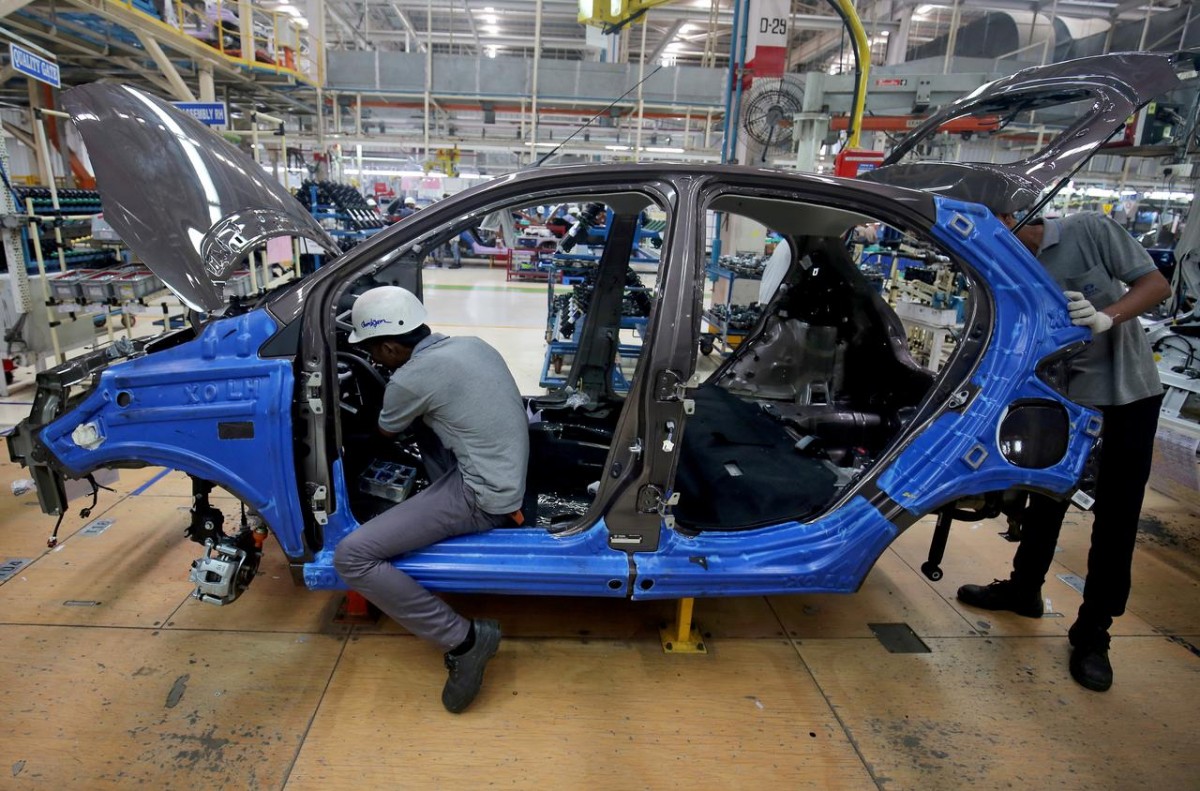
Workers assemble a Tata Tiago car inside the Tata Motors car plant in Sanand, on the outskirts of Ahmedabad, India, August 7, 2018. Photo: Reuters/Amit Dave/File Photo
Double standard
The support price for farm products has been a subject of hot debate in the country from time immemorial. The demand for a lower duty for the auto sector cannot be viewed differently. There can't be different approaches to sufferings of farmers and tribulations of business enterprise.
One is no less important than the other. Competition-induced pains are visible across industry verticals such as airlines, cement and the like. You can't certainly have it and eat it too. As the way things progress at the moment, one could find the emergence of new economic drivers.
The task now, both for the government and India Inc, lies in identifying emerging growth-drivers. That will perhaps be difficult to discover right now, as screaming headlines of slowdown dominate all else.
Also read: The Destruction of Fiscal Federalism
Perils of prevarication
What is the near-term prescription then? The moment, undoubtedly, belongs to the government. The onus is certainly on it to revive the consumption demand. Having got a huge bounty from the Reserve Bank of India, the government will do well to flow it into infrastructure development.
Diversity in terms of political affiliations notwithstanding, the state governments will be advised to keep their game of politics aside and focus on solid infra development. Along with this, the policy environment has to play the enabler role and clear the bumps on the way to smooth navigation.
The fast-slipping economy needs a decisive action from a government headed by a party which has a commanding majority. Prevarication on petty pretexts will have perils of greater proportions.
K.T. Jagannathan is a senior business journalist.
This article went live on September nineteenth, two thousand nineteen, at zero minutes past seven in the morning.The Wire is now on WhatsApp. Follow our channel for sharp analysis and opinions on the latest developments.


