

When Development Eases Departure: Bihar's Migration Paradox


Now that the pre- and post-election debates over palayaan (distress migration) and unemployment in Bihar have almost died down, it is time to ponder why, despite massive improvements in road, ail, and air infrastructure over the last three decades, the state has – instead of attracting investment – witnessed large-scale exodus of every category of the workforce and intellectual capital.
Bihar still occupies the last position on the developmental ladder of the nation, notwithstanding almost total electrification and vastly improved internet connectivity.
Chief Minister Nitish Kumar's government, rightly or wrongly, claims that it has brought about a big change in the law-and-order situation in Bihar as well. Yet, neither entreprenuer-philanthropist Bill Gates nor Asia's wealthiest man, Mukesh Ambani, have set up any factory years after their high-profile visits to the state. Yes, an Adani Group company has now been allotted land in Bhagalpur at a dirt-cheap rate for a power plant.
A close analysis would reveal that the movement of human beings always increases after the improvement of infrastructure. Broadly speaking, there are two types of migration: that of the better-off population, and that of the poor, who have no option but to travel on jam-packed trains for 40 or 50 hours to earn a livelihood in far-off places. The expression palayaan fits the second type of flight.
Migration since the mid-1990s
Bihar is among the parts of India from where palayaan increased manifold since the mid-1990s, though this does not mean that people did not go out in large numbers before that period.
The year 1996 is significant because that June, Ram Vilas Paswan became railway minister in the H.D. Deve Gowda ministry. He was succeeded by Nitish Kumar, who served twice between March 19, 1998 and August 5, 1999, and again between March 20, 2001 and May 22, 2004. From then until 2009, Lalu Prasad Yadav was in charge of Rail Bhawan.
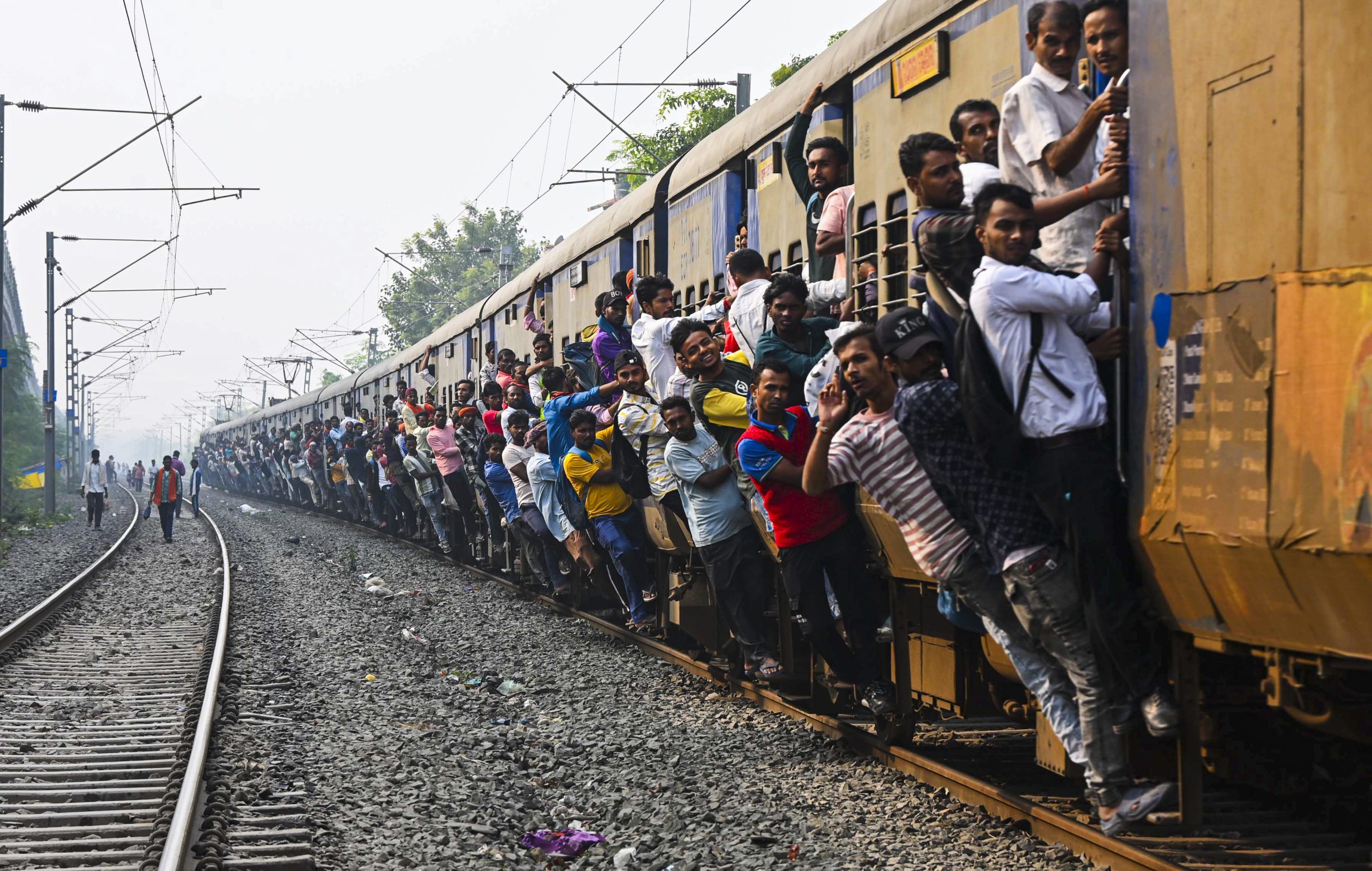
An overcrowded train during the Kartik Purnima festival, in Patna, November 5, 2025. Photo: PTI
These three successive railway ministers from Bihar changed the rail map of Bihar. During his 22-month tenure, Paswan initiated many new projects, including laying of tracks and gauge conversion works. He also brought the East Central Zone to his parliamentary constituency, Hajipur. He was instrumental in laying the foundation stone of the rail bridge near Patna over the Ganga.
Nitish carried this exercise forward and brought several ambitious projects in Muzaffarpur, Mokama in Patna district and Harnaut in Nalanda district. Another bridge over the Ganga linking Khagaria and Munger came up. Electrification of thousands of kilometres of track and doubling of single lines gained momentum during his tenure.
Also read: Bihar: 19 Years After Construction Began, Munger’s Road Bridge Across the Ganga Still Incomplete
However, it was Lalu Yadav who got a full five years to further develop these projects. He inaugurated rail engine factories in Madhepura and Saran, where a Rail Wheel Plant also came up. He got the rail bridge between Sonepur and Digha (Patna) converted into a road-cum-rail bridge.
What these three ministers could not anticipate was that instead of bringing in big investment, these initiatives, in a way, facilitated the massive outflow of workforce and intellectual capital from Bihar. Hundreds of new long- and medium-distance trains were flagged off from various destinations for metros and other cities in these 13 years.
Bihar, which has 38 districts, has more than two dozen originating and terminating points of express trains – some of them in small towns.
New roadmap
Throughout these years, there was also a jump in long-distance road-building in Bihar, especially after January 6, 1999, when then Prime Minister Atal Bihari Vajpayee gave the green signal to the Golden Triangle and the East-West and North-South highway corridors.
Steps to expand the national highways network were followed by the construction of state highways and rural roads. When Nitish Kumar became chief minister on November 24, 2005, he undertook ambitious projects in this direction. His ascent to power almost coincided with Raghuvansh Prasad Singh becoming rural development minister in the first Manmohan Singh (2004-09) government.
As Singh was from Bihar, Raghuvansh Prasad displayed enormous generosity towards the state. Allotment under the Pradhan Mantri Gram Sadak Yojana increased 22-fold. Yet the media gave all the credit for this facelift of rural Bihar to Nitish Kumar, not Raghuvansh Prasad, simply because the latter belonged to the Rashtriya Janata Dal, Lalu Prasad Yadav's party.
All this road-building was preceded by large-scale construction of streets across the towns and cities of Bihar using MPLAD (Member of Parliament Local Area Development) Funds in the 1990s. MPs of various parties took interest in this scheme.
However, it was the highways which, like railways, boosted the transportation of labourers, students and professionals from Bihar. While lakhs continue to be exploited in far-off labour markets just for a minimal livelihood, a relatively small number of migrants excelled in their respective fields. They became wealthy and powerful and contribute immensely to the development of their karmabhoomi (place of work).
A few migrants from Bihar rose to become millionaires and billionaires, yet they too did not look back to invest in a big way in their janmabhoomi (place of birth). A negligible proportion invested in real estate and housing, but they did not take interest in establishing industries here.
Like the new trains, by the early years of this century, bus services started operating from almost all districts of Bihar to places as far as Delhi. Curiously, it was these highways on which millions of Bihari workers walked or cycled home from Delhi, Mumbai, Kolkata and many other places after the sudden and abrupt announcement of lockdown on March 24, 2020 during the COVID-19 pandemic.

Mohammed Sajjad Ansari and six other power loom workers from Madhubani district in Bihar during the March 2020 COVID-19 lockdown. Photo: Sukanya Shantha
After the lockdown was lifted, factory owners, affluent farmers and big contractors of north and west India sent buses to the deep interiors of Bihar to bring back these labourers.
Flying out and in
To facilitate the smooth journey of successful Bihari entrepreneurs and high-income professionals who have settled outside, the government launched the UDAN (Ude Desh ka Aam Nagrik) scheme, under which several airports were built in Bihar. So, Darbhanga and Purnia in Bihar can boast of being on the air map of India, but not the coal capital, Dhanbad, nor the steel capital, Jamshedpur, both in neighbouring Jharkhand.
Also read: Loss of Land, Shifting Cultural, Political Terrain Fuel Jharkhand Mob Lynchings
Jamshedpur has a non-functioning airport. Surprisingly, the industrial township earned the distinction of having an aerodrome way back in 1928 – after only Bombay, Calcutta and Delhi. The irony is deepened when we think about the situation in Jamshedpur while considering the well-known contributions of J.R.D. Tata and his company to the aviation industry.
The importance of Dhanbad can also be easily gauged from the fact that it was among the three stoppages of the prestigious Howrah-New Delhi Rajdhani Express when it was launched in 1969 – the other two were Kanpur and Mughalsarai (since renamed).
Overlooking the significance of these two industrial and mineral hubs situated in neighbouring Jharkhand, the Union government has now undertaken to build six airports in towns of Bihar – Saharsa, Madhubani, Valmikinagar (in West Champaran district), Birpur (in Supaul, Munger and Muzaffarpur. These plans have clearly not been deterred by the closure of 15 airports all over India – including those in Kushinagar and Aligarh in Uttar Pradesh – under the UDAN scheme due to several reasons, including lack of passengers.
Colonial past
The emphasis on toning up Bihar’s infrastructure is reminiscent of the British period. When railways were first built in India, the colonial masters laid thousands of kilometres of track in the mineral-rich regions of central India. As they had their eyes on coal and other resources, all these mines were directly linked by broad gauge lines to ports in Calcutta and Bombay. In the rest of India, track-laying started later. Besides, they were metre gauge in many regions.
Similarly, the improvement of rail and road connectivity in Bihar in the last three decades perhaps inadvertently facilitated the movement of cheap labour from densely populated and poor regions to more developed states.
It was only in the liquor manufacturing sector that a real concerted effort was made to woo investors in the last 20 years. But that too was abandoned midway. When the Nitish Kumar government launched the New Excise Policy on July 1, 2007, it invited reputed foreign-brand liquor and beer manufacturers. They responded in a big way. Thousands of wine shops came up in every nook and cranny of the state.
But there were widespread protests by women’s groups, including the Jeevika didis, following rampant alcoholism and a big jump in crimes, and the government imposed prohibition on April 1, 2016. All the firms were asked to pack up and leave on the same trains, planes and highways they had come on. The liquor outlets were shut. Still, the same newly constructed infrastructure –besides the waterways – have now become conduits to smuggle liquor from all directions.
So, in the post-tariff period, when more advanced states of India face an uphill task maintaining their rate of progress, the struggle for the Nitish Kumar government is even more challenging. It could not industrialise when the ground reality favoured Bihar.
This article went live on December tenth, two thousand twenty five, at forty minutes past nine at night.The Wire is now on WhatsApp. Follow our channel for sharp analysis and opinions on the latest developments.


