

Empty Classrooms and Rapidly Closing Schools Spell Doom for Bengal's Children


Kolkata: Nestled in the heart of upscale South Kolkata lies the Kasba Modern Institution for Girls. Established in 1967 and supported by government funding, this institution used to buzz with educational activities until just a few years ago. Now its seven teachers continue to report for duty daily, only to find themselves without a single student to teach.
This peculiar situation is not unique to the Kasba school alone. There are 253 other government-aided schools in West Bengal grappling with a similar predicament – empty classrooms and vacant desks. In a state with one of the lowest enrolments in private schools, this raises pressing questions about the state of education and the factors driving this phenomenon, for which no satisfactory answers seem to be available.
The West Bengal government has announced the closure of 8,207 primary and secondary schools with fewer than 30 students, nearly 10% of total government controlled schools, citing financial unviability and the need to optimise resources in the education sector.
The closure of schools has once again brought to the forefront the importance of the three A's of universal education: access, attendance, and achievement. It has also raised significant concerns about ensuring equitable access to education for all students.
In the foothills of the Terai Himalayas lies Kalchini, a hilly region in Alipurduar district known for its 21 tea gardens. With the impending closure of 37 government schools in this block, there is growing uncertainty over the future of the children living in this area, which has a significant tribal population that works in the tea plantations. Many parents are now being forced to enrol their children to private English medium schools.
A social worker from this area, Ayan Naidu, said, "Not every area is urban. Here, settlements are small. In a remote village with just 150 people, there used to be a school. This forested area has sightings of tigers and other wild animals. It's not feasible for a six-year-old to travel through this jungle to a distant school, especially when parents are away at work. Having a nearby school is crucial for these children."
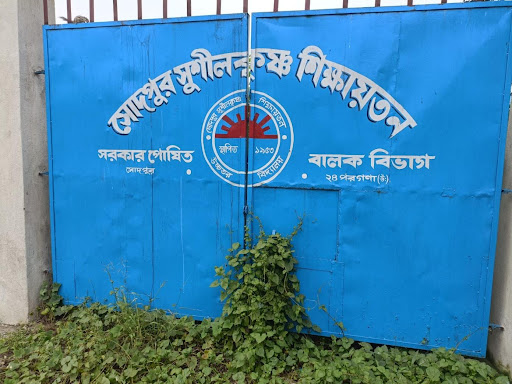
Sodpur Sushil Krishna Sikshayan, with its doors closed. Photo: Joydeep Sarkar
Until last year, Suman Das was a Class VI student at Sodpur Sushil Krishna Sikshayan. However, due to the declining number of students, his parents recently transferred him to another school 5 km away from their residence. Sodpur Sushil Krishna Sikshayan currently has only five students, but it employs 13 full-time teachers.
Suman says, "My previous school was within walking distance from my house. Now I have to take an auto for my commute, which costs Rs 30."
Suman's friend, Amal Mondal, however, did not enrol in any school. Instead, he was sent to his maternal house in Santipur in Nadia to learn a trade.
“Why are schools closing? Deep analysis is needed. Before this we had seen that schools used to have a regular attendance rate of 65%. As many as 35% do not attend. Why they are not going to school? The reasons behind this need to be explored. I am not in favour of closing schools. Even if there are only two children, a school must run unless the situation is financially unviable,” said Kumar Rana who has been associated with the Pratichi Trust, Nobel laureate Amartya Sen's organisation which works in education.
Around 84% of the children in West Bengal study in government-sponsored and aided schools. The Mamata Banerjee-led government has been promoting several schemes to encourage and incentivise education among students including a monthly stipend for girl students, a one-time incentive for SC/ST girl students, and a student credit card scheme.
Among these programmes, Kanyashree, designed to encourage girls' education, has garnered international acclaim. Despite these efforts, there has been a consistent decline in the number of students appearing for Class 10 board examinations. In 2023, only about 6.99 lakh candidates appeared for the Class 10 Madhyamik examination, marking a 36% drop compared to 10.98 lakh in 2022 and 11.18 lakh in 2021.
Out of this, over 2 lakh students had failed to appear despite registration, indicating a sharp increase in last stage dropouts. This is in stark contradiction to the Annual Status of Education Report West Bengal 2021 report which did not indicate any possibility of such a phenomenon after the pandemic, based on senior school enrolment.
Also read: How Online Education Exposed West Bengal's Fault-Ridden Education System
According to the 2022 West Bengal report, the state has witnessed a sharp increase in government school enrolment. Despite one of the longest school closures during the pandemic, there has been an increase in government school enrolment from 88.1% in 2018 to 92.2% in 2021 for children in the age group of 6-14 years.
Former CPI(M) MP and academic Malini Bhattacharya said, “Government-sponsored schools appear orphaned. There is no structure, no supervision; teachers from village schools are transferring to the cities. The state seems to have washed its hands of the central role. In reality, it appears as if there is an attempt to redefine the central education policy. In the midst of this, children from impoverished households are losing their right to education. In my opinion, this is a transgression by the government.”
Across the state, there are 110,000 vacancies across primary, upper primary, secondary, and higher secondary schools, with 69% of these openings situated in rural areas. Over the past 11 years, around 7,000 schools vanished in West Bengal, as evidenced by the decline from 74,717 primary schools in 2012 to 67,699 by March 2022.
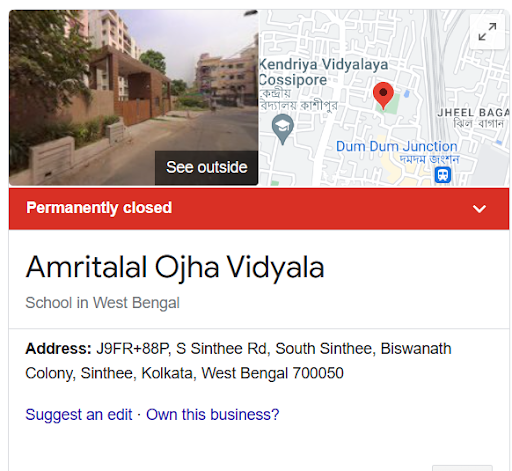
One such instance is Amrit Lal Ojha Vidyamandir in Dumdum, where the land was allegedly used for a substantial real estate project.
A few years ago, the government initiated a teacher transfer scheme, which led to an uneven teacher-student ratio.
The Kultali Model School in South 24 Parganas has eight regular teachers for just 22 students, resulting in a ratio of 2.75:1.
In contrast, Narayanpur High School, also in the same district, has 2,000 students but only 24 teachers, with a staggering ratio of 82.41:1.
The Rashtriya Madhyamik Shiksha Abhiyan (RMSA) framework prescribes a secondary-level pupil-teacher ratio (PTR) of 30:1. However, when examining district-level PTR, significant disparities emerge. For instance, Darjeeling district has the lowest PTR at the higher secondary level, standing at 14:1, while Cooch Behar, another district in North Bengal, reports an alarming PTR of 52:1.
The Student Classroom Ratio (SCR), another crucial metric, gives away the stark educational inequities within West Bengal. The striking contrast between Kolkata's SCR, at 35:1, and Murshidabad's SCR, at 110:1, underscores the challenges in providing access to quality education across the state.
Also read: Bengal SSC Recruitment Scam: How a 'Focused' Judge Exposed the Racket
"Through the government's official portal, teachers are applying to be transferred to schools near their homes in the city. There are vacancies for teachers in various subjects. If the government was serious about maintaining the student-teacher ratio, such a situation would not have occurred. Besides, the parents are not accepting the irregularly appointed teachers," said Sukupar Pain, secretary of the Left-affiliated teachers’ organisation, ABTA.
In this backdrop, the massive teacher recruitment scandal in West Bengal, occurring from 2016 to 2018 and which has dominated headlines this year, has left many parents concerned about the state of school education. The scandal involved a series of irregularities, including manipulated marks, resulting in the termination of numerous teachers and the imprisonment of the then education minister, making it one of the most significant cases of graft in the state's recent history.
"I cannot trust the future of my child in the hands of someone who has bought a teaching job. I have enrolled my son in a private school," said Amit Halder, a parent from Sonarpur in the state's South 24 Parganas district.
This article went live on September twelfth, two thousand twenty three, at fifty-four minutes past five in the evening.The Wire is now on WhatsApp. Follow our channel for sharp analysis and opinions on the latest developments.


