

How NCERT's Class 8 Social Sciences Textbook Omits South India


From the moment one opens the newly-published Class 8 social-science textbook (Part 1) of the National Council of Educational Research and Training (NCERT), titled Exploring Society: India and Beyond, a quietly alarming pattern emerges. In tone, in scope, and in what is insisted upon for retention, the textbook seeks to sketch history differently. But beneath the surface of this ‘new’ narrative lies an even more profound concern, namely, the systematic marginalisation of large swathes of India’s past, and in particular, the histories of South India. Dynasties, resistance movements and cultural contributions of South India are either squeezed into peripheral mention or entirely excluded.
Such exclusions, needless to say, have long term implications as far as historical education, regional identity and national memory, are concerned. Textbooks are far more than curriculum documents. They are cultural artefacts that shape how young people imagine the past, position themselves in the present, and project into the future. A student picking up an NCERT Class 8 book is not simply learning facts, he/she is internalizing the implied question — which stories of India’s past matter and which don’t? And when a considerable region, like South India in this case, finds its past under-represented or omitted, the consequences ripple widely.
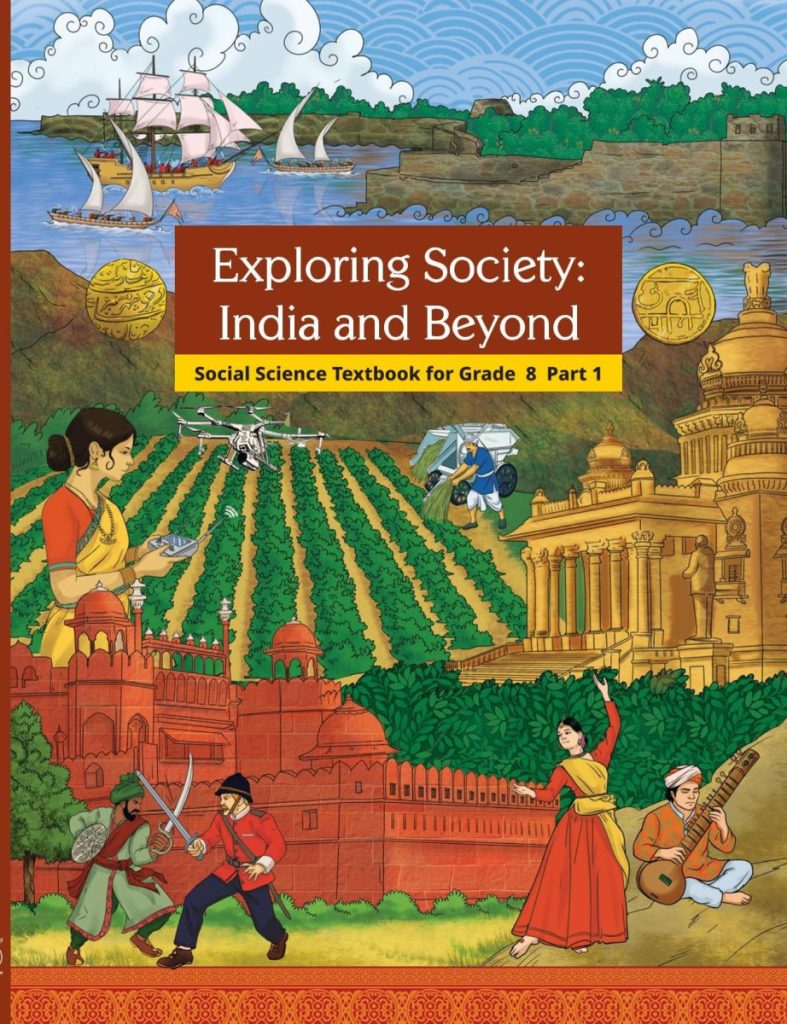
NCERT's Class 8 book, 'Exploring Society: India and Beyond (Part 1)'.
The Class 8 textbook, Exploring Society: India and Beyond (Part 1), consolidates history, geography, civics and economics into a single integrated volume.
The chapters in the history section, titled ‘Tapestry of the Past’ are quite lopsided. While substantial space has been given to chapter 3 (‘The Rise of the Marathas’) and chapter 4 (‘The Colonial Era in India’), chapter 2 (‘Reshaping India’s Political Map’) has been shortened. Noticeably, the headings of chapters 3 and 4 make their themes clear at the outset. However, the heading of the shortened chapter 2 fails to convey its theme. This chapter focuses on the Delhi Sultanate and Mughal eras.
Even in chapters where the titles communicate their essential theme, major absences are discernible. Take chapter 4 (‘The Colonial Era in India’). The fact that the closure of the Silk Route, the traditional land trade route between Asia and Europe, by the Ottoman rulers in 1453, was one of the primary reasons that led European powers to explore sea routes, eventually paving the way for the arrival of the first colonial power, Portugal, in India, has conveniently been ignored. Students thus miss out on comprehending the context, or interplay of reasons, that powered colonial objectives,
Likewise, while the textbook touches upon economic facets like famine and drain of wealth, the absence of any discussion on the land revenue policies of the East India Company in the late 18th and early 19th centuries, is striking. Land revenue systems like the Permanent Settlement, Ryotwari system and Mahalwari system, had a profound impact on the economic policies of the East India Company. The land revenue policies of the Company, and subsequently the British state, contributed majorly to the economic exploitation of India. The wealth generated through such revenue policies was transferred by the colonial regime to the home country without any economic returns. It was in this specific context that the phrase ‘Drain of Wealth’ was coined by the Indian nationalist leader, Dadabhai Naoroji. Without a discussion on the revenue policies of the Company, students will find it difficult to understand the importance and relevance of Naoroji’s arguments, outlined in his magnum opus, Poverty and Un-British Rule in India (1901), which tried to provide an explanation for India’s poverty and underdevelopment.
The discussions in the three chapters on Indian history focus on the Indo-Gangetic plains – namely, the Delhi Sultanate, Mughal and early colonial period. But the emphasis on resistance movements in that region is confined to the Mughal period, leaving out the opposition to the East India Company. Conversely, several major polities and movements of South India receive little or no dedicated treatment. Major political powers, like the Vijayanagara Empire, are often mentioned only insofar as they resisted northern polities, like the Sultanate. No attempt, in fact, has been made by the authors to study them as autonomous centres of civilisation.
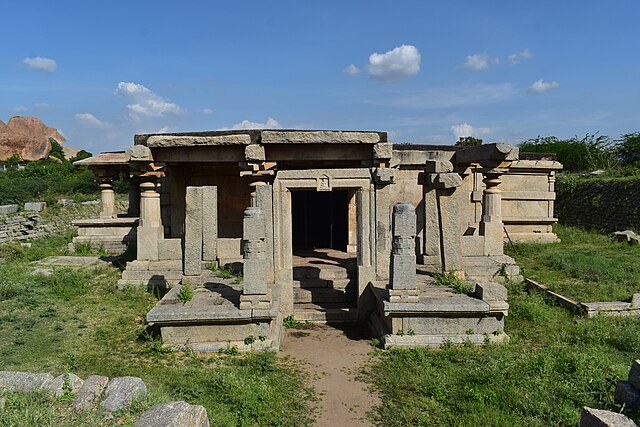
The ruins of the Vijayanagara Empire. Photo: Public domain.
Strikingly, there is no mention of the fact that the Vijayanagara Empire is the only state which draws its name from a place, Vijayanagara, rather than a family. The Vijayanagara Empire consisted of four dynasties, which ruled between 1336-1646 from the city of Vijayanagara. These were the Sangama dynasty (1336-1485), Saluva dynasty (1485-1505), Tuluva dynasty (1505-1565), and Aravidu dynasty (1565-1646). The most well-known ruler of this Empire, Krishnadevaraya (r.c. 1509-1529) (discussed briefly on p. 34 of the textbook), belonged to the Tuluva dynasty. From the way in which the reigns of different rulers of this political entity have been discussed (pp. 31-36) it seems as if they belonged to the same dynasty, when actually all the rulers mentioned in the section belonged to different dynasties. The ‘founder’ of the kingdom, Harihara I (r.c. 1336-1356) and his successor, Bukka Raya I (r.c. 1356-1377), belonged to the Sangama dynasty, while Krishnadevaraya belonged to the Tuluva dynasty. Similarly, Aliya Rama Raya (r.c. 1542-1565), the son-in-law of Krishnadevaraya, was the founder of a distinct dynasty, the Aravidu dynasty. This was the final ruling dynasty of the Vijayanagara Empire.
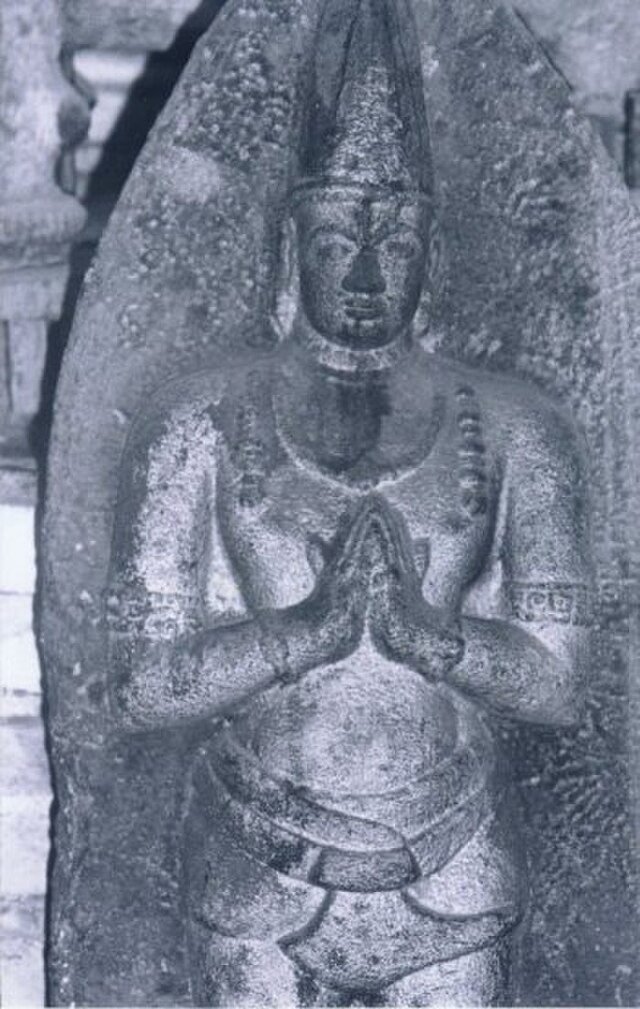
A sculpture of Krishnadevaraya. Photo: Public domain.
Further, in the chapter on Maratha history, in the brief portion concerning South India, particularly the Brihadeeswara Temple, it has been mentioned incorrectly that the ‘largest single inscription’ (p. 80) in the temple complex was composed during the reign of the Maratha ruler, Serfoji II. While, Serfoji (r.c. 1777-1832) is known to have rebuilt buildings like the Ganapati shrine in the religious complex, and an inscription inscribed on one of the walls of the ‘Big Temple’ (local name for Brihadeeswara Temple) is also attributed to him, there is no evidence to suggest that the said inscription is the largest single inscription found in India. The inscription, which records the history of the Bhonsle family, to which Serfoji belonged, is extensive at most.
Historically, the peninsular region of India has seen powerful and enduring dynasties like the Cholas, Pandyas, Rashtrakutas, and Chalukyas, to name a few. Their contributions to temple architecture, regional trade networks, cultural systems, e.g., the Bhakti movement in Tamil Nadu, vernacular Tamil inscriptions, and maritime commerce, are well-documented. However, in the present Class 8 textbook, the coverage of South Indian polities appears minimal. Rather than offering dedicated chapters with depth and context, the volume gives only fleeting references or subsumes them under broad thematic chapters like ‘Regional Cultures’. The absence of a discussion on the aforementioned polities, makes the peninsular region appear passive rather than dynamic. Besides, the cultural influences emerging from the south, from Tamil, Telugu, and Kannada inscriptions to temple sculptures, to meditation on grammar and mathematics, provide a rich substrate for much of Indian civilization. A textbook that neglects these facets traps students into a shallow understanding of the subcontinent’s internal diversity.
Noticeably, the volume moves from the later Mughals straight into British rule – skipping or condensing the era of regional successor states, including the Deccan sultanates in Hyderabad and Mysore. It may be argued that without deliberating upon them, the southern states become an afterthought rather than integral actors in the process of shaping the subcontinent. In the process, the peninsular contribution to Indian polity, culture and economy becomes marginalised.

The Last Effort and Fall of Tippoo Sultaun is an 1800 history painting by the British artist Henry Singleton. Photo: Public domain.
Perhaps the most concrete example of omission in the revised Class 8 social science textbook concerns the removal of references to Hyder Ali and Tipu Sultan and the wars they fought including the Maratha-Mysore War (late 18th century) and the four Anglo-Mysore Wars (1767-1799). Given that the fiercely fought four Anglo-Mysore Wars played a pivotal role in establishing British rule in southern India, the political event cannot be ignored. Students, in fact, should be informed that it was only after these four wars that the British were able to secure their position as the most powerful colonial regime in the country.
Importantly, while north and central India centric uprisings such as the Sannyasi-Fakir rebellion, Kol rebellion, and Santhal uprising, have been discussed at length, anti-colonial movements of South India, such as the Channar Revolt in Travancore (1813-1859), have been omitted. These exclusions matter because the narrative of anti-colonial resistance, regional assertion and local identity is weakened. Such a narrative may make students infer that resistance happened mostly in the north or that southern societies were passive or derivative, which, of course, is historically inaccurate.
Textbooks are not just about text; they are also about maps, pictures, and timelines. Maps in the Class 8 history textbook, appear to show north-Indian and the Deccan polity of Vijayanagara more prominently, but southern polities such as the Cholas and the Pandyas, their maritime networks, and coastal trade have been given short shrift.
The chapters on history in the new Class 8 social science textbook contain historical gaps which actually reduces their academic relevance. The omission of South India is not a minor oversight. It is a symptom of a deeper curricular imbalance which educators, parents, policymakers and historians must address. The risk now is that the vastness of India’s south remains out of frame. And in history education, what is out of frame, often remains out of mind!
Amol Saghar is a historian with a specialisation in the early history of Tamil Nadu, particularly the period of the Pallavas (4th Century CE-9th Century CE).
This article went live on November twenty-eighth, two thousand twenty five, at twenty-two minutes past four in the afternoon.The Wire is now on WhatsApp. Follow our channel for sharp analysis and opinions on the latest developments.


