

India's Skill Gap Could Derail the Promise of its Demographic Dividend, Finds Study


India is at a critical juncture in its development journey. With one of the world’s youngest populations and over a million youth entering the labour market each month, the country holds the promise of a demographic dividend. Yet this potential is being undercut by a persistent and widening mismatch between the skills possessed and demanded by industry – a challenge that poses serious implications for economic growth, social equity and national competitiveness.
A recent report by The Institute for Competitiveness, Skills for the Future: Transforming India's Workforce Landscape, highlights a troubling disconnect between educational qualifications and industry-relevant skills which is now threatening to derail the promise of India's demographic dividend. The study underscores the urgent need of strengthen technical and vocational education and training to better align talent with the evolving demands of the labour market.
When talent misses the target
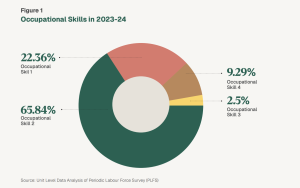
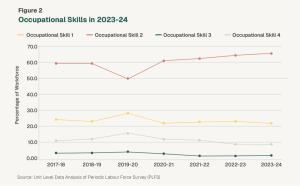
In India the skill mismatch reflects a fundamental disconnect between the country’s education and vocational training systems and the real needs of labour market. According to recent analyses of the education-occupational skill matrix, a staggering 88% of India’s workforce is employed in low-skill, low-productivity roles, while only a small fraction hold high-skill, high-value jobs. Over half of the working population has only completed primary education, significantly limiting their employment prospects.
Even among the educated, underemployment or unemployment remains rampant. Many college graduates find themselves inadequately prepared for the workplace, lacking both technical and practical competencies. Meanwhile the employers frequently report difficulties in recruiting skilled workers in key sectors such as manufacturing, healthcare, IT services and many more.
"To unlock the full potential of India's demographic dividend, strengthening the foundation of vocational education, ensuring industry relevance, and integrating it with general education is imperative," says the IFC report.
Big plans, bigger files
In response, the Union government has introduced several initiatives aimed at addressing the skill-crevices. The National Credit Framework (NCrF) seeks to unify formal education, vocational training, and on-the-job learning under a single credit system, allowing learners to build and transfer skills across various educational and career pathways. This approach is designed to promote lifelong learning and ease transitions between learning and employment.
And this is where the National Educational Policy (NEP) could play a pivotal role. According to the government, NEP 2020 provides a broader roadmap for reform. It advocates the dismantling of rigid distinctions between academic and vocational streams, promotes early exposure to skill-based learning, and encourages the integration of digital literacy and multilingual instruction.
However, translating this vision into reality requires far more robust public investment. The 2025-26 Union Budget allocated Rs 1.28 trillion to education– representing 6.5% increase but making this allocation only 2.5% of GDP. This remains well below the NEP’s recommended benchmark of 6% of GDP. Moreover, significant cuts to scholarship programmes for tribal and minority students – some exceeding 99% – have raised concerns about the weakening of equity and inclusion within the education system. And the impact is already evident. While states like Haryana, Punjab, Madhya Pradesh offer ample training opportunities; students from the regions such as Assam, Manipur or the Andaman and Nicobar Islands are being left behind.
Cracks in the blueprint
Despite ambitious policy frameworks, India’s vocational training infrastructure remains fragmented and under-resourced. Many ITIs and private centres struggle with outdated equipment, a shortage of qualified instructors, and weak linkages with industry.
The dominance of the informal sector – which employs over 80% of India’s workforce – compounds the issue. These jobs typically offer no security, limited wages and few opportunities for skill advancement. Beyond technical skills, access to employment is deep-rooted structural inequalities. Social discrimination continues to marginalise Dalits, Adivasis, Muslims.
Gender disparities remain stark as well. A recent study found that gender discrimination accounts for nearly 98% of the employment gap between men and women.
A way forward
Addressing India’s skills for the future requires a multi-pronged, systemic response. First and foremost, education and training systems must be better aligned with labour market demands. Curricula must be continuously updated in consultation with industry, with a greater emphasis on practical, applied learning and digital skills. Sectors such as healthcare, electronics, renewable energy and advanced manufacturing should be prioritised for targeted skilling efforts.
Vocational training must also be integrated with mainstream education, shedding the stigma of being a second-tier option. The NCrF report offer a framework for the integration, but their successful implementation will depend on Government will.
Equally important is the need to strengthen public infrastructure for skill development, particularly in rural areas. Community-based training centres should be equipped with modern tools and technologies. Scaling apprenticeship programmes and expanding employment-linked training can further bridge the gap between education and work.
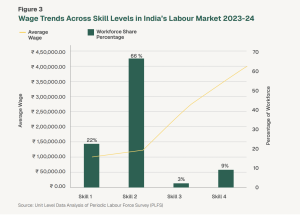
"This analysis highlights the substantial economic value of combining formal education with vocational training, especially at higher education levels. The magnitude of income gains suggests that integrating skilling into the education pathway can enhance both employability and earnings potential, further justifying investment in skill-aligned education reforms," says the IFC report.
Skill development alone is insufficient without meaningful job creation. The Indian economy must generate more high-value employment opportunities to absorb skilled workers. This calls for coherent industrial policy, support for MSMEs and strategic investment in labour-intensive sectors. We must also address regional disparities by developing state-specific skilling strategies tailored to local industries and labour needs.
The pathway forward demands vision, investment and goodwill. By aligning skills development and real job creation and ensuring equitable access for all, India can transform its workspace into a true engine of economic resilience and social progress.
Sayani Chakraborty is an editorial intern at The Wire.
This article went live on July twenty-third, two thousand twenty five, at fifty minutes past three in the afternoon.The Wire is now on WhatsApp. Follow our channel for sharp analysis and opinions on the latest developments.


