

JNU’s Counsel in a Kangaroo Court


I recently read a few reports about a programme on ‘urban Naxalism’ held in Hansraj college, Delhi University, under the aegis of the ‘Group of Intellectuals and Academicians’, and was struck by two things. One, that it was a platform to take potshots at Jawaharlal Nehru University, but invoked the latest buzz-phrase, ‘urban Naxal’ to do so (“anti-national” having probably been milked for all that its worth); and the second, that the person to do so was none other than JNU’s standing counsel, Monika Arora. As the Indian Express reported,
Arora, also JNU’s standing counsel and a member of the GIA, spoke about how the group has been working to expose teachers allegedly working as ‘Urban Naxals’. “Ek zor lagana hai, inko poora nikaalne ke liye… Kerala, media aur JNU mein hi toh baaki hain (We just have to push a little harder and kick them all out … They only remain in Kerala, the media and JNU),” she said.
A day after five significant figures in the fight for people’s movements, liberties and democratic rights, including lawyers, poets, writers and activists, were summarily arrested on the supposed grounds of being linked to the violence that took place in Bhima Koregaon, it is worth looking at how the neologism ‘urban Naxal’ is being deployed. Many have commented that the timing of these arrests coincide both with the linking of the Sanatan Sanstha with the Narendra Dabholkar and Gauri Lankesh assassinations, and the heating up of the discussions on the Rafale deal that implicates Bharatiya Janata Party bigwigs, helping to buy them some time in creating if not an aggressive response to these, then at least a smokescreen around the issues, as is commonly seen these days. Yet somehow these do not seem to be the only reasons for the ways in which some citizens, and certain ideologies, of the country are being selectively targeted.
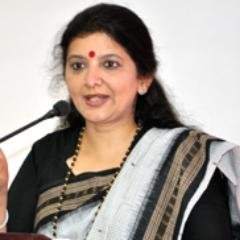
JNU's standing counsel Monika Arora. Credit: Twitter/Monika Arora
For this one needs to return to the ideological work being done by Sanghi ideologues, like those in the GIA, which involves the creation of a new lexical artillery that is produced at key instances to name, mark and decimate. And in between such shifts of vocabulary and tactics, or the morphing of the older ugly war cry of ‘anti-national’ into the ‘urban Naxal’, lie stories of democratic rights violations (the arrests of professor G.N. Saibaba and more recently of those active with the prisoners’ rights movement, like Rona Wilson, or fighting cases of those incarcerated under the Terrorist and Disruptive Activities (Prevention) Act/Unlawful Activities (Prevention) Act, like Surendra Gadling); steady encroachments on Adivasi lands and the expansion of corporate interests in mineral rich parts of the country (be it Chhattisgarh or Jharkhand); the pellet gunning of ordinary Kashmiris by state forces, including little children, making it seem as though stones were the biggest threat to the Indian state; the fear created in the country of a beautiful word, 'azadi', which in this new order is supposed to invoke the figure of a militant anti nationalist; and the unabashed support given by members of the ruling party for rapists and those who lynch Muslims.
The ‘crime’ committed by each of the five who were arrested last week (or the five before) has been to fight for the rights of different marginal sections of Indian society – whether they be Adivasis, Dalits, Muslims, Kashmiris, women or the poor. In a truly democratic country, people like these would be honoured for their continued struggles for rights and dignity. On the contrary, the fact that they present a threat to the state and to the ruling party speaks volumes about its purported commitments (made available through propaganda material or hastily assembled welfare programmes) to democracy, social or gender justice.
Since JNU faculty too are now included within the ‘urban Naxal’ elect, it may not be a bad idea to reflect on the deployment of this phraseology by the university’s standing counsel at Hansraj college. That, however, is not the only reason for examining her statement “ek zor lagana hai inko poora nikalne ke liye”. It is extremely telling that the vice-chancellor of JNU, M. Jagadesh Kumar, and its administration (that has many professors of the university now holding administrative posts) sees fit to use as their legal counsel someone who is openly hostile to JNU faculty and wishes to ensure that every “urban Naxal” is pushed out of the university. Such a sentiment is in keeping with the aggressive manner in which JNU faculty and students have been routinely attacked and vilified, be it in the press, on the electronic media and even, should the chance present itself, on social media platforms. Not once has the maligning of the university, its students and faculty, or its rich intellectual contributions ever been countered by the vice-chancellor. That has ceased to surprise most of us, because that would require a truly enquiring mind, and a certain catholicity of spirit, that has been found sadly lacking in those presently at the helm of JNU’s affairs. However, what is more critical is that the term being employed for political ‘cleansing’ at the moment, ‘urban Naxal’, is now also being used for the university’s faculty.
So what should JNU’s dissenting anti-nationals, now turned ‘urban Naxals’, expect now? If thinking, reading, arguing and encouraging our students to resist, intellectually and politically, all forms of injustice is the charge against us, then I fear we will always be found guilty as charged. But that is what every committed citizen of this country does, and must continue to do, putting us in very good company. Attempts to terrorise driven by the catchphrase ‘urban Naxal’ will work only as long as the citizens of this country are afraid or quiescent, which is hardly the case. On the other hand, the government and its puppet representatives must certainly worry, as they perhaps do not realise that every Goliath will one day have to face his David. And we all know how that encounter ended.
Arunima G. is professor at the Centre for Women’s Studies, JNU.
The Wire is now on WhatsApp. Follow our channel for sharp analysis and opinions on the latest developments.


