

JNU Teachers’ Association Raises Concerns Over Academic Standards, Harassment, Governance Issues


New Delhi: The Jawaharlal Nehru University Teachers' Association (JNUTA) on Friday, September 22 raised concerns over the deteriorating condition of the university, including academic standards, rule violations, admission issues, and reduced diversity.
It released a report, titled 'JNU: The State of the University' report, highlighting a series of critical issues affecting the university, spanning from governance concerns to academic irregularities.
In a statement, JNUTA said, "...the process of destruction of the university unleashed from 2016 has continued abated, even after the change of the Vice Chancellor in February 2022."
"This destruction involves erosion of the institutional and academic ethos of the University and the undermining of its role as a promoter of social equity – the hallmarks of the University which were integral to establishing it as a premier higher education institution," read the statement.
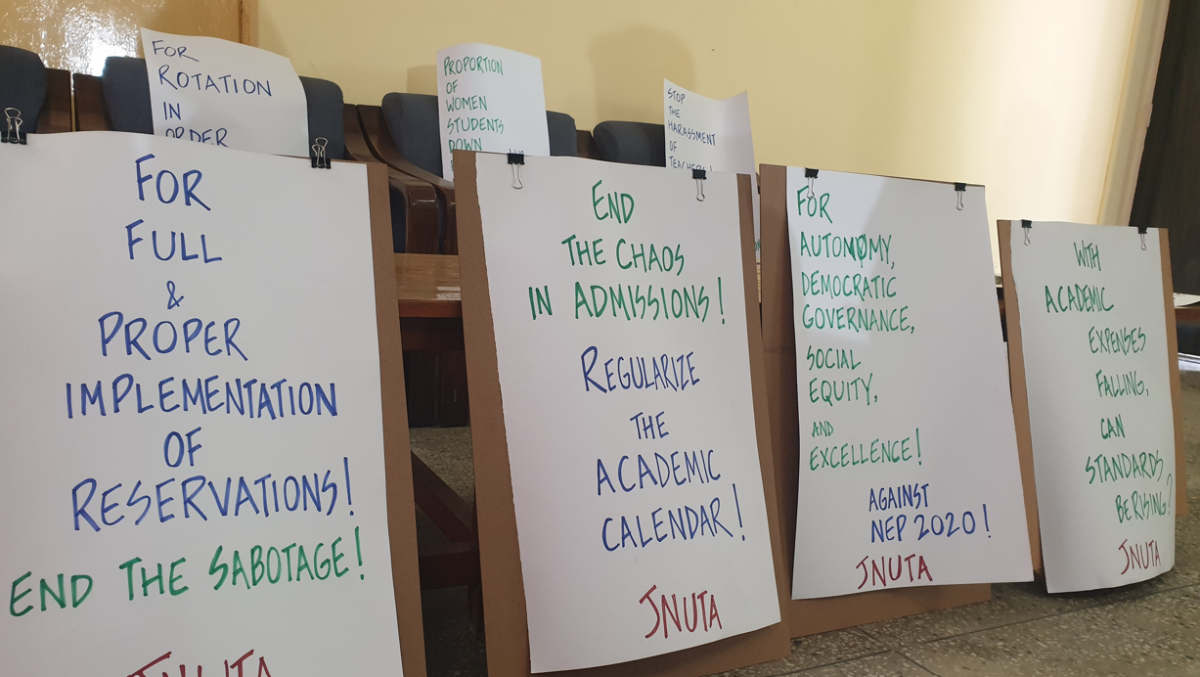
Posters displayed at the JNUTA office, highlighting the issues mentioned in 'JNU: The State of the University' report.
JNUTA president D.K. Lobiyal told The Wire, "What happened after Santishree Pandit [the current Vice Chancellor] joined JNU in 2022? We had thought that there would be some substantial change, but nothing happened. [Nothing changed in] the way appointments are made, recruitment is done. And people are waiting for the last seven to 10 years for their promotions. And promotions are very selectively done. So, people are waiting, and this is one part of the report."
The report alleges that teachers are subjected to harassment for any matter they choose to address.
"Leave for academic purposes is a facility granted to teachers for their academic improvements and achievements, which ultimately benefit the institutions of higher learning. Unless there is any specific exigency, any leave that a faculty member is eligible for is expected to be granted as a matter of routine," said the report.
However, restrictions have been imposed on such leaves, it added.
JNU professor Surjit Mujumdar told The Wire that asking for a leave amounts to harassment.
"The process of granting leave, the process of promotions, or any such case, any matter that teachers have to take up, they are subjected to all kinds of harassment and victimization. No one knows where the file is, where the application is going. People have to run up and down the administrative offices and spend long periods of time in that particular process. The administration has built this kind of insensitivity, where there's no accountability," he said.
Teachers attribute the reasons for such an appalling condition to bureaucratization and administrative apathy.
JNU State of the University Report by Taniya Roy on Scribd
The introduction of a 'leave committee' without statutory backing has hindered the academic leave processes, resulting in unreasonable demands and delays. Additionally, 48 teachers were issued charge-sheets, alleging they participated in 'illegal' protests, noted the report.
Their pensionary benefits were withheld until court orders intervened, it added.
Furthermore, retiring teachers are denied recognition for their contributions through honorary appointments as Emeritus Professors, it added.
Recent years have witnessed substantial changes in the JNU governance. These changes, according to the report, have had far-reaching consequences.
One of the most important concerns is the abandonment of the seniority-based rotation system for appointing chairpersons and deans – a practice that has eroded collegial decision-making structures and faculty representation in key statutory bodies like the academic and executive Councils. And this practice persists in defiance of court orders and regulations, noted the report.
Moreover, the transition to online meetings during the COVID-19 pandemic has raised questions about transparency and meaningful discussions, as agenda-driven items are swiftly approved, often omitting crucial matters.
Meetings often fail to meet regulatory standards, as many emergency meetings happen for the sake of formality. These problems highlight the difficulties in maintaining institutional autonomy and governance at the university, alleged the report.
Even during the previous administration, faculty promotions at the university were contentious, often tied to compliance with the administration.
The report mentioned that after the leadership changed in February 2022, a JNUTA study had revealed that 276 faculty members, primarily assistant and associate professors, were eligible for promotions. However, a staggering 76.4% of them had been waiting for promotions for over four years. Further, 62% had reached the stage where even their next promotion had become due.
Although the promotion processes have resumed, progress is slow, and the reasons for delays remain unresolved. In four regular meetings, the executive council considered 91 promotion cases, with only one rejection, but the number of promotions processed remains fewer than the pending cases, said the report.
This article went live on September twenty-third, two thousand twenty three, at fifty-eight minutes past five in the evening.The Wire is now on WhatsApp. Follow our channel for sharp analysis and opinions on the latest developments.


