

Given Their Track Record, Governors May Not Be Best Candidates to Improve Universities


New Delhi: As Indian universities continue to slide in global rankings, making the news over on-campus violence rather than academic achievements, President Ram Nath Kovind’s call to governors – who are also the chancellors of state universities – to play a more proactive role in resolving the problems afflicting these varsities is very welcome.
There is one catch though – most of these gubernatorial posts go to those aligned with the party ruling at the Centre, at the moment the BJP, and recent conduct of governors in political matters pertaining to the formation or dismissal of governments has shown them to be taking a biased stand.
In such a scenario, where even the Supreme Court has had to step in twice – in the case of Uttarakhand in 2016 when its intervention led to President’s Rule being lifted and the Congress being reinstated, and more recently in Karnataka, where it cut down on the fortnight’s time given by the governor to the BJP to form a government despite it not having the numbers – it is hard to imagine the governors engaging with the universities while taking the interests of students and faculty of all political leanings on board.
However, if there indeed is a serious effort in this regard, it may help the universities emerge from the recent low they have hit.
Indian universities sliding in world rankings
According to the World University Rankings 2018, while the Indian Institute of Science, Bangalore is on top in the country, the other four top positions among India's varsities are all held by the Indian Institutes of Technology (IIT) – Bombay, Delhi, Kanpur and Kharagpur. Other IITs like the ones in Roorkee, Madras, Guwahati and Dhanbad also figure high on the list. Incidentally, none of these institutes have politicised students' unions. Rather, they have associations for various activities.
Among the major non-technical universities which figure in the top 1000 the world are central universities like Jawaharlal University, Aligarh Muslim University, Banaras Hindu University, Delhi University and Hyderabad University as also some of the state universities like Jadavpur University and Calcutta University in West Bengal, all of which have in the past couple of years been witness to violence by or among students.
President wants governors to play a proactive role in lifting standard of universities
It was in this backdrop that President Kovind, who is himself the chancellor of all central universities, while speaking at the two-day 49th Conference of Governors, which concluded at the Rashtrapati Bhavan on June 5, spoke about how governors, being chancellors of state universities, could “provide the necessary impetus and inspiration to these institutions and to enhance the level of scholarship.”
He noted that 69% of all universities in the country come under the purview of state governments and about 94% of students enrolled for higher education study here. As chancellors of state universities, and with the instruments of their office and rich experience in public life, he told the governors that they were “ideally equipped for this responsibility”.
“You can help ensure that admissions of students and appointments of teachers in state universities are completed well in time and in a transparent manner. You can also help ensure that examinations, declaration of results and convocations take place as scheduled. It is for you to inspire state universities to maintain this discipline and integrity. In a fast-changing, globalised environment, it is equally essential to keep the academic curriculum updated so as to maintain the contemporary relevance of education. As governors of your states, it is for you to engage the youth and motivate them to use their academic achievements for the welfare of society and of our country. We need to strive collectively for a better life for our coming generations,” Kovind said.
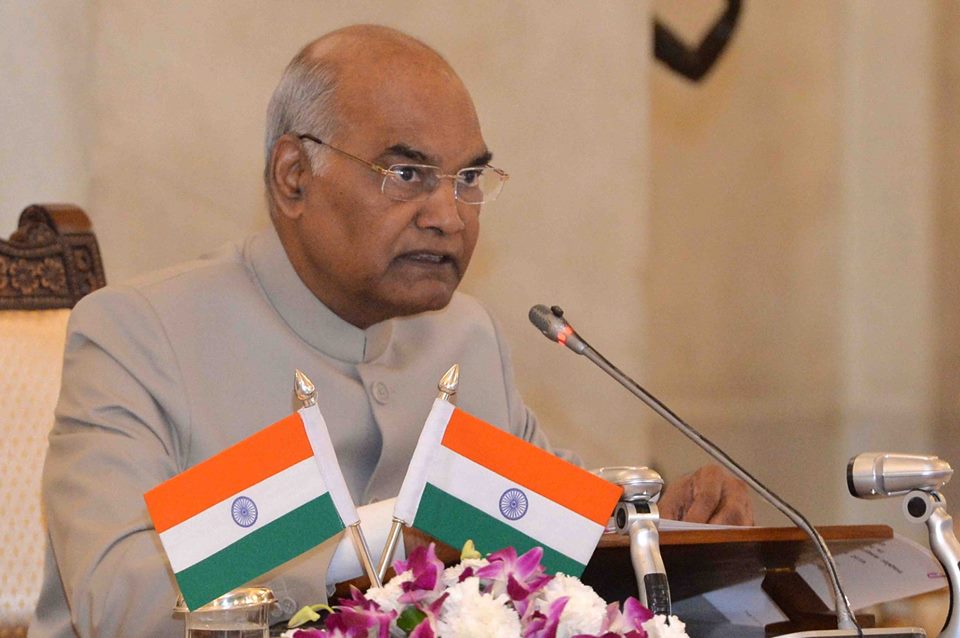
President Ram Nath Kovind at the 49th Conference of Governors. Credit: Facebook
‘Universities should also take up social responsibility initiatives’
He also said the governors can inspire universities towards adopting a more socially productive role or USR (university social responsibility). “University students should visit villages at regular intervals. They should engage with residents of the village in regard to cleanliness, literacy, immunisation and nutrition programmes. Governors could hold discussions with vice chancellors to make the ‘Swachhta Internship’ programme more effective,” he said.
The president also urged governors to convene meetings of vice-chancellors of state universities from time to time and expressed happiness that some of them had already taken this proactive step.
'Governors should also work with V-Cs, departments to resolve problems’
Kovind suggested the governors could also play a more proactive role in finding solutions to the vexed problems. He said the agenda of conferences being convened by them could be decided in consultation with the VCs and “to find quick solutions, representatives of state education and finance departments, as well as officials from the Union Ministry of Human Resource Development, the UGC and other institutions, could be invited.”
The conference also saw Prime Minister Narendra Modi urge the governors to play a proactive role in making universities promote excellence in academics so that the Indian universities are counted among the best in the world. He said the governors should strive to ensure that universities under them “promote excellence in various spheres of academics”.
Ambedkar had also seen governors as 'representative of the people'
The idea of having the governors play a more proactive role, especially for the students and the marginalised communities like the Scheduled Tribes, which has been suggested now also finds an echo in the speech of the author of India's constitution, B.R. Ambedkar, in which while speaking on the role of governors he had stated that each one of them should use his discretion not as “representative of a party” but as “the representative of the people as a whole of the state”.
This role assumes significance since many of the prominent universities have witnessed a great deal of violence ever since the Narendra Modi government came to power. The change of government emboldened the students' wing of Rashtriya Swayamsevak Sangh, the Akhil Bharatiya Vidyarthi Parishad, and it began asserting itself more on many of the campuses. The growth of BJP in the last four years has also encouraged right-wing groups and small parties to take the Left, Congress and ultra-left groups on the campuses head on. With the student wings of several regional political parties also joining forces with the latter to take on a resurgent Right, the campuses have turned into virtual battlefields of these political players.
Three central universities in UP among those rocked by violence
Several of the states like Uttar Pradesh and West Bengal have witnessed multiple cases of campus violence, the most recent being in Allahabad University on June 5 when students protesting against eviction from hostels clashed with the police, pelted stones and set a police jeep and vehicles belonging to university officials on fire. The police also lathi-charged the students. However, no one sustained serious injuries in either the stone pelting or the cane charge.
This was, however, not the case when several armed activists of the Hindu Yuva Vahini had entered the Aligarh Muslim University campus on May 2 to demand the removal of a portrait of Mohammad Ali Jinnah that had been hanging in the students' union office since 1938. Scores of students were injured in the violence then.

Protest at Aligarh Muslim University. Credit: PTI
The incident had occurred hours before former Vice President Hamid Ansari was to deliver an address at the Kennedy Auditorium on the campus. Ansari had later said, “the disruption, its precise timing and the excuse manufactured for justifying it, raises questions.” It needs to be remembered that this episode around Jinnah occurred just before the Karnataka state assembly elections and by-elections to the Kairana Lok Sabha constituency in UP
Yet another central university in the state, the Banaras Hindu University (BHU) had similarly witnessed violence on its campus in September 2017 on a day when Prime Minister Modi was in the city – which also happens to be his parliamentary constituency – to attend various events.
In that incident, there was a spontaneous protest by female students on the night of September 23 against harassment and other longstanding problems they had been facing. Subsequently, a group of boys had blocked the gate of the vice chancellor’s lodge in support of the demands of the female hostellers. The police, which was on high alert due to Modi’s presence in the city, reacted sharply and disproportionately and lathi-charged the students, leading to serious injuries to many of them.
Following the incident, the students had blamed vice chancellor Girish Chandra Tripathi for the violence. They said it was his theory of involvement of “outsiders” which caused the protest to escalate. Incidentally, BHU happens to be one of those central university campuses – along with Jamia Millia Islamia in Delhi – which do not have an elected students' union.
However, the media had also reported how students from the boys’ hostel had indulged in hurling stones and petrol bombs at the police and paramilitary forces on VC Lodge Road.
Campuses in states witnessing political violence are worst affected
As Kovind suggested, many such incidents can be prevented if the governors regularly interact with all the concerned groups on every university campus under their jurisdiction. Since many of these cases of violence also reek of political play, constant vigil appears to have become the need of the hour.
While the political shifts in UP – which is witnessing a battle of attrition between the BJP on the one hand and the Congress, SP and BSP on the other – are impacting the peace on its campuses. Same is the case with West Bengal where BJP, Trinamool Congress, the Left parties and the Congress are engaged in a four-way tussle for survival and consolidation.
This has also impacted the atmosphere on its campuses where issues now quickly take a political turn.
So in January, a protest over a sharp dip in the pass percentage in first-year results in Calcutta University led to a virtual face-off between the Trinamool and one of the Left parties.
While a section of the unsuccessful students, particularly from the Arts stream who were backed by some communist students’ union, demonstrated outside the university gates, the Trinamool government refused to give in.
The students claimed that only 27,475 out of 64,543 of them had managed to pass the BA exam, and the pass percentage of 43% was far lower than the 71% for the BSc Part I exam. They also claimed that it was the worst pass percentage in the past five years.
However, education minister Partha Chatterjee described the demand for a review of the results as unacceptable. “There cannot be any agitation demanding qualifying marks for students who have failed exams,” he said.
The agitation, however, grew big across the Calcutta University, which has 164 colleges, following the suicide by one of the unsuccessful students, Parna Dutta. Though the Democratic Student Organisation (DSO), the student-wing of SUCI (Communist), came out in support of the protesting students, and leader of the Left parties in the state assembly, Sujan Chakrabarty, also spoke in favour of the students, no relief was provided by the government. In fact, a Trinamool students' union leader Jaya Dutta accused “some outsiders encouraged by rival student unions” of creating all the trouble.
The state, which has been witnessing widespread political violence, had also seen protests outside its Jadavpur University campus in March this year. The trigger was the alleged defacement of Syama Prasad Mookerjee’s statue in south Kolkata allegedly by seven students of Jadavpur University in retaliation to the BJP pulling down a statue of Lenin in Manipur, following its victory in the state assembly elections there.
It was alleged that some members of a right-wing Hindu outfit were beaten up outside the campus while they were holding protests against the defacement of the statue of Jan Sangh’s founder. This incident had come amidst a string of attacks on the busts of prominent leader like Ambedkar, Mahatma Gandhi and E.V. Ramasamy ‘Periyar’ in the state.
As actions of governors remain suspect, questions linger over their ability to improve situation on campuses.
But if Kovind feels that the governors can really bring the campuses around, it needs to be ensured that they also inspire confidence in the state governments, something which has been lacking till now. In West Bengal, the conduct of governor Keshari Nath Tripathi was criticised by chief minister Mamata Banerjee's government last year when she said she felt “threatened, humiliated and insulted” by him and accused him of behaving “like a BJP block president”. She had also stated that “the governor’s post is a constitutional one and he should be neutral.”
Similarly, Uttar Pradesh governor Ram Naik had courted controversy this year when had claimed that ‘Ram’ was part of Dr Ambedkar’s name. He had also insisted that "a postal stamp released on the centenary functions of his birth anniversary also bore his full name as Dr Bhim Ram Rao Ambedkar... his signatures in the constituent assembly also had his full signatures.”
Clearly, with the BJP-nominated governors toeing either the party line, working on the instructions of the party bosses or saying things to please their political masters, they do not inspire much confidence in the opposition parties and this may also come in their way of effecting meaningful changes in the university education system in the country.
This article went live on June seventh, two thousand eighteen, at zero minutes past four in the afternoon.The Wire is now on WhatsApp. Follow our channel for sharp analysis and opinions on the latest developments.


