

Tamil Nadu Extends Acclaimed Breakfast Scheme to 29,463 More Schools


The Government of Tamil Nadu extended its Chief Minister’s Breakfast Scheme for primary students to 29,463 more schools on Friday, August 25.
The scheme will now serve nutritious breakfast to 17 lakh students from Classes I to V studying in 31,008 schools at an annual cost of Rs 404.41 crore. Launched on September 15, 2022, the scheme initially covered 1,14,095 students in 1,545 schools at a cost of Rs 33.56 crore.
Chief minister M.K. Stalin launched the extension of the scheme at Tirukkuvalai in Nagapattinam, where his father and former chief minister M. Karunanidhi had studied. Stalin also shared the meal with the children.
“The government expanded the scheme considering the outcome of the preliminary phase,” the government said in a statement. “The aim is to ensure children attend school without hunger and prevent malnutrition, achieve average height in children, prevent underweight in adolescents, prevent anemia and vitamin B12 deficiency.”
Stalin had invited elected representatives to launch the plan’s extension in a government primary school in their respective constituencies.
VIDEO | Tamil Nadu CM MK Stalin enjoys a meal with school children in Nagapattinam district as he launched the Chief Minister’s breakfast scheme.
The scheme was initially launched to provide breakfast to over 1 lakh students in classes 1 to 5 across 1,545 government schools,… pic.twitter.com/Ac7KBSI4uF
— Press Trust of India (@PTI_News) August 25, 2023
Smiles all around
Health minister Ma Subramanian inaugurated the programme at the Chennai Primary School at Manthope in Saidapet. As many as 1,075 students of the school will benefit from the programme.
The Tamil Nadu government stated that each student will be served cereals like semolina, wheat, rice, millet, and pulses, and locally available vegetables from Monday to Friday.
They will be provided 150 to 200 grams of cooked food and 60 grams of sambar with vegetables. This is apart from the mid-day meal provided to students till Class X.
S Paul Raj, a fifth-grade student at Chennai Primary School in Saidapet, is one of the beneficiaries.
The boy used to attend school on an empty stomach, since his mother has to leave for work early and family has limited resources. On Friday, his face lit up when the school bell rang, announcing the breakfast time.
Raj told South First that he had a satisfying meal of khichdi, sambar and kesari. “Earlier, I would be famished by 11 am and eagerly wait for the bell to ring to have the mid-day meal provided at the school,” the child grinned.
“More than 70% of the students do not have breakfast at home. We were happy that the students enjoyed the breakfast. No one wasted the food. The dull, inactive faces of the children lit up with happiness,” V. Umaparvathy at the Saidapet school said.
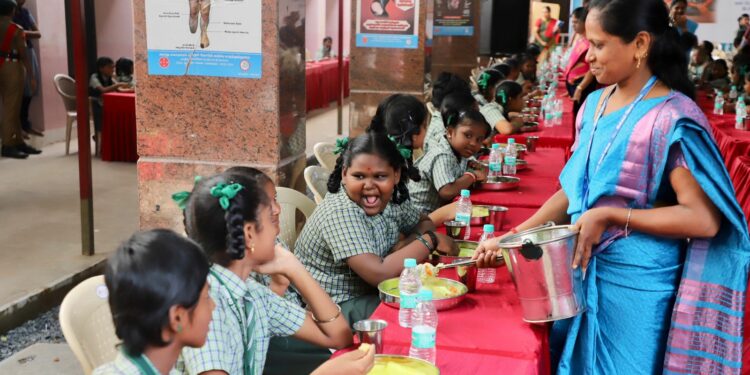
Schoolchildren being served breakfast. Photo: Laasya Shekhar/South First
Improved attendance
The positive impact of this programme extends far beyond filling empty stomachs. A recent study conducted by the State Planning Commission found a significant increase in attendance among government schools implementing the breakfast scheme.
According to the commission’s report, out of the 1,543 schools where children have been receiving breakfast since 15 September, 2022, 1,319 schools witnessed a remarkable rise in attendance during January and February, compared to June-July the previous year.
The base attendance data of the initial 1,543 beneficiary schools was compared against that of neighbouring schools within 1-2 km by considering the geographical coordinates of the schools, reported Deccan Herald.
The study considered only schools with enrolment of 25 and above and schools with consistent attendance reporting above 75%. This left the study with 72 beneficiary schools each mapped with at least two to 15 neighbouring schools, which took the total to 414.
Quick rewind
The Chief Minister’s Breakfast Scheme is an extension of many pioneering schemes in Tamil Nadu.
The state has a long history of providing food to the school children — an initiative that improved the attendance and reduced malnutrition among socially struggling children.
- 1920: The then Mayor of Chennai Corporation, Sir PT Thiyagarayar, passed a resolution to implement the mid-day meal scheme in Corporation School at Thousand Lights, Chennai. The scheme saw an increase in the school’s student strength. The scheme was expanded to a few more schools
- 1947: Due to financial constraints, the mid-day meal scheme was abandoned, except in Harijan Welfare Department-run schools.
- 1957: Chief minister K Kamaraj resumed the mid-day meal scheme for primary school students. ₹10 lakh was allotted for implementing this scheme, with a clause that it should not exceeding ₹18 per child a year.
- 1982: Chief minister MG Ramachandran introduced the Nutritious Meal Programme. Children in pre-school and primary schools were the beneficiaries.
- 1989: Chief minister M Karunanidhi included an egg every two weeks to the menu of the nutritious meal scheme.
- 1998-2008: The egg count gradually increased from one per week to three per week. The Tamil Nadu government provided bananas for the children who would not eat eggs.
- 2010: Egg count goes to five every week.
This article was originally published on The South First.
This article went live on August twenty-sixth, two thousand twenty three, at thirty minutes past one in the afternoon.The Wire is now on WhatsApp. Follow our channel for sharp analysis and opinions on the latest developments.


