

International Nuclear Fusion Project Seeks Reversal of Trump Budget Cuts


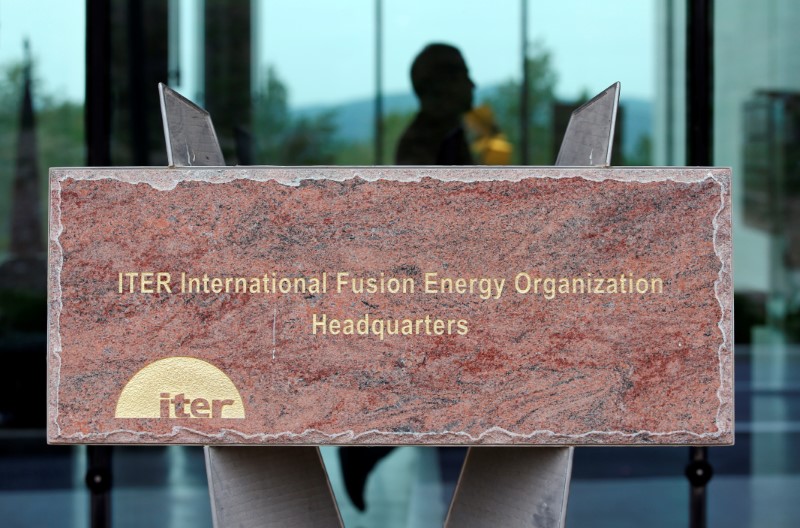
A man walks past a block of stone with the name of the International Thermonuclear Experimental Reactor (ITER) organisation headquarters in Saint-Paul-lez-Durance, Southern France, October 6, 2016. Credit: Reuters/Jean-Paul Pelissier/Files
Washington: An international project to build a nuclear fusion reactor in France that would start generating electricity in 17 years will face delays if Trump administration cuts are not reversed in a few months, the head of the venture said on Tuesday.
Bernard Bigot, director-general of the International Thermonuclear Experimental Reactor project, or ITER, said the administration's budget cuts would reduce the US contribution to the project and lead to construction delays.
"It's not a question of capability, it's a question of political will," Bigot said in a telephone interview while he was in Washington to meet with US officials.
The Energy Department did not immediately respond to a request for comment.
ITER, launched 10 years ago by seven partners: the EU, the US, China, India, Japan, Russia and South Korea, would generate electricity from a process similar to the nuclear fusion that powers the sun.
Conventional reactors split atoms to generate power and create poisonous nuclear waste, for which there is no permanent disposal site in the US.
The cost of the experimental project, which its partners hope will reach its first full-power fusion by 2035 is $21 billion to $26 billion.
The US has given about $1 billion to ITER so far, and had been planning to contribute an additional $500 million through 2025.
But with US President Donald Trump's proposed budget cuts, Washington's contribution for 2019 would drop to $75 million from $165 million. Last year, the administration cut the 2018 US contribution to $63 million from a planned $120 million.
Bigot said he told officials from the Energy Department, the White House's office of science and technology policy and the State Department, that the project will face delays unless Washington promises by June to fund the original amounts.
If the US, which provides 9% of ITER's funding, does not contribute the planned tens of millions of dollars on time, contracts for assembling large parts of the project will be delayed, he said.
In December, Shaylyn Hynes, an energy department spokeswoman, said that the administration is reviewing civilian nuclear policy, including research and development, which will influence its policy toward ITER going forward.
(Reuters)
This article went live on March seventh, two thousand eighteen, at zero minutes past seven in the morning.The Wire is now on WhatsApp. Follow our channel for sharp analysis and opinions on the latest developments.


