

The Environment Ministry Is Tweaking a Rule for Cement Plants. Here's Who It Can Benefit


New Delhi: People from at least 10 villages near Kalyan, which is part of the Mumbai Metropolitan Region, have been rallying against an Adani cement grinding plant that is coming up near their homes. It will pollute their air, land and water, they said. On September 16 at a public consultation meeting, they made it clear: they do not want the plant.
But their say will no longer matter, if the union environment ministry’s latest draft rules get their way.
According to a news report by The Indian Express, the proposed draft rules exempt certain types of cement plants from the process of prior environment clearance. This will make it easier for the Adani Group to establish its cement grinding plant in Kalyan because it will no longer need to consult with angry locals to set up the plant. On October 6, the Adani Group announced plans to develop a similar plant near Gangavaram Port, Visakhapatnam, Andhra Pradesh.
The move by the Union environment ministry to exempt some cement plants from prior clearance is one of the many recent dilutions being made in existing environmental safeguards, to promote ‘ease of business’ for industrial and developmental projects across the country. A recent study has found that emissions from industrial plants under the Adani Enterprises alone are responsible for 31 heatwaves between 2000 and 2023 – heatwaves that would not have occurred otherwise.
However, in a statement to The Wire, Ambuja Cements said that it was following all prescribed norms for the Kalyan cement plant and that it “assures that public health, local rivers, and the environment will remain fully protected”.
Adani’s cement grinding plant at Kalyan
At a public consultation meeting on September 16 conducted by the Maharashtra Pollution Control Board (MPCB), people living around Ambivli near Kalyan (part of the Mumbai Metropolitan Region) in Thane district, Maharashtra, strongly opposed the construction of a cement grinding plant (which grinds pebble-sized clinker with materials like gypsum to produce fine, powdery cement) in the area, per The Hindu.
The cement grinding plant with a capacity to produce 6 million metric tonnes per annum (MMTPA) will be set up at Rs 1,400 crores by Ambuja Cements (Adani Cement Business), a subsidiary of the Adani Group. The plant will come up on 26.13 hectares of land near the Ambivli railway station. This space was first envisioned for a logistics park, an industrial space to store, process and assemble goods. Locals have told media houses that they were not aware about a cement plant coming up here until they read about it in local papers in August, when the MPCB published a notice inviting objections and suggestions within a month, per The Hindu.
The Wire accessed the executive summary of the EIA report conducted by the Adani Group for the project. The study was extremely short, not comprehensive, and conducted just over a period of three months (October to December 2023). It admits that the plant could cause both air and noise pollution (both gaseous and dust emissions are a given, and noise levels will “increase significantly” during operation). However, these can be mitigated by several measures such as bag filters to limit dust levels, the study claimed. Per the study, the plant will consume a total of 600 kilo litres per day – which will need to be met from local ground water resources.
It’s also a densely populated area: the 10 km-radius of the proposed plant is home to more than 70 villages, nearly 3.5 lakh households, and 14.8 lakh people. Within a 1.15 km radius of the plant are four schools; the Mohone N.R.C. School is just a 100 meters away.
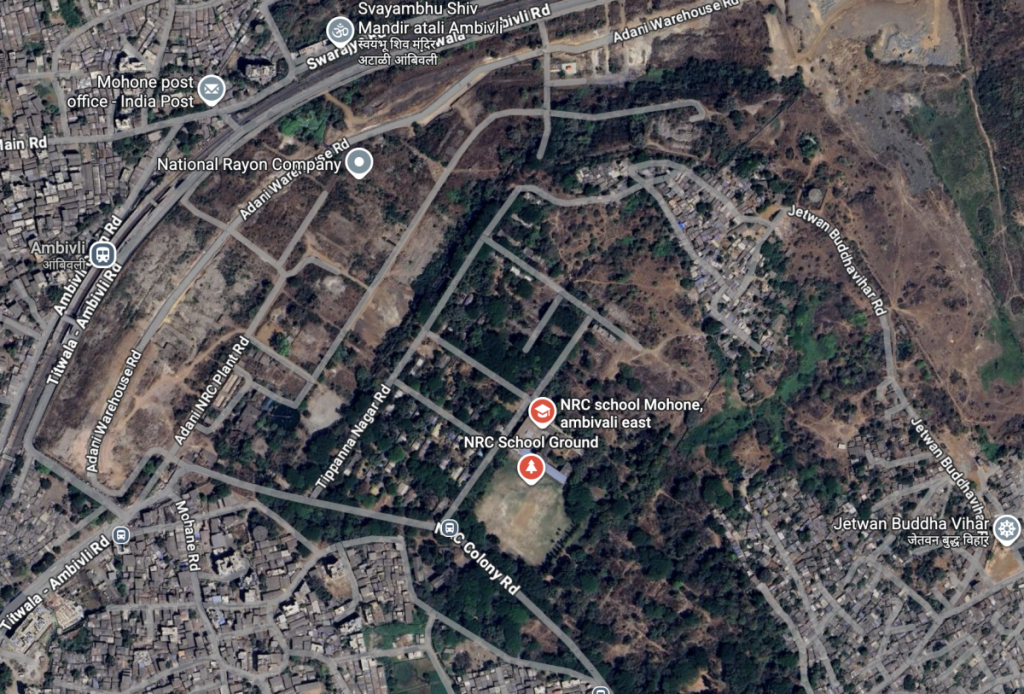
The Mohone NRC School and the 'Adani NRC Plant' to the left. Photo: Google Maps.
Despite this, the Adani Group’s EIA for the project claims that the plant is beneficial for the area, and “expected to yield a positive impact on the socio-economic environment” because it will employ around 1,500 people during its construction phase, as well as around 150 people during its operational phase.
In a letter to the MPCB, environment NGO Vanashakti raised significant concerns. Cement grinding plants are categorised as a ‘red industry’, the most-polluting type of industry, it noted, asking how such an industry could be planned in such a populated area in the first place. Apart from fugitive dust emissions that will affect thousands of people who live in the area, dust emissions as well as surface-water runoff during the monsoon season will pollute both the Ulhas and Kalu rivers. The latter is just 600 meters away, the letter read. The Vadavali Koliwada Lake just around 80 meters away will also be polluted, it read.
“Permissions to this industry is simply violative of the fundamental right to clean air and water for every citizen…To sum things up, this project is nothing but disaster on the humans and natural resources,” Stalin D., director of Vanashakti wrote in his letter to the MPCB, asking that the project not be given permission to operate.
On September 16 at the public hearing, people from ten neighbouring villages including Mohone cited all these reasons as they opposed the project. Over the long term, the grinding unit will pollute their lands, water and air, and they do not want that, they told The Hindu. Objecting to it in its entirety, they said that there was “no scope of negotiations” [to establish the cement plant].
Ministry’s controversial move
Ten days later, on September 26, the union environment ministry released a ‘draft notification’ – a document that lists a change proposed to a legislation that is being currently implemented. The Ministry proposed a change to the Environment (Protection) Rules, 1986 (which lists, among other things, locations where industries cannot be located, and standards for emission or discharge of pollutants from industrial units). To these Rules, the union environment ministry wants to now add in a sub-rule: that standalone cement plants be exempt from prior environmental clearance.
To obtain prior environmental clearance, an environmental impact assessment study (EIA) and public consultation are mandatory. In a public consultation, the project proponent and the implementing government department has to provide the results of the EIA to locals, and record and take into consideration any concerns that locals may have about the project.
Per the Ministry's draft notification accessed by The Wire, standalone cement grinding units which do not have a power plant on their premises “are still required to undergo the appraisal process for the grant of EC [environmental clearance], in spite of the fact that such projects do not require Public Consultation and detailed EIA [Environment Impact Assessment] report”.
Also read: Adani Power Receives 1,020 Acres For Lease In Bihar’s Bhagalpur – At Rs 1 Per Acre Per Year
According to the Ministry, standalone cement plants do not require public consultation and an EIA because such units do not have a power plant on their premises, and do not undertake calcination and clinkerisation (both high heat- and emission-generating manufacturing processes). Thus, according to the Ministry, these plants have “lower carbon emissions, waste generation (as compared to cement plants) and energy consumption (due to absence of high temperature processes)”.
“In addition, transportation of raw materials and finished products via Railways and/or E-Vehicles or a combination of both further reduces the pollution potential,” the Ministry’s draft notification mentioned. It stated that despite standalone cement grinding plants having a “lower pollution potential compared to integrated cement plants”, they are subjected to a “similar regulatory and monitoring regime, resulting in disproportionate compliance obligations”.
This is what the Union environment ministry now wants to change.
Per the Ministry’s draft notification, its Expert Appraisal Committee, after “due deliberation” had recommended that standalone cement grinding units – that do not have a power plant on its premises and conducts all transportation of raw materials and finished products via the Railways and/or electric vehicles – can be exempted from prior environmental clearance as this would “encourage green logistics and environmental governance”.
The draft notification neither mentions what ‘green logistics’ or ‘environmental governance’ are, nor how exempting standalone cement grinding plants will “encourage” these in any way.
‘Following all norms’
Their proposed Ambivli unit will “operate as a green and community-friendly facility without adverse impact on public health”, a spokesperson of Ambuja Cements told The Wire in a statement.
According to the statement, the plant will not emit gaseous pollutants such as sulphur dioxide (SO₂) or nitrous oxides (NOₓ) due to the dry-process grinding technique it uses. Incidentally, the EIA report undertaken by the Adani Group for the same plant says otherwise: it specifies that the project will likely emit particulate matter and polluting gases such as sulphur dioxide, nitrogen dioxide and carbon monoxide during its operational phase.
Per the statement, the plant will use mitigation mechanisms such as advanced bag filters and electrostatic precipitators to ensure that emissions of particulate matter will remain “well below” statutory norms. “This should address the concerns by local commuters and residents,” it read.
“When it comes to proximity concerns raised by local residents, we must point out that the project, on the premises of the erstwhile NRC Limited – a chemical company, is located in an industrial zone as per Development Plan approved by the Kalyan-Dombivli Municipal Corporation (KDMC) and we follow all the respective norms set for this zoning,” the statement added.
According to Ambuja Cements, it “operates with a strict zero liquid discharge policy”. The cement plant at Ambivili will not generate any liquid effluents and domestic wastewater will be treated in a modern Sewage Treatment Plant.
“No untreated water will ever be discharged into the Ulhas or Kalu rivers, or into the soil. All stormwater drains will be lined and monitored to prevent runoff,” the statement read.
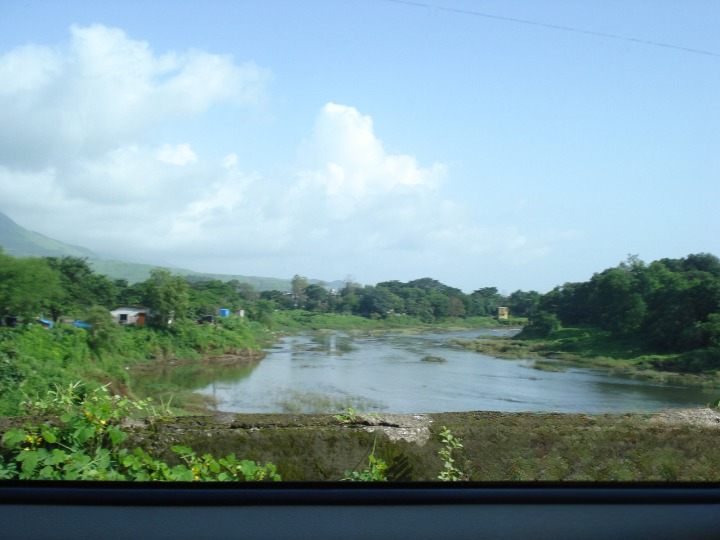
The Ulhas river. Photo: CC BY 3.0/Wikipedia.
It added that Ambuja Cements “assures that public health, local rivers, and the environment will remain fully protected”, and that it looks forward to partnering with the community to foster “green growth” and “shared prosperity”.
Ten days after the ministry’s draft notification, Ambuja Cements on October 6 announced its plans to develop another cement grinding plant: this time, an “eco-friendly” one, near the Adani-run Gangavaram Port in Vishakhpatnam, Andhra Pradesh.
Links to emissions and heatwaves
A recent study found that emissions produced by industries under the Adani Enterprises could alone be responsible for at least 31 out of 213 heatwaves that the world witnessed between 2000 and 2023.
A team of scientists studied heatwaves between 2000 and 2023 using satellite imagery, and also compiled data on emissions produced by carbon majors, or the top fossil fuel and cement producers across the world. They found that emissions produced by 180 carbon majors have made 213 heatwaves in this two-decade time period more frequent and more intense. The list of 180 carbon majors includes five Indian companies — including Adani Enterprises. Per the study, Indian companies were attributed to be among the highest emitters.
Emissions from Coal India alone made 51 of the 213 analysed heatwaves between 2000 and 2023 possible, while ONGC and Singareni individually contributed to 50 heat events. Adani Enterprises was responsible for 31 such heatwave events.
This is an important study because the research builds on peer-reviewed attribution methods that have been widely used to understand how climate change is influencing the frequency and intensity of different types of extreme weather events, including heatwaves, said climate change attribution scientist Mariam Zachariah, Research Associate at the Centre for Environmental Policy, Imperial College London. And more importantly, it connects that impact to emissions from major fossil fuel and cement producers, she noted.
This is crucial for two reasons, Zachariah said.
First, it transforms the responsibility of individual emitters in driving climate change from an abstract concept into something that can be scientifically quantified.
Second, it opens the door for clearer communication to the public, policymakers, and potentially even legal systems about who is driving the climate impacts we are already experiencing.
It is the first time that a study is quantifying how specific companies within India may be contributing to extreme heat events that are already affecting millions, Zachariah said. While India’s position that it cannot immediately abandon coal and fossil fuels is understandable given its developmental priorities and energy access needs, the study highlights just how high the stakes are, she added.
“Heatwaves in India are already becoming more frequent, more intense, and more deadly and now and the emerging links between some of those events and emissions from Indian fossil fuel producers makes the case for accelerating the transition away from fossil fuels even more compelling.”
A recent trend
Undoing an existing environmental safeguard, the new exemption proposed by the union environment ministry to exempt certain cement plants from prior environmental clearance is in stark contrast to its numerous mandates — to not only protect India’s forests and ecology, but also the environment through implementing legislations such as the Environment Protection Act (1986) and Rules that contain safeguards to protect against pollution — of the air, water and land — too.
The move is also just one in a series of similar such exemptions for industries and development projects in recent years.
For instance, the union environment ministry recently exempted all critical mineral projects from public hearings. The Hindustan Times reported last week that to “fast-track environmental and forest clearance processes” for critical minerals, all mining projects of atomic minerals and critical and strategic minerals notified in the first schedule (parts B and D) of the Mines and Minerals (Development and Regulation) Act will be exempt from public hearings. The rationale was that critical minerals are crucial for the defence and transport sectors, among others. Several critical mineral blocks have been identified in Himalayan-range states and union territories such as Jammu and Kashmir and Ladakh. In the districts of Kargil and Leh alone, the government has identified 67 minor mineral blocks, of which 25 have already been approved by the respective departments. With no public consultation, it will be easier for tendering companies – large corporations like the Adani Group, for example – to establish projects even if there is resistance from people on the ground.
Due to “the timing and the nature” of the latest draft notification pertaining to cement plants, the impression that it is intended to “subserve the interests of a private corporate group, rather than subserving the public interest” has gained ground, said retired civil servant E.A.S. Sarma, a former secretary to the government of India, in his submission to the Secretary of the union environment ministry highlighting how the proposed draft notification will dilute the existing Rules.
“It is not a coincidence that two standalone cement grinding projects have been presently proposed to be set up by the same corporate group, one, a 6 MTPA cement grinding plant in Kalyan, close to Mumbai and a 4 MTPA cement grinding plant near Gangavaram Port close to Visakhapatnam,” he wrote.
The process of cement grinding is a highly polluting process, Sarma, who has a degree in nuclear physics, explained. Reminding the Ministry that the “rationale for the Ministry’s existence” was to protect and improve the environment to fulfil Article 48 A of the Constitution instead of functioning as “an agency for promoting the business interests of a few influential private companies”, Sarma wrote:
“Finally, as evident from the latest move of your Ministry, those very same influential project proponents seem to be forcing your Ministry to dilute the EIA process itself to have an easy way to set up their units and profiteer to the detriment of the public interest. Should your Ministry become a willing party to such a blatant fraud [sic] on the people? Should your Ministry commit a breach of the spirit underlying Article 48A? Should your Ministry become a promoting agency for a few private oligarchs or remain faithful to the Constitution and be an instrument for protecting the public interest?”
Meanwhile, state pollution control board officials told The Hindu that they have noted the objections raised by villagers in the area. Regarding the union environment ministry’s draft notification, an MPCB official told the Indian Express that they would “act as per the rules” once the ministry takes the final call.
This article went live on October ninth, two thousand twenty five, at zero minutes past six in the evening.The Wire is now on WhatsApp. Follow our channel for sharp analysis and opinions on the latest developments.


