

COP27 Diary: Updates From Day 3


Kochi: November 8 marked the third day of the 27th Conference of Parties (COP27) at Sharm El-Sheikh in Egypt, and day two of negotiations and discussions on the climate crisis and ways to tackle it.
The Sharm El-Sheikh Climate Implementation Summit continued for the second consecutive day. Several high-level events and side events, as well as roundtable sessions occurred too. The first part of the high-level segment continued, where Heads of States and Governments delivered their national statements. After today, the high-level segments will resume only on November 15 and 16.
Fossil fuels and ‘loss and damage’
Some small island nations called for a treaty against fossil fuels, and a global tax on the profits of fossil fuel corporations.
Informal discussions on ‘loss and damage’ – the economic and other impacts caused by climate change – began. The heads of several nations also promised funds for tackling ‘loss and damage’ in developing countries. First minister of Scotland Nicola Sturgeon announced that her country would contribute £5 million, while Austria has pledged $50 million to developing countries. On Monday, Germany and Belgium had already committed to finances for ‘loss and damage’. New Zealand announced a commitment of NZD 20 million.
However, fears that a lot of these funds could just be reallocated money hangs in the air. “Critically, however, the funds New Zealand has announced are merely a re-allocation of a portion of the $1.3b in climate finance the Government already announced late last year,” according to the NGO Climate Action Network New Zealand.
Sharm El-Sheikh Adaptation Agenda
At the Global Climate Action High Level Event conducted as part of the Sharm el-Sheikh Implementation Summit, COP27 President Sameh Shoukry launched the Sharm El-Sheikh Adaptation Agenda. The agenda aims to rally global action around 30 adaptation outcomes (such as having smart and early warning systems in place) that are needed to address the adaptation gap and achieve a resilient world by 2030, as per the UN.
The Marrakech Partnership for Global Climate Action (which aims to strengthen collaboration between governments and stakeholders to lower emissions and increase resilience against climate impacts) released the Yearbook of Global Climate Action 2022, which reviews the state and scope of global climate action in 2022.
Over the days to come, other Global Climate Action events will focus on finance, resilience, industry, land use, water, energy and transport.
Net-zero commitments
The High Level Expert Group launched its report on Net-Zero Commitments of Businesses, Financial Institutions, Cities and Regions. The Expert Group consisted of 17 independent experts from around the world, including Arunabha Ghosh, Chief Executive Officer of the Delhi-based Council on Energy, Environment and Water (CEEW).
Their report highlighted how greenwashing and weak net zero pledges are threatening to undermine global efforts. It provided ten practical recommendations to bring integrity, transparency and accountability to net zero by establishing clear standards and criteria.
“If we want to act on climate, we have got to have projects coming out where clean energy infrastructure is needed, but also where it delivers the most returns, where the sun shines the most. That is in the tropics, in the global south,” said Ghosh.
Therefore we call for a new deal for development in the global south wherein the move towards net zero is consistent with the move towards increased flow of low-cost capital going to the global south, he said. The report asks that non-state actors – such as businesses and cities – should work with state actors (governments) to look actively for such projects in developing countries. We also need to set a high ambition for the scale of climate investments we want to see, Ghosh added.
“Let’s call for no unjust transitions as all transitions must be just,” he said.
Another report, commissioned by the current and previous climate summit hosts, Egypt and Britain and released on November 9 said that the world needs a new roadmap on climate finance that can mobilise $1 trillion in external finance that will be needed by 2030 for emerging markets and developing countries other than China. Current investment stands at only around $500 million.
An alliance for wind energy
The International Renewable Energy Agency (IRENA), Denmark and the Global Wind Energy Council together launched the Global Offshore Wind Alliance (GOWA) on November 8.
The GOWA aims to help achieve a total global offshore wind capacity of at least 380 gigawatts (GW) by 2030.
Currently, offshore wind capacity is at just 60 GW. During COP27, nine new countries – Belgium, Colombia, Germany, Ireland, Japan, the Netherlands, Norway, the UK, and the US – have joined the Global Offshore Wind Alliance.
…and another for mangroves
At a side event in the United Arab Emirates pavilion, the UAE and Indonesia launched the Mangrove Alliance for Climate (MAC).
The alliance says it will work to increase mangrove cover worldwide.
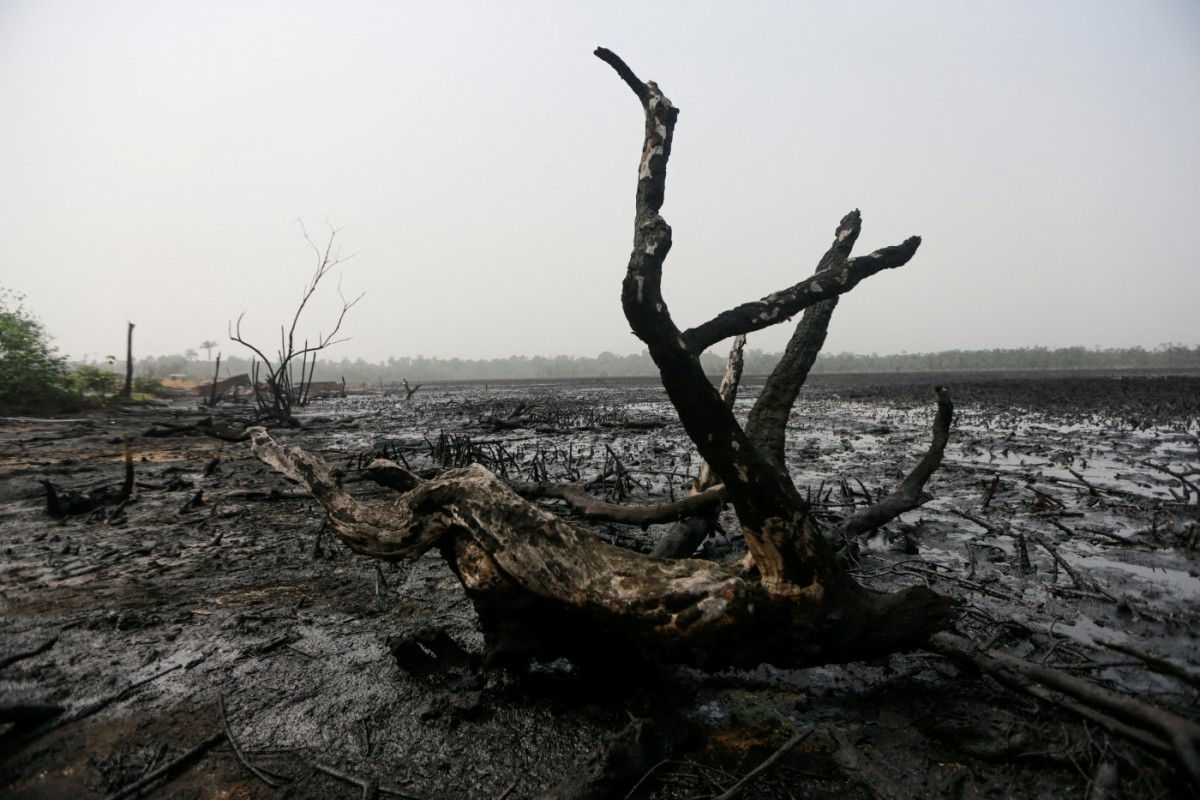
A dead tree is seen in a polluted mangrove area of Bakana ii camp in the Niger delta area of Okrika, Nigeria, January 28, 2022. Photo: Reuters/Afolabi Sotunde
As part of MAC, Indonesia and UAE will also establish an international mangrove research centre in Indonesia, which will specialise in studying, protecting and restoring mangrove systems, carbon sequestration and so on. India, Australia, Spain, Sri Lanka and Japan are the first countries to be part of this alliance.
The MAC will leverage and strengthen ongoing efforts and commitments of member countries, said Alue Duhong, the Vice Minister of Forestry and Environment, Indonesia.
India’s Union Environment Minister Bhupender Yadav spoke at the launch.
He said that India has committed to create an additional carbon sink of 2.5 to 3 billion tonnes of CO2 equivalent through additional forest and tree cover by 2030 as part of its Nationally Determined Contribution (long term goals to tackle climate change).
He added that mangroves have “tremendous potential” for mitigation of growing GHG concentrations in the atmosphere. He claimed that there was a “significant increase” in mangrove cover in India in the Andaman, Sundarban and Gujarat regions.
Integrating mangroves into the national REDD+ scheme – a UN framework that guides forest-based activities to reduce emissions caused by deforestation and forest degradation – was “the need of the hour”.
Human rights and the COP
The UN Human Rights and Right Here, Right Now, a public-private partnership that aims to address climate change as a human rights crisis, launched a new initiative for rights-based climate action, the Human Rights Climate Commitments (HRCC).
The HRCC will serve as an “aspirational and prescriptive living document”, urging governments and other actors to include specific commitments to prevent and minimise the adverse effects of climate change and address their impacts.
Meanwhile, several world leaders and the UN human rights chief urged the Egyptian government to release jailed activist Alaa Abdel Fattah. Fattah’s health may have deteriorated, as per news reports. Fattah had been on a 200+ day fast, and on November 6 – the day COP27 kicked off – stopped consuming water too.
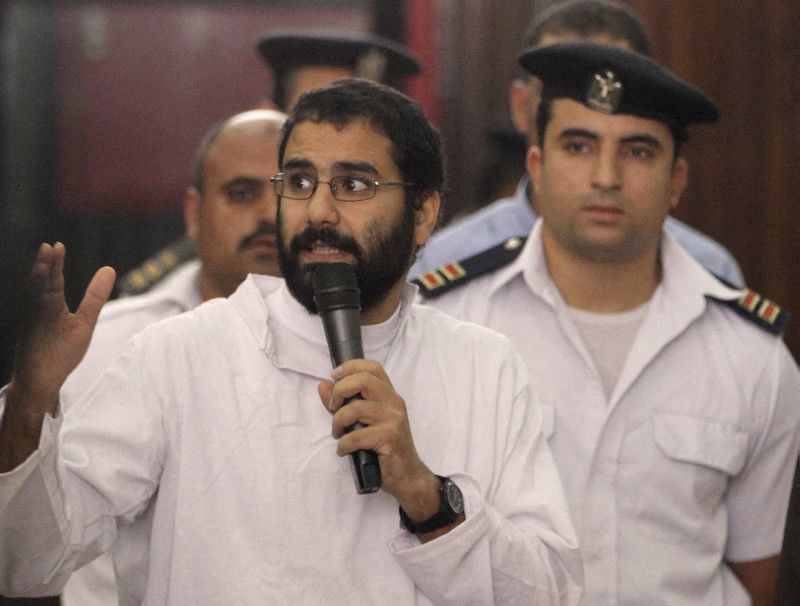
FILE IMAGE: Activist Alaa Abdel Fattah speaks in front of a judge at a court during his trial in Cairo, November 11, 2014. Photo: Reuters/Al Youm Al Saabi Newspaper
This is his effort to draw international attention to his incarceration, as well as that of around 60,000 political prisoners across Egypt, he had said.
While Fattah’s sister spoke to the press at COP27 about her brother’s status on November 9, an Egyptian government representative “confronted” her and had to be escorted out by UN security personnel, tweeted a participant.
Revive green trade talks, says WTO chief
Ngozi Okonjo-Iweala, head of the World Trade Organisation, told Reuters that negotiations on a global environmental trade deal should be revived.
The deal had revolved around removing tariffs and other trade barriers on goods such as solar panels that can help tackle climate change through investments in renewable energy.
However, WTO discussions collapsed in 2016 after disagreements between China and Western countries about which products should be on the environmental list. According to Okonjo-Iweala the talks should also be expanded to include services such as air pollution mitigation or wastewater treatment.
On the cards tomorrow
Tomorrow, officially the third day of the conference proceedings, will witness two Global Stocktake (GST) and related technical dialogue (TD) roundtables.
The GST takes stock of the implementation of the Paris Agreement to assess the world’s collective progress towards achieving climate goals, including long-term ones. While one will focus on mitigation including response measures, the other will conduct discussions on adaptations to deal with climate change, as well as loss and damage.
Discussions on finance will dominate many events tomorrow. In fact, November 9 will be the first thematic day of COP27 – and the theme will be finance.
Climate finance, which refers to local, national or transnational financing to support mitigation and adaptation actions to address climate change per the UN, is a crucial agenda item that the ongoing COP will focus on, and is of particular relevance for developing nations.
Finance Day will address several aspects of climate finance, including blended finance, and tools and policies that will help enhance access and scale up finance (including finance pertaining to debt for environment swaps, wherein part of a developing nation’s foreign debt is forgiven in lieu of investments it makes in conserving the environment).
Several Global Climate Action events tomorrow will also discuss finance.
This article went live on November ninth, two thousand twenty two, at sixteen minutes past nine in the morning.The Wire is now on WhatsApp. Follow our channel for sharp analysis and opinions on the latest developments.


