

Serpent Heads, 'K-Pop Demon Hunters' and Fossil Fuel: A Day in the Life of COP30


Belém (Brazil): Fifty six thousand people are at this year’s COP, the UN-led climate meetings, in Brazil’s Belém. For two weeks we have and will read of negotiations going into the dead of the night, of protesters facing off with police and of the prickly heat of promises. The climate is changing and its impact justifiably makes a lot of people angry. But so diverse is this meeting and so eclectic its progress that no single news copy can do justice to how much happens in a day. This does not either, but it is a hint of an idea of a day in the life of the COP30.
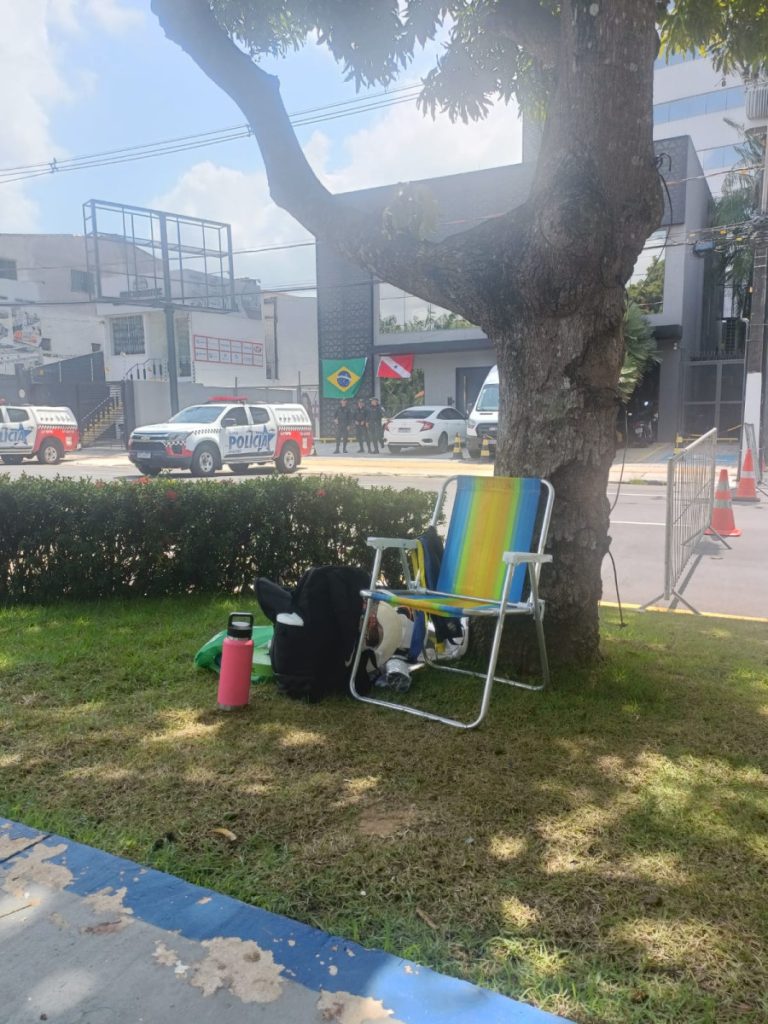
A lawn chair on the way to the COP30 venue. Photo: The Wire.
It is 10 am and the equatorial sun is so excruciating that people are squinting as they walk the long path towards the ‘Blue Zone’ of the COP30 venue at Parque da Cidade – the Belém's sprawling park. The Blue Zone is where the negotiations happen. But the Green Zone, the consensus seems to be, is where the “fun” is – with civil society, NGOs and visitors trooping in. The otherwise quiet gateway to the Amazonian rainforests, Belém has unfurled itself for COP in a way that is very reflective of the ethos of the Global South. Across the length of the city, service providers and others alike need only a second to whip up Google Translate and give detailed advice, instruction or notes on where to find an ATM.
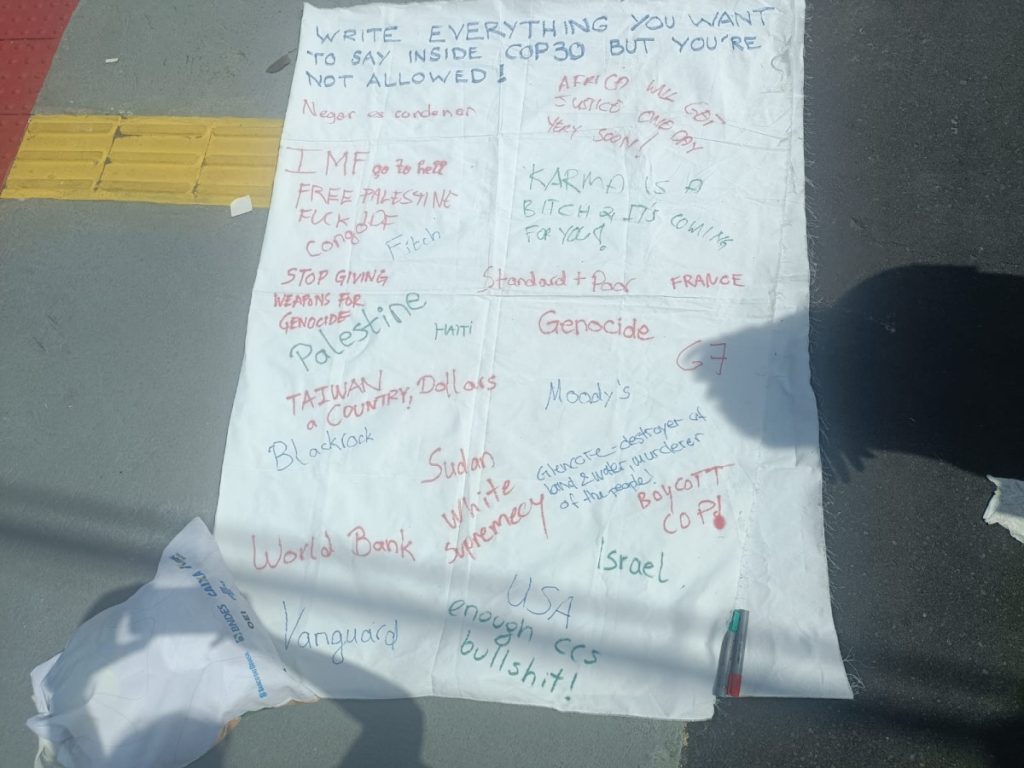
A free-for-all poster at COP30. Photo: The Wire.
At the entrance of the park, a lone woman is speaking English poetry into a mic.
“Indigenous people want to be heard. We don’t want your money,” she says, barefoot on the scorching cement. Her performance is without pause – so much so that we don’t get to ask her her name. The journalist Shelly Walia strikes up a conversation with a person standing close by, who says he might be able to find out for us. "She spent seven years in Italy, so her accent is a little different," he says. Later, he texts Shelley that she is Djatchy Ka'a Tupinambá, a 34-year-old audio-visual artist with a thriving Instagram page.
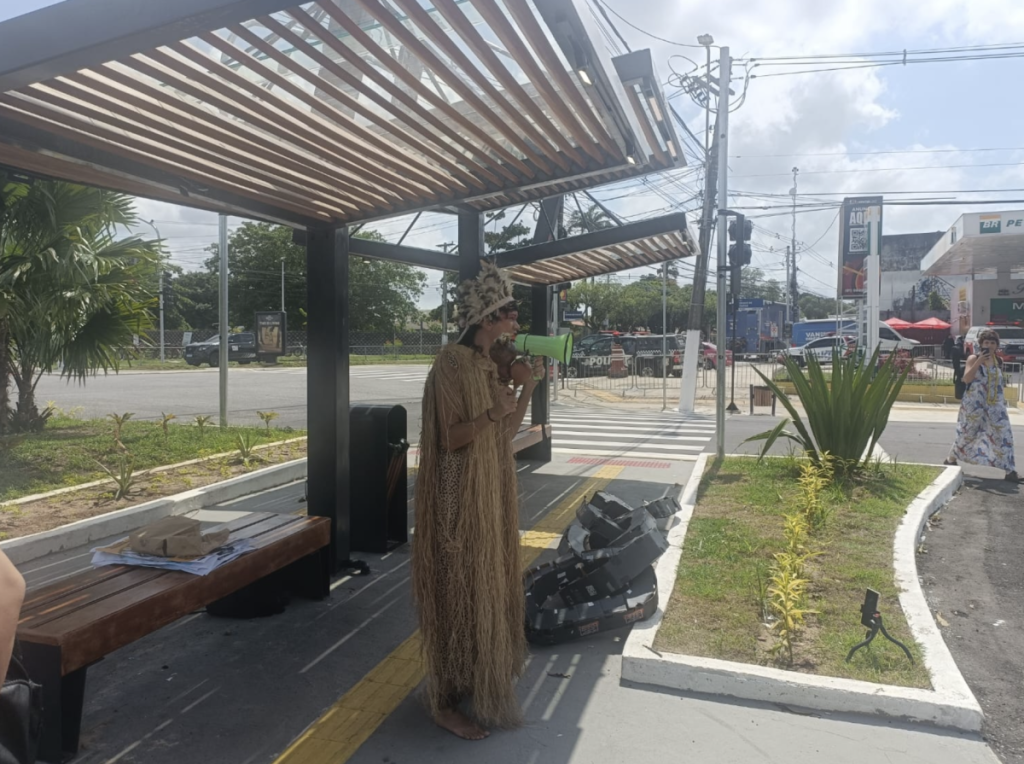
Djatchy Ka'a Tupinambá outside the COP30 Blue Zone on November 18. Photo: The Wire.
Inside the venue, everyone pauses to take a photo of the façade. The cops of COP30 mill about in full fatigues, some trotting the largest guns.
With protests last week, ministers in town for the talks, and the threat of slogans from a disgruntled person who has lost everything to climate change ever dangling, the venue has been crowded with law enforcement.
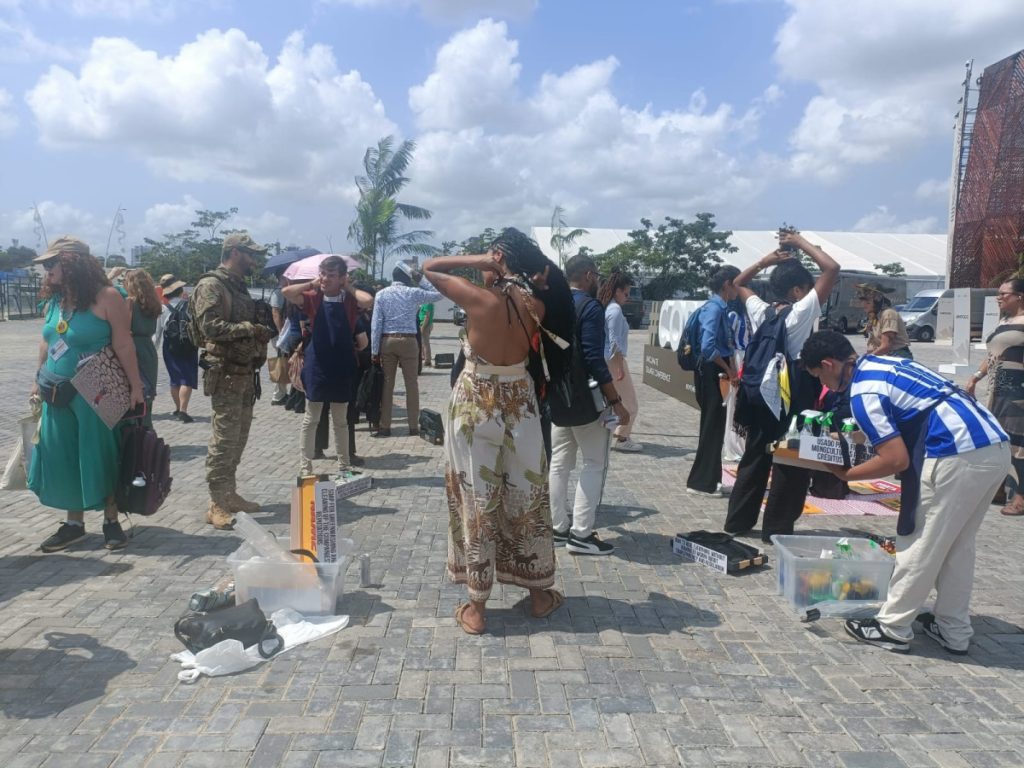
Police smile at a group of protesters and ask them to wind things up outside the COP30 Blue Zone on November 18. Photo: The Wire.
But that does not stop a group of indigenous people from around the world, who have gathered at what I can only assume – but can never be sure thanks to its vastness – is the midway mark of the Blue Zone. As their centrepiece, the protesters have a gigantic papier-mâché serpent, so huge that a person could easily sit comfortably inside the head itself.
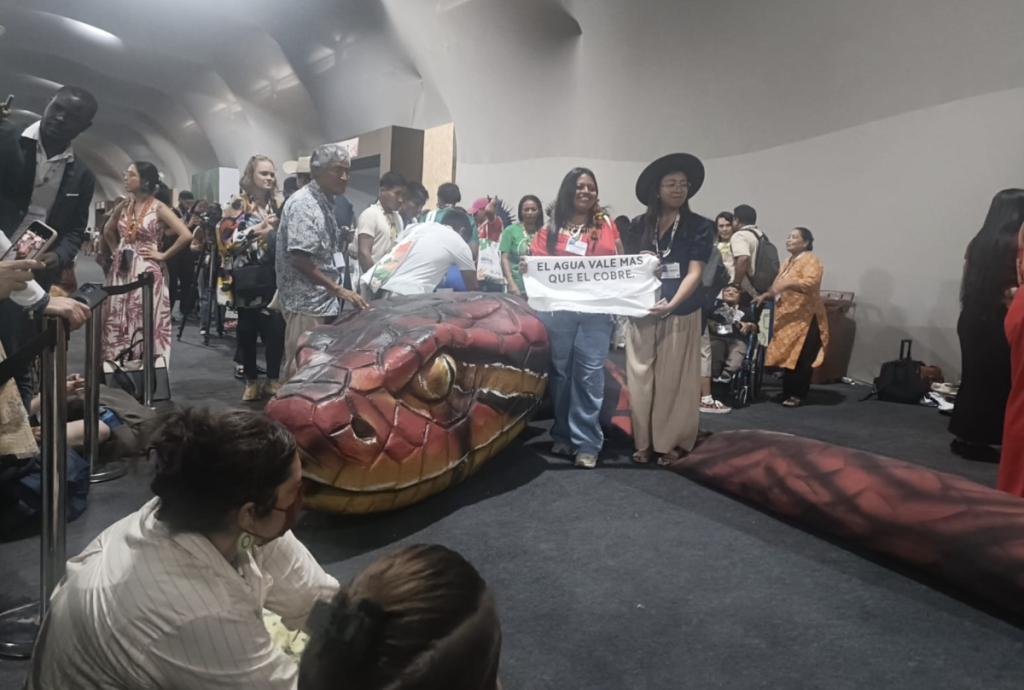
A protest at the COP30 venue on November 18. Photo: The Wire.
Aakaluk Blatchford – “I am first and foremost a mother,” she says – has travelled from Alaska for COP30 and says that the protest just came together when a “few of us reached out to a few others.” The snake is a symbol of many things, Blatchford says, and likens it to our collective greed, the cyclical nature of it and nature itself. As she speaks, her friends carry the snake around in a circle, chanting.
Blatchford says she forgot to say ‘Free Palestine’ at the end of her speech. She wears a keffiyeh and is among many who do.
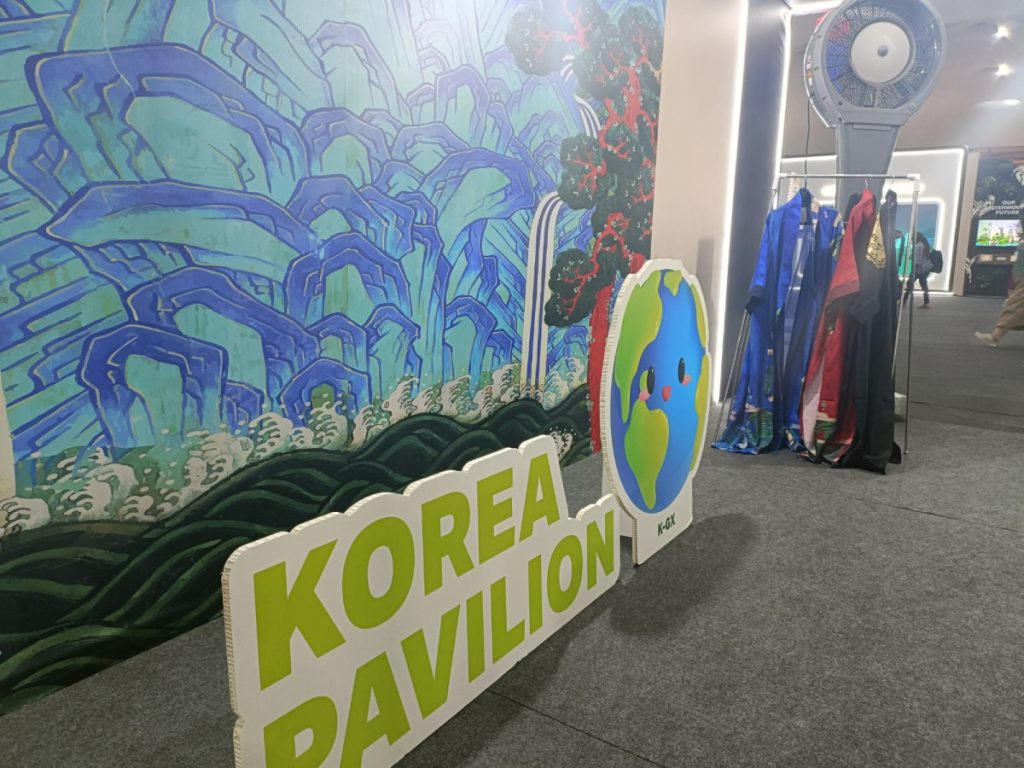
The South Korea Pavilion at COP30 in Belem, Brazil. Photo: The Wire.
At noon, there is a line outside the South Korea pavilion, where you can dress up in a hanbok – the national dress – and take a photo against a traditional Minhwa art piece showing off a waterfall against the mountains and wilderness. Inside, there is serious talk on sustainability and cities.
But you can also, if you want, take away fans depicting characters from the animated smash-hit, K-Pop Demon Hunters.
Clap twice for a show of strength
At 2 pm, several ministerial-level country representatives come together to form the ‘Mutirão Call for a Fossil Fuel Roadmap.’ ‘Mutirão’ means ‘joint effort’ and the call has people’s interests piqued. By now, everything is everywhere and also all at once. Many journalists troop into the press conference room panting.

Ministerial representatives at the ‘Mutirão Call for a Fossil Fuel Roadmap' press conference at COP30 on November 18. Photo: The Wire.
The room is packed, but so is the stage. Among the 20 people on it are Tina Stege, climate envoy for the Marshall Islands, Irene Velez Torres, Colombia's minister of environment and sustainable development, Ed Miliband, the UK's secretary of state for energy and climate change, Ole Thonke, climate ambassador at Denmark’s foreign ministry, and Carsten Schneider, Germany's environment minister.
The countries occupying seats make short speeches on how to effect a just and equitable transition from fossil fuels. In the next few hours the total number of countries offering support balloons to 84.
 Stege says that the 38,000-people-strong Marshall Islands in Oceania has included the move away from fossil fuels in its Nationally Determined Contributions declaration, which it submitted in February, within deadline. India has not submitted its NDC yet, although reports have it that environment minister Bhupender Yadav has told journalists that it is coming in December.
Germany’s Schneider says that we must all learn to practice mutirao and free ourselves from fossil fuels. He calls on the COP30 presidency to include this in the text of the outcome and gets a prompt round of cautious applause. A day ago, incidentally, the German chancellor Friedrich Merz appeared to slight the host city of Belem, saying that everyone who travelled from Germany was “delighted to have left the place.” On social media, Brazilians say this hurt less than Germany’s 7-1 defeat of its football team in 2014.
Colombia’s representative says that the urgency of the climate crisis allows no delay and that science is clear. “People of the world are mobilising on a massive scale, demanding complete action on climate justice. We have chosen not to grant any new oil contracts,” she says.
The Kenyan representative who follows says that transition must be just because as many as 600 million people don’t have access to electricity in Kenya. UK’s Ed Milliband says that this is a global coalition of the Global North and the Global South.
Sierra Leone’s representative is honestly tired of waiting. “We are coming to the table. We want to be coming to the solution. It is important that finance and technology is coming to us.”
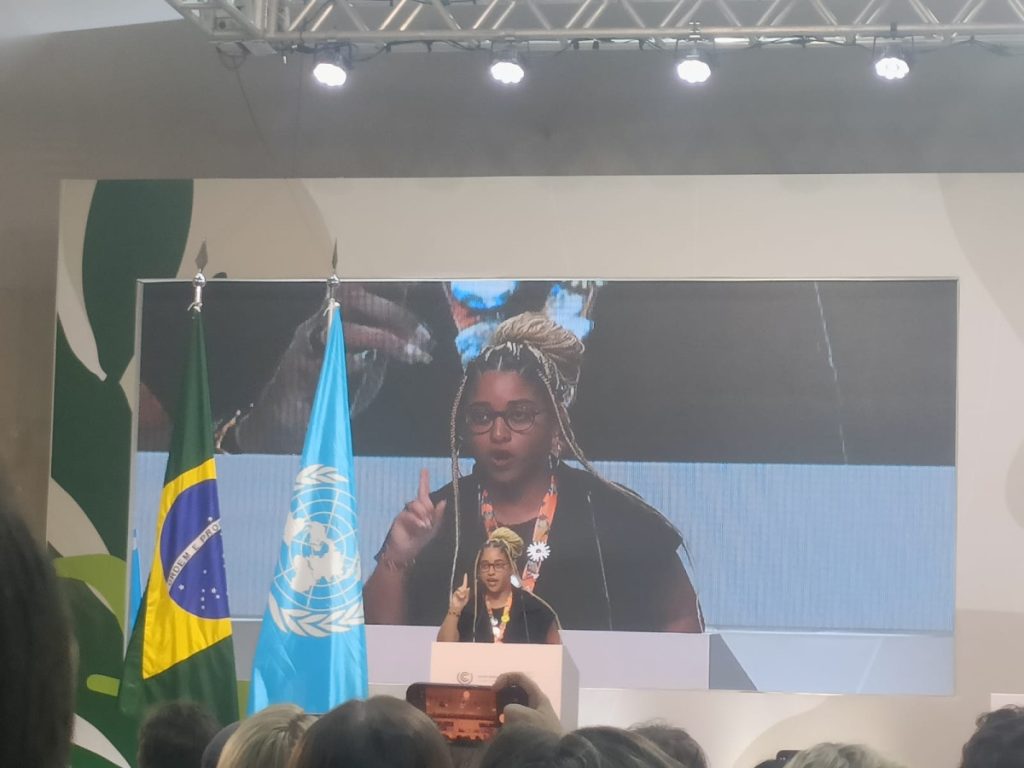
Marcele Oliveira at the ‘Mutirão Call for a Fossil Fuel Roadmap' press conference at COP30 on November 18. Photo: The Wire.. Photo: The Wire.
The COP presidency’s youth climate champion, Marcele Oliveira, then takes the stage as a clear fan favourite. “If you can hear me, clap once,” she starts. “If you can hear me, clap twice!” she says again. Legions of journalists happily follow.
Oliviera thanks ministers for support but says that the action needs more people. “Today is the day. We are here,” she adds.
Stege has the mic for the final time and says that it “only works if we do it together.”
“Journalists get this message out. We need you too,” she adds.
They end the presser but say that the ministers and their envoy will be around for questions. Outside, broadcast journalists are ready with their cameras. Inside, there is a light buzz of positivity. For a few seconds, in a world with genocides, the COP is heady with the promise if countries coming together for the global good.
'We will go home and nothing will change'
But metres away, just outside the media centre, journalists have surrounded Lina Yassin in a neat circle illuminated by the single tally light of the gigantic camera of the news agency AFP. Yassin, the Sudanese adaptation negotiator for the Least Developed Countries speaks a rapid French. As I look around, a Bangladeshi journalist says that she is deeply unhappy.
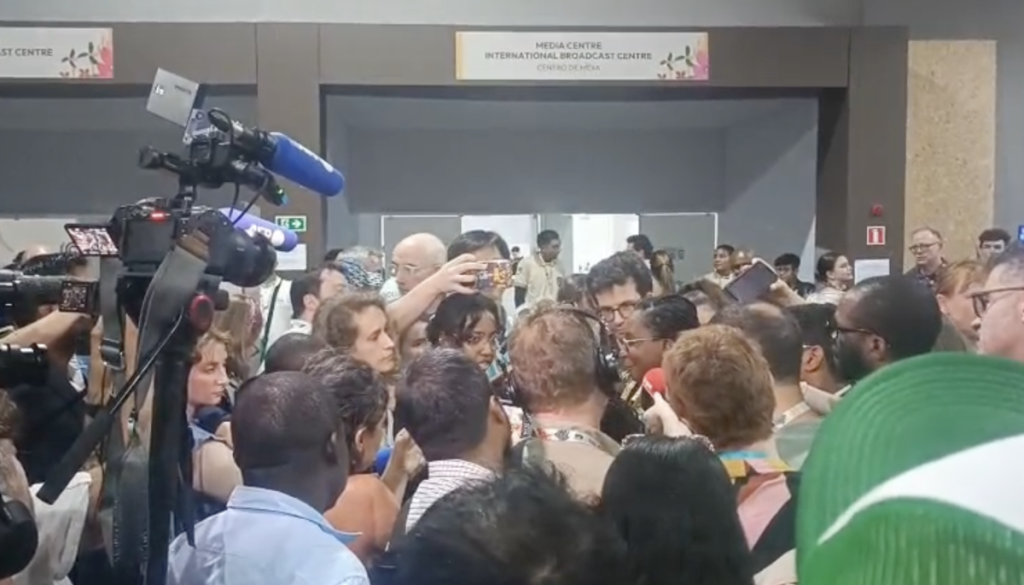
Lina Yassin and an orb of journalists at COP30 on November 18. Photo: The Wire.
A little later, the press note with her quote from the deliberations earlier proves that the journalist was right. “The LDC Group is calling for adaptation finance to be tripled by 2030, and we have made this clear in the GGA negotiations. A comprehensive adaptation package is necessary; without it, commitments remain words on paper. Yet donor partners have not given clear support…Without a meaningful package and the finances to act, indicators will mean nothing. We will go home, and nothing will change,” she says in the official statement.
Several authoritative men and women scoop Yassin away. A man is now speaking to the same microphone circle but his French is even more rapid than Yassin’s. Eventually, he is also done and the journalists walk into the media centre and hurry to upload this footage.
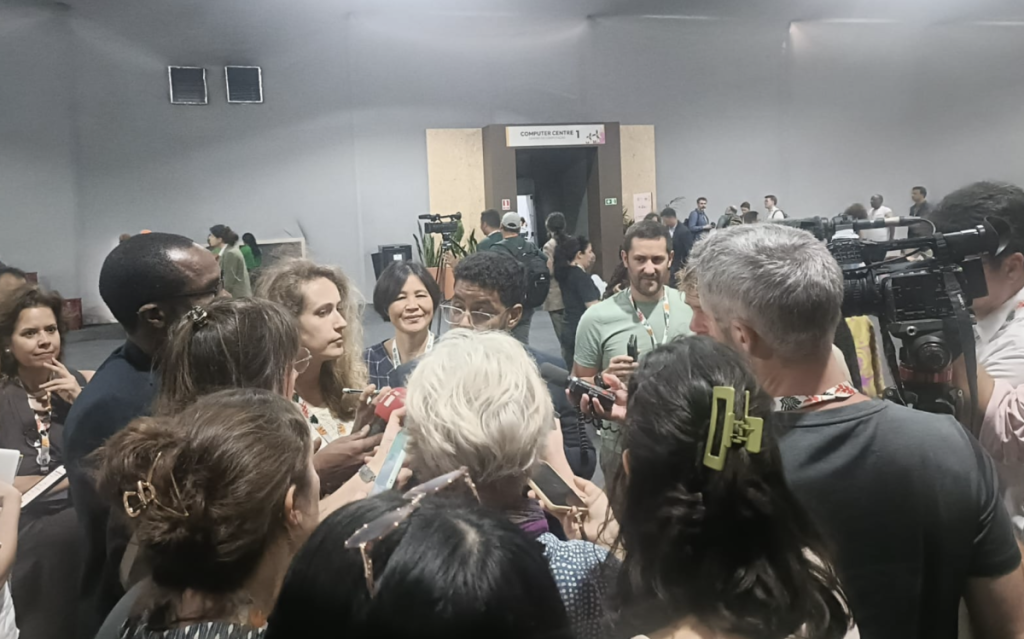
More talk after the LDC meeting at COP30 on November 18. Photo: The Wire.
Three pm rolls into the media centre and talk is on the ‘Global Mutirão’ draft text of presidency consultations on the four contentious issues of this COP. Colleagues shoot off articles and live blog updates on the sheer speed at which it has arrived – signalling a distinct glimmer of hope for what this COP can achieve. Will there be a resolution before Friday, the 21st? Eh, unlikely, say the veterans.
The Guardian notes how lines referring to the “transition away from fossil fuels” are among the options for an outcome in this draft document. Discussion on this was effectively shut down last year in Baku, so its resurgence is a triumph of sorts.
There is a light pitter-patter of keyboards. The pop of cans of free water – refrigerated and ‘COP30’ branded – punctuate the whirr of the enormous wind blowers. It is cool and you struggle to remember the oppressive sun outside.
At 4 pm, the EU program director Jens Mattias Clausen who is responsible for the COP negotiations is at a meeting room, entertaining questions from journalists. This is happening in a corporate-looking ‘Meeting Room’ – one of 21.
Clausen says that there is high-level political momentum and guidance in the talks. He is cautious, optimistic of the outcome, and notes wistfully that back in the day, the US absorbed the first layer of protests from developing countries, in its role in climate funding, offering a degree of protection to the EU.
In infrastructural support that impresses one to dumbfoundedness, colleagues who are Portuguese speakers can listen to a live translation of the negotiator’s English through headphones.
Critical minerals and the case of women
At 5 pm, there is a press conference of women leaders.
Osprey Orielle Lake, executive director, Women's Earth and Climate Action Network (WECAN), says that women are doing the work of climate resilience but have no financial support. “It is time to centralise the role of women.”
Lake’s words bounce about in the largely empty hall. There are seven men and double the women when this presser begins – a distinct departure from the choc-a-bloc negotiation and finance pressers.
“Investing in care is climate action,” she says.
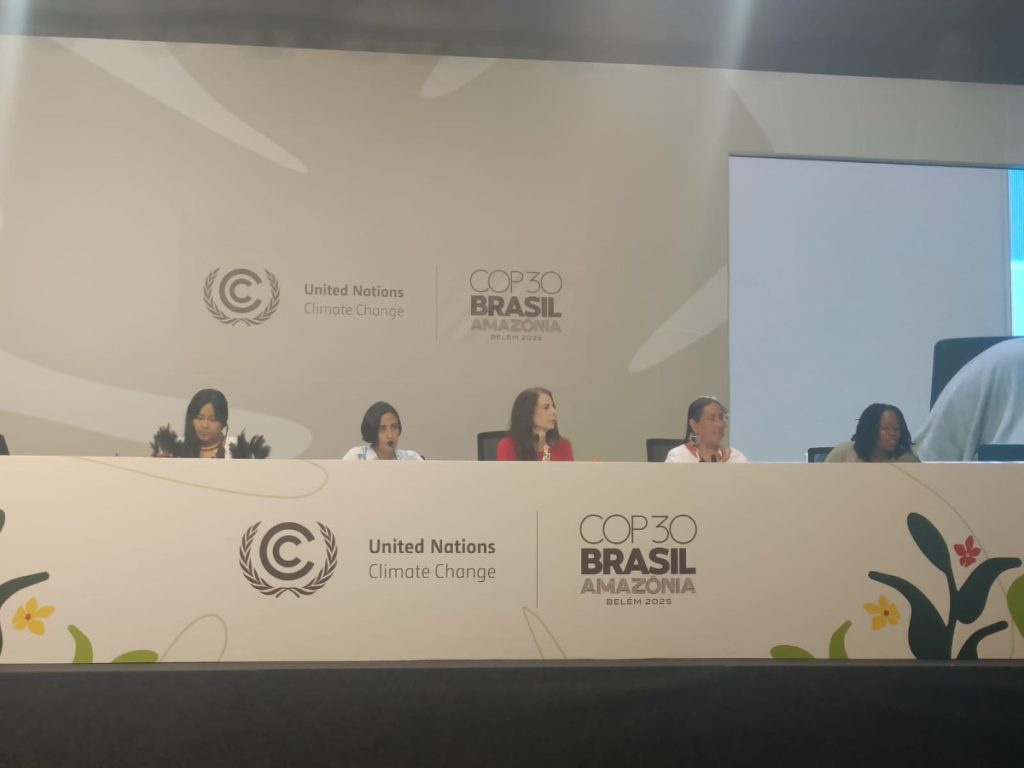
The Women's Earth and Climate Action Network's press conference on November 18 at COP30. Photo: The Wire.
Zukiswa White, gender advisor at the African Women’s Development and Communication Network of South Africa says, “We are done waiting, we are done being patient.”
White asks about convenient nomenclatures. “We must mine critical minerals, but who are they critical for? African women must have the right to ask this question,” she says.
Former Colombian environment minister Susana Muhamad says that the COP process is imperfect but that women need to unite with democratic governments nonetheless. “Our sisters in Palestine. The people in the frontline. I want to thank them,” she says.
Taily Terena of the Terena Nation of Pantanal in Brazil says that her territory is routinely in the top five of the world’s most dangerous places to be an indigenous rights activist. A man was shot and a woman – a teacher – was injured while defending their right to land, she says.
Then comes the actor, author and legendary activist Casey Camp-Horinek of the Ponca Nation. Casey played a leading role in the drafting and adoption of the first International Indigenous Women’s Treaty protecting the Rights of Nature. The Ponca Nation of Oklahoma in the US became the first tribe to pass a moratorium on fracking on tribal lands.
She turns to Terena and says, “Thank you for allowing us to come into your territory. This is not the UN’s territory. This is your territory.”
Casey, who acted in Avatar: The Last Airbender, has had it with the talks of finance at COP and the erasure of people.
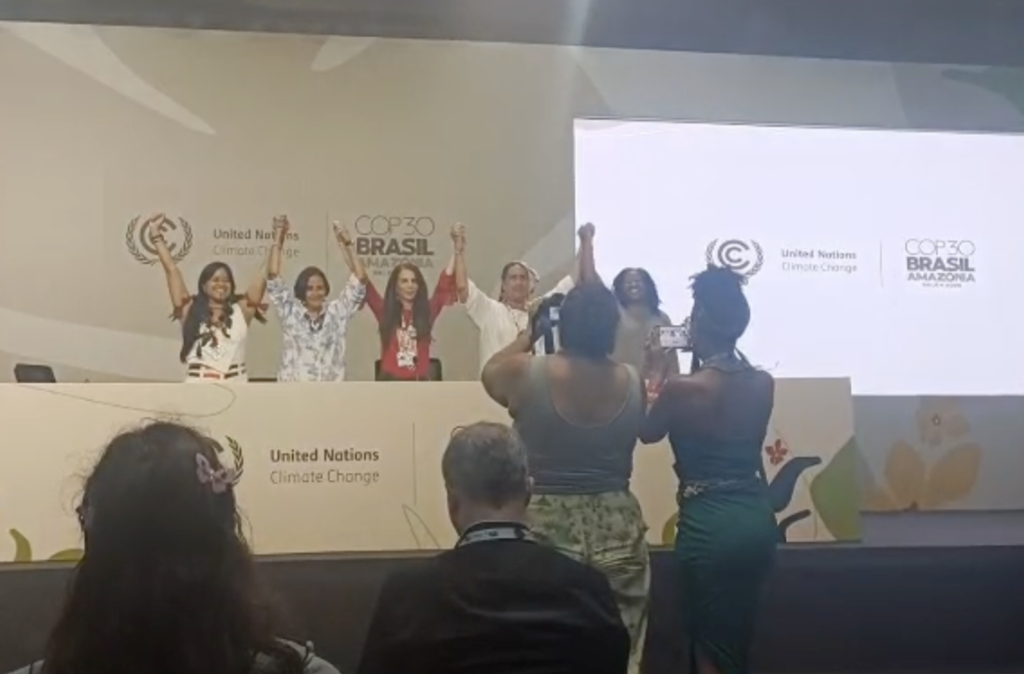
Taily Terena, Susana Muhamad, Osprey Orielle Lake Casey Camp-Horinek and Zukiswa White. Photo: The Wire.
“We thought we were coming to the indigenous people’s COPs and we thought we would be watching you making the decisions,” she says. Every word of her speech lands. The hall – almost half full now – is bristling.
The women stand up, arm in arm, and issue a battle cry. The audience stands up too and starts clapping. The hair on your arms stands on end.
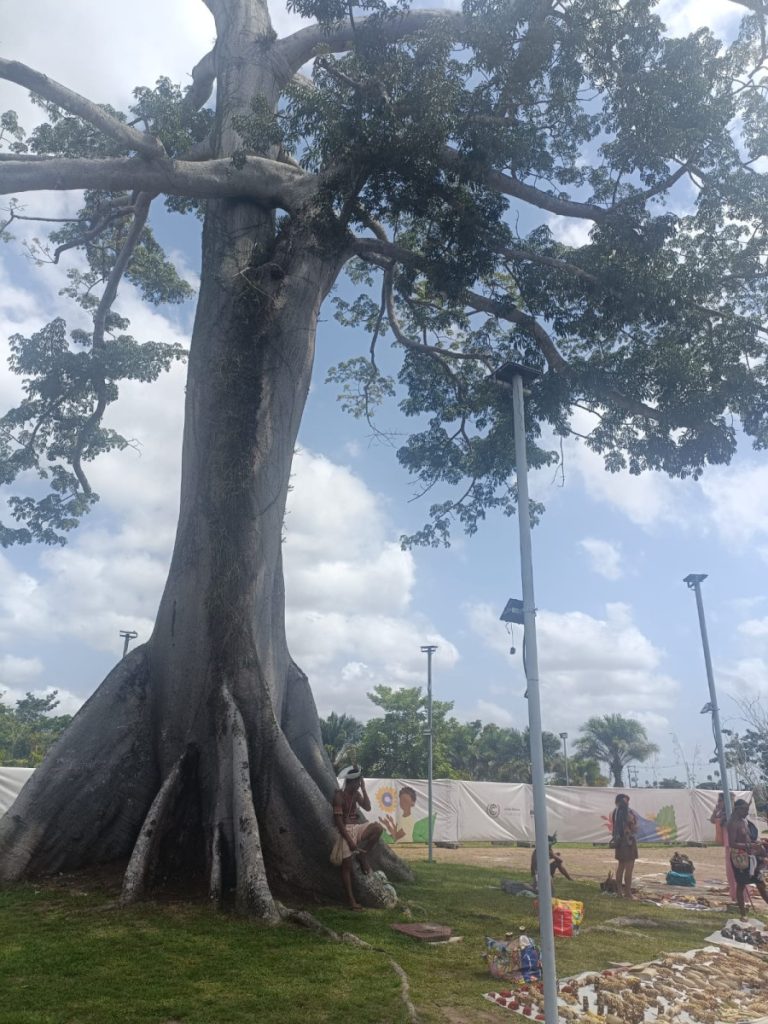
An indigenous person stands against a samauma tree at the COP30 venue. Photo: The Wire.
There is a long line at the China pavilion. The Azerbaijan pavilion is suspiciously closed. And there are snacks and drinks at the Ocean pavilion. In the middle of the Blue Zone, a man is speaking into a mic and beside him is a person in a dinosaur costume.
The sun sets against the samaúma tree at the COP courtyard, but for many negotiating teams, the day has just begun.
This article went live on November nineteenth, two thousand twenty five, at twenty-six minutes past four in the afternoon.The Wire is now on WhatsApp. Follow our channel for sharp analysis and opinions on the latest developments.


