

Cyclone Sitrang Skirts Bengal Coast, 9 Die in Bangladesh as Storm Wreaks Havoc


Kolkata: Nine people have died in Bangladesh, as Cyclone Sitrang skirted the West Bengal coast and made landfall near Barisal late on Monday, October 25, Bangladeshi media has reported.
Those who died include five women and two children, the Bangladesh daily Prothom Alo reports.
Sitrang made landfall between Tinkona island and Sandwip near Barisal in Bangladesh between 9.30 pm and 11.30 pm on Monday with a sustained wind speed of 80 to 90 kmph gusting to 100 kmph, the Regional Met Centre in Kolkata said.
🌀 Cyclone Sitrang: Heavy rain fall with gusty wind in costal belt of Bangladesh. pic.twitter.com/dWc7dH34UR
— Arif Rahman (@arshibly) October 24, 2022
There has been widespread damage of electricity lines and poles as a result of the heavy rain in south and southeastern parts of Bangladesh, local media reports.
"There is no special warning for any district [now]. Because Sitrang has now become weak," meteorologist Abul Kalam Mallik told the Bangladesh paper Daily Star.
Authorities in Bangladesh had evacuated hundreds of thousands of people on Monday before Cyclone Sitrang made landfall amid fears of heavy damage to houses and crops and disruption to road and power links.
Strong Cyclone "Sitrang" is approaching Bangladesh.
Nearly 3 cr. people in 19 districts are at risk. It's getting worst and all coastal areas have been asked to be alert. 🚨
May Allah protect everyone 🤲
Pray for Bangladesh 🇧🇩#CycloneSitrang | #PrayForBangladesh | #Bangladesh pic.twitter.com/f0DxzjHHVp— Fahim Bin Reza 🇧🇩 (@Fahimbinreza1) October 24, 2022
Enamur Rahman, the junior minister for disaster management, told Reuters that more than 7,000 cyclone shelters were set up to accommodate three million people.
Aid workers stockpiled emergency items such as food, tarpaulins and water purification tablets in refugee camps housing more than a million Rohingya in flimsy shelters in Cox's Bazar.
Officials had also advised nearly 33,000 Rohingya refugees, moved from camps to a flood-prone island in the Bay of Bengal, to stay indoors.
Heavy rain fell on the streets of the capital Dhaka, with some roads inundated with water, disrupting commuters.
Bengal
In West Bengal, the system, which moved towards Bangladesh from north Bay of Bengal at a speed of 56 kmph caused moderate to heavy rain and squally weather in West Bengal's coastal districts of South 24 Parganas, North 24 Parganas and Purba Medinipur.
It is likely to weaken into a depression and then into a low pressure by Tuesday evening.
Intermittent showers on Monday forced people to remain indoors in Kolkata and south Bengal.
The West Bengal government had advised people take necessary precautions in view of the weather forecast.
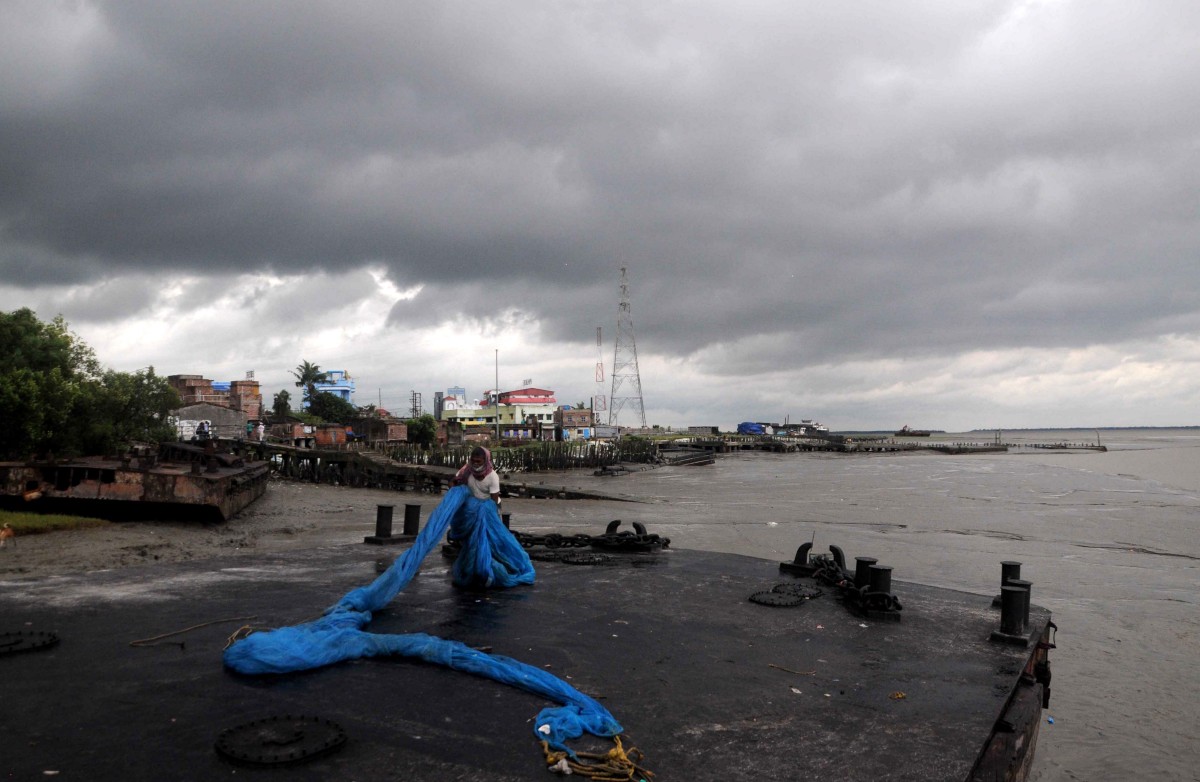
Dark clouds hover in the sky as a fisherman folds his fishing net, ahead of the landfall of Cyclone Sitrang, in South 24 Parganas district, Monday, Oct. 24, 2022. Photo: PTI
The two neighbouring countries have experienced increasing extreme weather in recent years causing large-scale damage. Environmentalists warn that climate change could lead to more disasters, especially in densely populated Bangladesh.
"2022 has seen climate emergencies such as floods and droughts impact countries on a scale that has never been witnessed before. The climate crisis is growing, and here in Bangladesh we feel its ferocity," said Farah Kabir, Bangladesh Country Director of ActionAid.
"When extreme weather events like Cyclone Sitrang strike, communities are left devastated. We urgently need access to funds that support communities living through the reality of the climate crisis.”
(With inputs from PTI and Reuters)
This article went live on October twenty-fifth, two thousand twenty two, at thirty-six minutes past eight in the morning.The Wire is now on WhatsApp. Follow our channel for sharp analysis and opinions on the latest developments.


