

Farm Fires Dip Sharply, Yet Delhi-NCR Chokes: Govt Tells Parliament


New Delhi: In a response to a starred question by Member of Parliament Charanjit Singh Channi, the Ministry of Environment, Forest and Climate Change (MoEFCC) said that from September 15 to November 30, 2025, Punjab recorded 5,114 farm fire incidents, while Haryana recorded 662.
Those figures represent a roughly 90% drop in stubble‑burning cases compared with 2022. (It is unclear why this figure was not reported on a yearly basis, though others were.) But while the government reports seeing in it a sign of significant progress in crop residue management and enforcement, it brings attention to the fact that the pollution problem in Delhi-NCR is not just a stubble-burning issue.
In the response in Parliament, the sharp dip in fire events has been credited to interventions by the central and state governments. Since 2018-19, over Rs 3120.16 crore has been released to Punjab and Haryana for crop‑residue management (CRM) machines. More than 2,60,000 CRM machines have been distributed to individual farmers and over 33,800 loan centres.
The Commission for Air Quality Management (CAQM) has mandated rent‑free availability of these machines for use by small and marginal farmers. Even brick kilns and thermal power plants outside the NCR are encourged to use paddy straw based biomass pellets or briquettes. These measures, listed by the government in its response, aim to reduce open burning and encourage alternative uses of agri-waste.
Also read: Delhi is Suffocating. So Is Its Political Consciousness.
However, the minister in charge, Bhupender Yadav, told Parliament that air pollution in Delhi‑NCR remains a “multifaceted” problem, with stubble burning an “episodic” aggravating factor. He cited vehicular emission, industrial pollutants, dust from construction sites and demolitions, waste burning, landfill fires and unfavourable meteorology as significant factors.
This marks the government acknowledging that the reduction in farm fires is not sufficient to ensure clean air in northern India, especially in urban centres and the capital and surrounding areas. It needs comprehensive efforts to tackle a variety of sources of emission, from industries to waste management and dust control.
The government also shared numbers – 200 “good days,” fewer “very poor” or “severe” days – in 2025. While this is technically accurate, it does not capture episodic crises, which are what most residents remember and experience when it comes to pollution. This data, which comes from official monitoring stations, provides averages over multiple sites rather than localised findings.
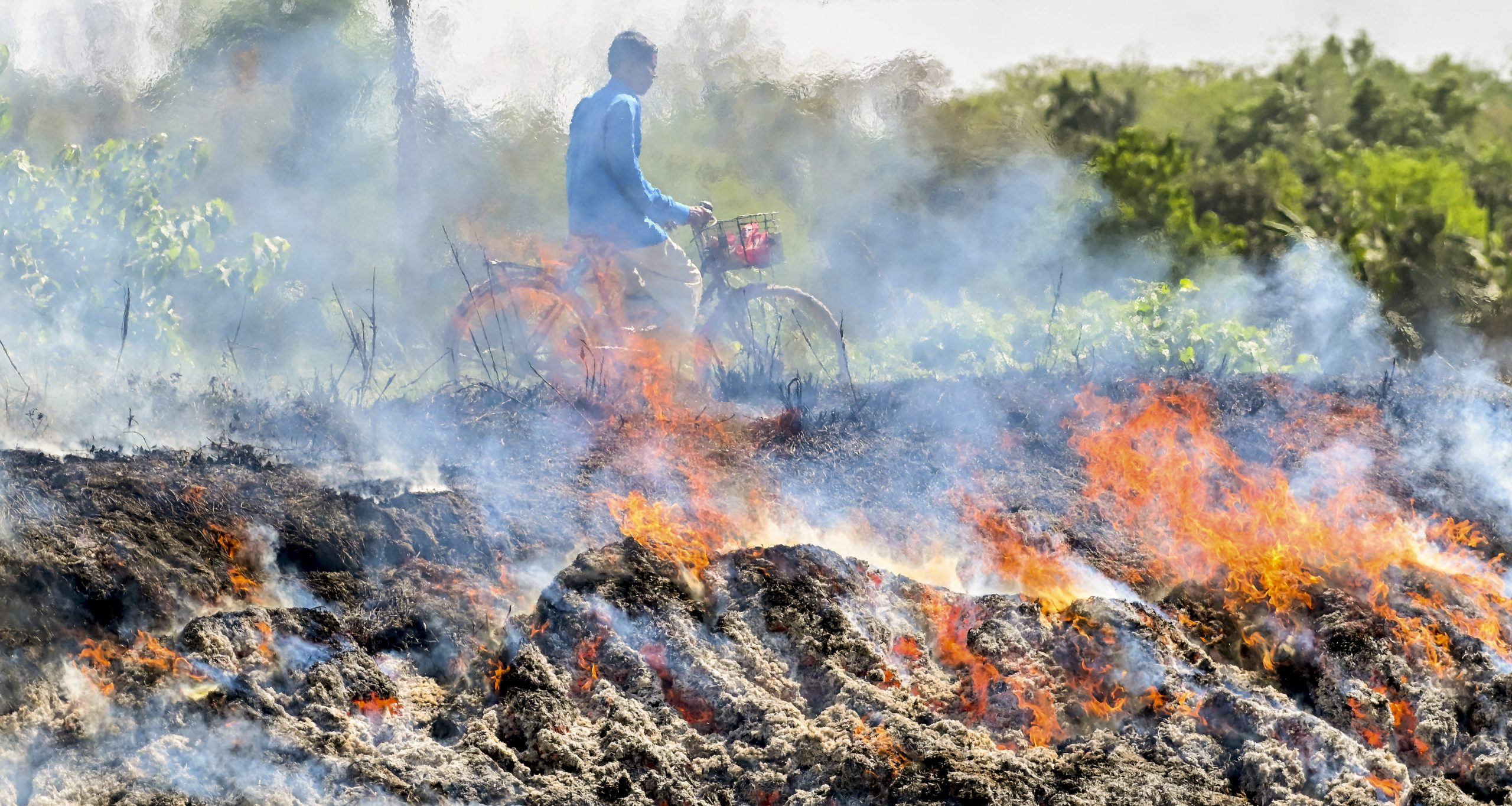
No more blaming farmers? Photo: PTI.
In other words, a single day can have wildly different AQI readings across neighborhoods. For instance, central Delhi might see “moderate” AQI, while roadside locations near traffic or construction may spike to “severe” – or even be outside the ambit of AQI monitors, as this Newslaundry report shows.
Delhi’s worst smog usually occurs in October-November, during paddy stubble burning, whereas the government’s statistics cover the whole year, not just the months after the monsoon. Therefore, full-year averages can show improvements over episodic high-pollution events.
Besides, wind direction and temperature changes, especially during winter months, can make shorter periods feel extremely polluted, even if AQI trends improve.
Also read: Toxic Air Caused 15% of Deaths in Delhi in 2023, Analysis Finds
The government says that severe days (AQI above 401) and very poor days (AQI 301 to 400) fell from 71 in 2024 to 50 in 2025 and that good days (AQI under 200) increased from 110 in 2016 to 200 in 2025. That could still mean that the AQI ranged between 201 to 300 (poor air quality) for many days, which the government does not refer to in the Lok Sabha response.
Some media houses, such as this Hindustan Times report, had found that the AQI had crossed 700-plus post-Diwali in Delhi, which means that the peaks, even if temporary, were even more severe than the AQI over 400 metric would ordinarily indicate.
A starred question in the Lok Sabha or Rajya Sabha implies that a minister would respond to it on the floor of the house (not just provide a written submission). Follow-up questions are also allowed.
This article went live on December second, two thousand twenty five, at thirty-four minutes past four in the afternoon.The Wire is now on WhatsApp. Follow our channel for sharp analysis and opinions on the latest developments.


