

From Chirgaon to Dharali: Greed, Governance and the Corporate Capture of the Himalayas


On August 11, 1997, the quiet valleys of Chirgaon in Himachal Pradesh turned into a nightmare as a cloudburst triggered massive floods and landslides, killing over 200 people. The tragedy was blamed on nature. But in truth, it was a man-made disaster – the result of reckless decisions, unsustainable development, a crisis fuelled by climate change, corporate-led exploitation of fragile mountain regions, and a continued disregard for scientific planning and local knowledge.
Now, in 2025, the devastation unfolds once again-first striking Himachal Pradesh with flash floods and landslides, and soon after sweeping into Uttarakhand, following the same tragic pattern of destruction we’ve seen before. Flash floods, landslides, cloudbursts – the symptoms are all too familiar. But so is the cause. Because this isn’t just a climate story. It’s a story of unchecked greed, a broken governance system, and the corporate commodification of the Himalayas – a fragile ecosystem being pushed to collapse under the weight of profit-first development.
What we have done in the hills
In the Himalayan hills, we have created a dangerous mix of development and neglect. First, we built roads near rivers, which naturally became focal points for small towns. Around these roads, schools, private clinics, shops, hotels, and homestays emerged, attracting people from surrounding villages in search of livelihoods, better education, and healthcare.
However, many of these towns developed either on floodplains or on unstable slopes-locations that are inherently unsafe in the fragile Himalayan terrain. Despite this, multi-storey buildings were allowed to be constructed, often without adequate regulation or geological assessment.
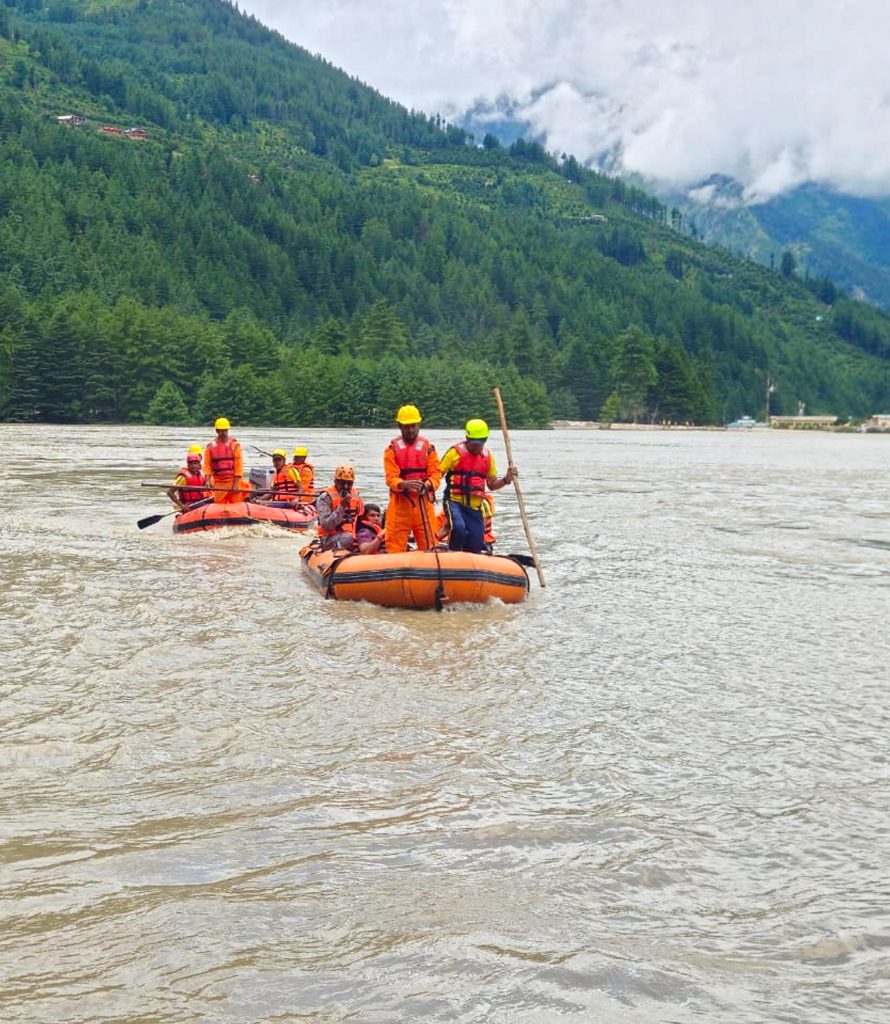
In this image posted by @15bnNdrf via X on Aug. 13, 2025, NDRF personnel and others are seen during an inspection at a disaster-hit area amid a search and rescue operation in the aftermath of the recent flash floods, at Dharali, in Uttarkashi district, Uttarakhand. Photo: Via PTI.
This pattern of growth, without understanding or respecting the landscape, has now shown its consequences.
Take the example of Dharali. The original village, located at a safer, higher elevation, remained unaffected. But the newer Dharali, which grew on alluvial fans of glacier-fed rivers, was devastated on August 5th, when water mixed with glacial slush followed its natural course and swept away hundreds of buildings.
So, who is to blame?
- The government, for permitting such development and often encouraging it without proper environmental safeguards?
- Or the people, who, though partially aware of the risks, settled in these areas due to lack of sustainable livelihood options, better facilities, or simply because they had no alternative?
In truth, we are all collectively responsible-people, government, and society. We failed to understand the land, ignored its warning signs, and prioritised short-term gain over long-term safety.
Human greed
Natural disasters don’t become deadly because of rainfall alone – they become disasters when we put people, infrastructure, and entire communities in harm’s way. And we keep doing it, not out of ignorance, but because of deliberate, profit-driven choices.
Since Chirgaon, the warnings have been relentless – from scientists, geologists, and environmentalists. Do not build on floodplains. Do not carve roads through unstable slopes. Do not dam every river for hydropower. Do not clear forests for hotels and highways. And yet, 28 years later, Chirgaon itself is twice as densely inhabited – with government buildings, homes, and a new bus stand standing on the very floodplain that was obliterated in 1997.
To the political class, ecological safety is an inconvenience. To corporations and developers, rivers and forests are just untapped real estate. And many of the public – thanks to the promises of short-term gains, jobs, and infrastructure – are sold the myth that this is "progress."
The government's role
Make no mistake: this crisis is not just about climate change. It is about political failure and bureaucratic complicity. Government after government – regardless of party – has actively enabled the destruction of the Himalayan environment. Under the pretence of “development,” entire mountains have been dynamited for roads, rivers choked by concrete, and fragile slopes stripped bare.
Hydropower projects like those in the Himachal and Uttarakhand are built without regard to slope stability, seismic activity, or downstream risk. Roads like the Char Dham highway, four lanes are carved through eco-sensitive zones with no cumulative environmental assessment. Forests are cleared for homestays and parking lots, and rivers are redirected into tunnels.
Environmental Impact Assessments (EIAs) are reduced to rubber-stamp processes. Community hearings are bypassed, manipulated, or entirely faked. Experts are ignored, silenced and Activists are branded as “anti-development.” The public is kept in the dark.
Meanwhile, disaster relief has become a ritual, performative and reactive. Bulldozers come out after the damage is done. Helicopters drop rations after homes are gone. But the actual prevention is starved of funding, ignored in budgets, and sidelined in policymaking.
This is not incompetence. This is policy by design, to serve corporate interests first, and people last. The Himalayas are no longer treated as ecosystems, they are treated as commodities to be bought, sold, and exploited, no matter the cost.
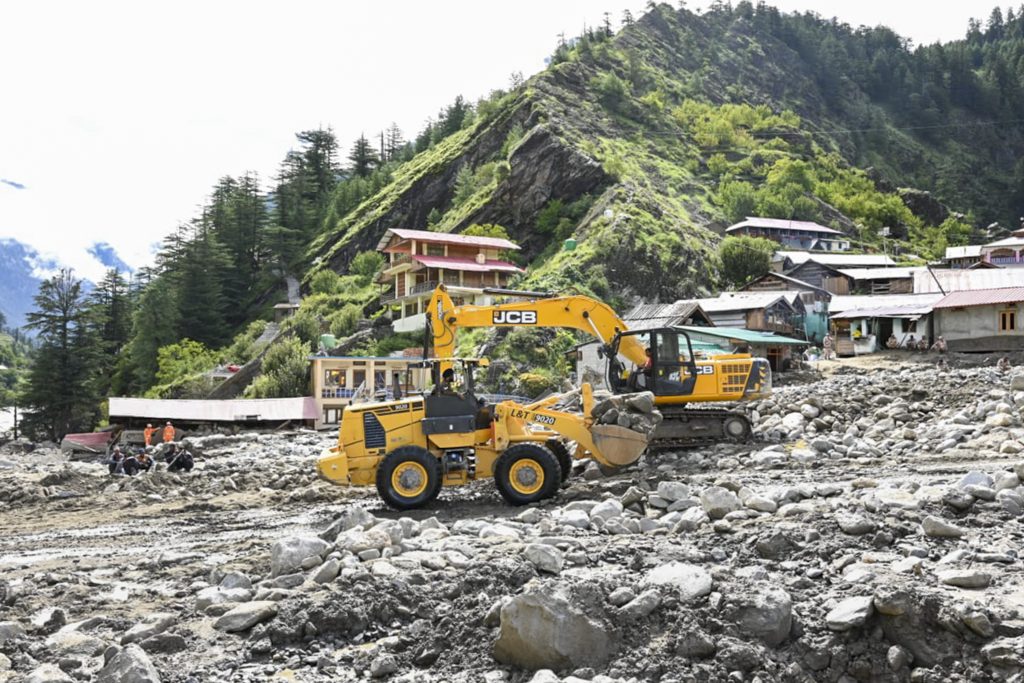
Search and rescue operation underway at the flood-hit Dharali, in Uttarkashi, Wednesday, Aug. 13, 2025. Photo: PTI.
Communities Caught in the Crossfire
And the people who live here? They’re the collateral damage.
Local voices are excluded from decision-making. When disaster strikes, their homes are swept away, their roads destroyed, their livelihoods shattered. And each time, the promises of "better planning" are repeated, only to be forgotten as soon as the headlines fade.
Community-based disaster preparedness is almost non-existent. Early warning systems are patchy at best. Watershed management programs gather dust. And even basic slope mapping is either outdated or ignored.
We must ask: Who benefits from this neglect? Certainly not the villagers in Chirgaon, Thunag or Dharali.
If the hills are not safe...
People often ask: "If the hills are unsafe, where should we move? Will that new place be any safer? Can we de-congest the urban areas? Can we regulate or ban high-rise buildings in vulnerable zones?"
These are not just questions, they are reflections of fear, helplessness, and also hope.
We must find answers rooted in local realities. In areas like Dharali, where settlements have grown in high-risk floodplains, relocation may be the only viable solution, no matter how painful. But in places like Thunag, where the natural risks are different, we could have created alternate water drainage routes or reinforced the slopes-solutions that are both preventive and cost-effective.
Above all, we must ask the most critical question: Does human life matter or not?
If the answer is yes-and it must be-then we need to make tough but necessary decisions. That includes identifying and relocating from high-risk zones, regulating or halting unsafe construction, planning better, and most importantly, respecting the landscape we live in.
Our search for alternatives should begin not with fear, but with a commitment: to protect life, to respect nature, and to rebuild smarter, not just bigger.
What needs to change
We already have the science, the policies, and the data. But knowledge means little when the system is built to ignore it. What’s lacking is political will, integrity, and the courage to put lives and ecosystems above short-term gains.
We need real action: a total ban on construction in high-risk zones, mandatory environmental impact assessments, community-led disaster planning, ecosystem restoration, and strict accountability for violations. Until these steps are enforced-not just proposed-disasters like Thunag and Dharali won’t be natural tragedies. They’ll be man-made crimes.
Dr. O.P. Bhuraita, a geomorphologist and social activist, has served in key roles including Research Associate at NISTADS, CSIR, Director of State Resource Centre, and currently works as a Consultant at WASH Institute, New Delhi.
This article went live on August eighteenth, two thousand twenty five, at twenty-two minutes past three in the afternoon.The Wire is now on WhatsApp. Follow our channel for sharp analysis and opinions on the latest developments.


