

In Uttarakhand, a Silver Jubilee of Lost Dreams


Uttarakhand completed 25 years of statehood on November 9, 2025. Despite officials' euphoric celebratory pronouncements, the mountain dwellers – the Paharis – who fought for the hill state find it hard to celebrate the occasion or feel any pride in it. The key aspiration behind the demand for a hill state was the right to self-manage resources and to ensure hill-centric, culturally and ecologically appropriate development. What they have received after state formation is the stark opposite. For them, it is a silver jubilee of governance failure and of an unprecedented extractivist and violative development programme that has threatened the very existence of their homes.
Ironically, in the new hill state, two large plains districts were included despite opposition. Consequently, the dream of a hill state was defied since the very beginning, as the development focus remained on the plains and the hills remained neglected. The Paharis had wanted Gairsain, a hill area approachable from both Garhwal and Kumaun, as their capital. But the ruling parties have not budged away from the comforts of the already developed Dehradun city. It is also a matter of dejection that no regional party has become politically powerful, and the national parties, like the BJP, despite its 15 years of rule, have failed to address local issues.
Also read: From Chirgaon to Dharali: Greed, Governance and the Corporate Capture of the Himalayas
The result of their governance is evident in the distressing state of education, health, employment, electricity and connectivity in the mountain villages, which has forced villagers to migrate away. Hundreds of these villages have become totally or substantially depopulated and are called ‘ghost villages’. Due to a shift in population density from the hill to the plains districts, there is fear that, in the next delimitation of assembly seats, unless geography is factored in, the hill seats will further decrease. This vicious circle of reduction of political clout and development funds for the hill districts, resulting in more out-migration and further reduction of Paharis’ political say, is a clear marker of the failure of the dream of a hill state.
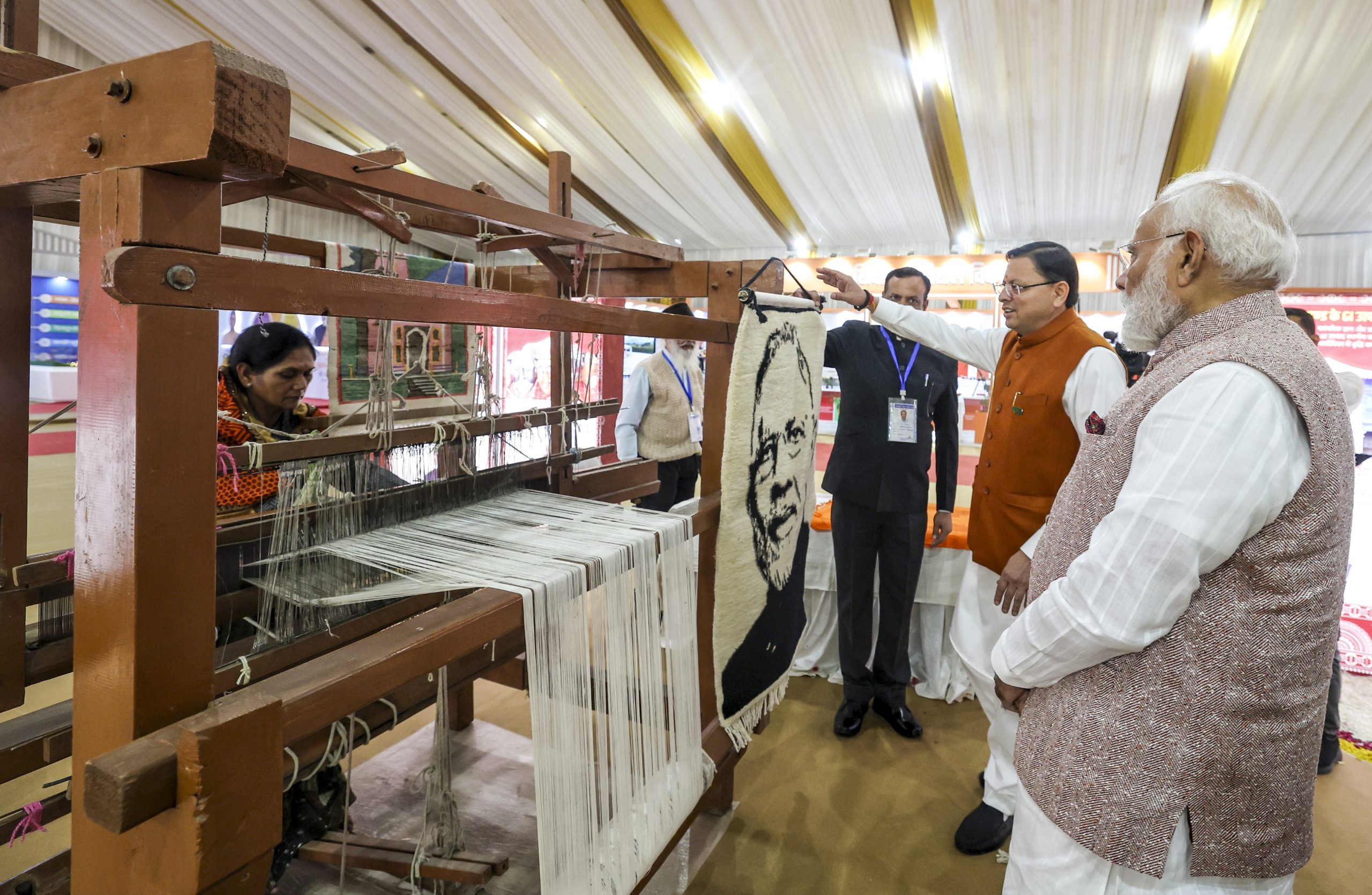
Prime Minister Narendra Modi, Uttarakhand Chief Minister Pushkar Singh Dhami and others during a walkthrough of different pavilions at an exhibition as part of an event on the occasion of 'Uttarakhand Formation Day, November 9, 2025, in Dehradun. Photo: PMO via PTI
Three recent incidents reveal the precarious and disturbing socio-political situation of the Paharis in their own state. In 2022, a 19-year-old Ankita Bhandari was murdered when she refused to provide sexual favours to a political leader. Ankita had taken the first step out of an interior hill village, in pursuit of becoming self-dependent, by joining as a receptionist at a resort owned by the son of a BJP leader. Her case highlights the lack of safe and satisfactory work avenues for more than three lakh unemployed youth in this small state. It also reveals the kind of tourism that is getting promoted in this devbhumi, which is one of the reasons that Uttarakhand is at the top in Himalayan states in crimes like rapes and child sexual abuse. It is a result of the absence of suitable education opportunities for the youth, who are not only facing the hopelessness of pervasive paper leaks, but also of the universities marred with corruption and irregularities.
In a second development, over the year 2022-2023, the historical Joshimath town sank, causing damage to more than 800 homes. Internationally known earlier for its Chipko movement, Uttarakhand now makes news due to such repeated disasters as the 2013 and 2021 floods and the 2025 Dharali-Tharali destruction. Massive deforestation, infringement of rivers, tunnelling and heavy use of explosives for a construction onslaught in the form of numerous hydropower projects, Char Dham road-widening project, railways and resorts, have made it a land of calamities. Despite repeated disasters, neither has the government halted the deadly infrastructure construction, nor has it provided rehabilitation to those falling prey to it.
Also read: The Quiet Exodus: On Vinod Kapri's 'Pyre'
In a third incident in July 2025, a popular Kumauni singer expressed that he would no longer be able to sing or see the beauty of the Himalayas untainted, as his younger sister and grandmother died suffering from mushroom poisoning in the higher Himalayas. The block and district hospitals failed to provide appropriate treatment, and an air-ambulance service could not be arranged to move them to a comparatively better health facility in the plains, more than ten hours away by road. Mountains witness such incidents daily, as the health facilities in the hills remain deplorable, and even the hospitals in the plains tend to refer the ‘difficult’ cases to Bareli or Delhi.
There are scores of other issues: absence of hill-specific agriculture policies, declining agriculture, increased human-animal conflicts, large-scale sale of land and massive land use change, drying up of water springs, irregular urbanisation, heavy work burden on women, attacks on Dalits, illegal mining, high liquor consumption and spread of drugs. Each is serious and needs political attention. However, in the last 5-6 years, the government's focus seems to be only on showcasing Uttarakhand as an investment and tourist hub and on establishing it as a model of Hindu majoritarianism. Manipulating the religiosity of the people, the government has pushed for all kinds of attacks on the minorities, be it the demolition of thousands of mazars, or the violence in Banbhoolpura, Haldwani. It has created an atmosphere of mistrust and fear by false accusations of half a dozen imaginary jihads, from thuk (spit), love and business to land. In addition, it has introduced such tools of intimidation as the Uniform Civil Code.
The aspiration of a hill state was not of disappearing rivers, crumbling or empty homes, closed schools, recruitment scams, pregnant women giving birth by the road and decreasing food self-sufficiency. It was an aspiration of a thriving hill ecology and economy, and a peaceful coexistence. The people of Uttarakhand have not forgotten their dream of a dignified life in the hills and continue to keep their spirit of dissent and solidarity alive in the wait for better times.
Shruti Jain is a researcher from Uttarakhand who currently works at the Institute of Development Studies in the United Kingdom.
This article went live on November twentieth, two thousand twenty five, at forty-nine minutes past eight in the morning.The Wire is now on WhatsApp. Follow our channel for sharp analysis and opinions on the latest developments.


