

India Could Witness Around 15,000 Heat-Related Deaths Due To 'Super' El Niño Over Next Six Months, Report Finds


Bengaluru: Extreme heat caused by the ongoing ‘Super’ El Niño could lead to an estimated 4,50,000 deaths worldwide in the first few months alone, according to a report published by the University of Chicago’s Climate Impact Lab on Wednesday (September 23). For India too, the figures are worrying: an estimated 15,000 deaths between just September and February. Nearly half those deaths will likely occur over just three months: December, January and February.
Experts who work on heat-related issues in India say the country should treat this as an important estimate and have urgent responses in place that go far and beyond mere heat alerts.
A Super El Niño that will claim lakhs of lives
A Super El Niño that will bring changes in weather and rainfall has gripped the world. Scientists are worried. On September 16, for instance, nearly 200 Indian ecologists published an open letter requesting fellow ecologists to strengthen monitoring data during the months to come so that the impacts of El Niño on ecological systems can be understood better. A few days before that, the UN’s World Meteorological Organisation announced that the El Niño is “firmly established and will intensify into a very strong event in the coming months, with big impacts on rainfall and temperature patterns and associated risks of floods, drought and extreme heat”.
Also read: Take Urgent Measures To Prep For ‘Super’ El Niño, Warn Nearly 200 Indian Ecologists
Scientists at the Climate Impact Lab at the University of Chicago, United States, estimated extreme heat-related deaths due to this year's Super El Niño. They analysed seasonal mortality projections using research from previous work that quantifies the relationship between temperature and excess mortality accounting for differences in local climate, vulnerability and adaptive capacity. They then applied this to the long-range forecasted temperature anomalies from European Centre for Medium-Range Weather Forecast’s data on sea ice and the resulting projected changes in temperature-related excess mortality compared to the 1996-2025 average.
Though the findings are not yet peer-reviewed, the results are alarming. The report predicts approximately 4,51,000 deaths worldwide during the first half of the El Niño period alone. This year’s El Niño is also a “postcard from our future,” bringing temperatures climate change is projected to deliver 20 years in the future, the report says.
“This report allows decision makers to see exactly where emergency actions can be taken now to save tens of thousands of lives in the coming months,” said Michael Greenstone, co-founder of the Climate Impact Lab and the Milton Friedman Distinguished Service Professor in Economics at the University of Chicago.
Around 15,000 deaths in India
As per the report, El Niño heat deaths are expected to be concentrated overwhelmingly in the Global South.
Over the next six months, the report projects an additional 66,800 deaths across the Sahel in Africa, with nearly half the fatalities emerging from Nigeria (31,400). Sudan will likely face 17,500 additional heat deaths, with Niger and Chad facing 10,000 and 8,000 heat-related deaths respectively. In South East Asia, the extra heat is expected to cause an additional 19,400 deaths in the Philippines, Vietnam, Thailand and Cambodia, with 19,300 deaths in Indonesia alone. In South America, Brazil is projected to be the worst impacted with 13,300 deaths from El Niño’s heat.
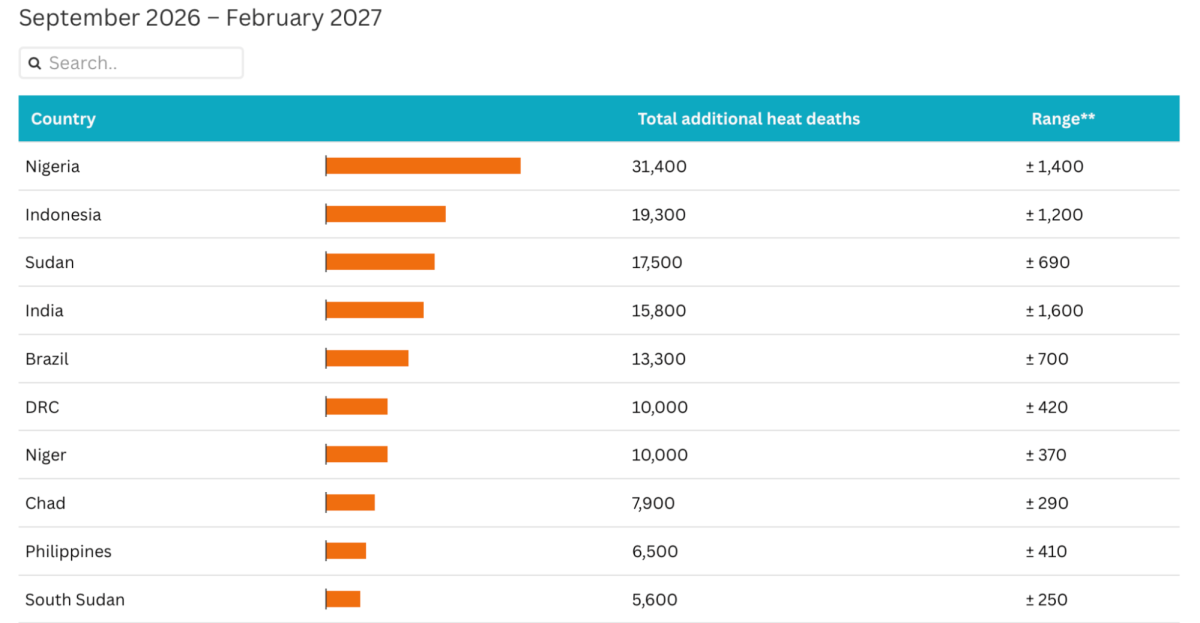
The top ten most-affected countries, in terms of heat-related deaths. India ranks fourth. Source: "451,000 at Risk: Where Action Can Save Lives During the Super El Niño," Climate Impact Lab, University of Chicago.
The extreme temperatures caused by the Super El Niño between September and February will likely cause an estimated 15,800 additional deaths in India alone. India will be the fourth hardest-hit country in this regard. Nearly half of those deaths (7,400) are likely to occur between the months of December and February.
Nearly 2,600 of the total 15,800 deaths will likely be concentrated in Maharashtra alone. West Bengal will likely witness around 1,500 additional heat-related deaths during this time as well. Furthermore, the report lists a predicted 1,600 deaths in Tamil Nadu, 1,000 in Odisha, 1,900 in Karnataka, 1,700 in Andhra Pradesh, 1,700 in Kerala and 1,100 in Telangana.
India should, therefore, treat this (the total heat-related deaths predicted for the country) as an important order-of-magnitude estimate, said Apekshita Varshney, Executive Director of HeatWatch, a group that works across India to build awareness, evidence and pressure for change on extreme heat.
“We lack robust, standardised training for district officials to identify and record heat-related illness and mortality, as well as an unbroken reporting chain from public and private hospitals through to district and state surveillance systems. Heat often aggravates underlying cardiac, respiratory and kidney conditions, so deaths are rarely recorded simply as ‘heat deaths’. Until surveillance, death certification and data-sharing improve, studies such as this offer some of the best available indication of the likely scale of this public-health crisis,” she told The Wire.
It is time that India started treating extreme heat as both a public-health emergency and an occupational and labour-rights crisis, she said.
Urgent measures need to be in place
“Informal workers – construction workers, street vendors, waste pickers, agricultural labourers, delivery workers and domestic workers – are among the most exposed and we have data to back it, yet they have the least control over when, where and how long they work. HeatWatch’s work shows that workers routinely continue in dangerous conditions because missing a day’s work can mean losing essential income. The response must therefore go beyond heat alerts,” said Varshney.
This includes enforceable heat-safety standards across formal, informal and platform work: paid rest breaks, shade, safe drinking water, cooling, first aid, flexible work hours, mandatory work stoppage or rescheduling during severe heat and strong inspection systems to ensure the measures are being implemented. Additionally, workers must be protected from wage penalties when heat makes work unsafe, and employers, contractors and platforms must be held accountable.
“At the same time, we need accessible cooling centres, reliable water and electricity, targeted support for low-income settlements, and district-level health systems prepared to identify, treat and record heat illness. This has to be implemented rapidly and urgently,” Varshney told The Wire.
This article went live on September twenty-fourth, two thousand twenty six, at thirty-seven minutes past eleven in the morning.The Wire is now on WhatsApp. Follow our channel for sharp analysis and opinions on the latest developments.


