

Latest Census Data 'Insufficient' to Draw Any Conclusions on Tiger Numbers, Say Experts


Kochi: Prime Minister Narendra Modi released the summary report on the status of tigers in India on April 9 at Mysuru in Karnataka. As per the report, there are at least 3,167 tigers in India currently, around 6% higher than the estimate of tiger numbers as per the last tiger census in 2018.
More analysis is underway: it is only a ‘summary’ report and the final report – which will have additional details of the methods used and analysis done – is yet to be released. Indeed, the current summary report does not provide enough information about its methods to provide meaningful insights into tiger numbers, scientists who have studied tigers and their populations told The Wire.
Though the report said that tigers have gone locally extinct in some areas, including Kanyakumari and Srivilliputhur in Tamil Nadu, the state forest officials have disputed this. The report also mentioned that disturbances such as linear infrastructure (e.g. roads) and dams could be affecting tigers in some parts of their range.
Meanwhile, the disturbance caused by the repeated movement of the PM’s security teams on the safari route prior to his visit to Bandipur Tiger Reserve is possibly why Modi did not get to sight a tiger on the morning of April 9, senior forest officials at Bandipur said. They came out in defence of the driver of the PM’s safari vehicle, who, as per news reports, has been blamed by the Bharatiya Janata Party (BJP) for the PM missing a tiger sighting during his safari.
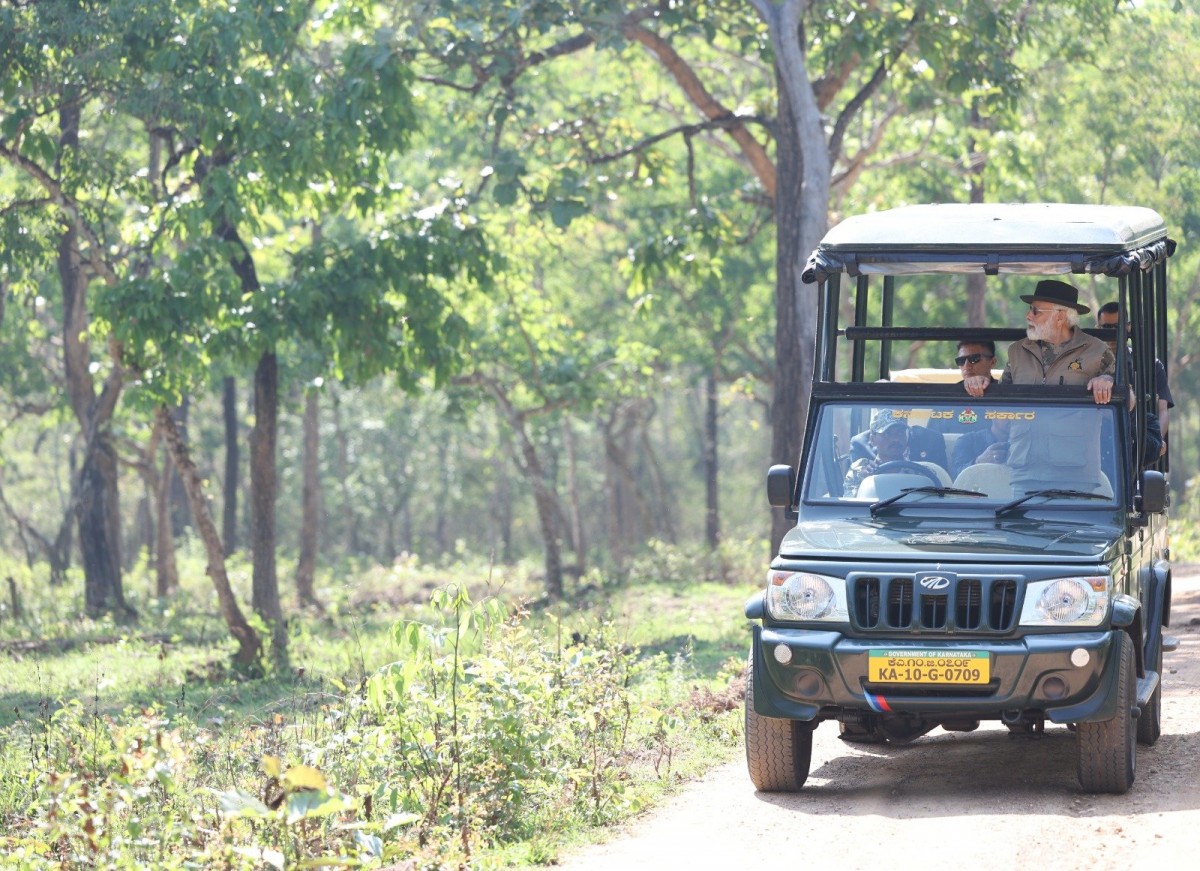
Prime Minister Narendra Modi at Bandipur Tiger Reserve in Karnataka on April 9, 2023. Photo: Twitter/@narendramodi
‘Minimum numbers’
As per the summary report released on April 9 – authored by scientists at the Wildlife Institute of India (WII) who analyse India’s tiger numbers – India is currently home to at least 3,167 tigers. This figure, per the report, is a minimum number – which is the number of unique individuals captured by camera trap photographs used for the survey – and not a final estimate.
Scientists arrive at the final estimate by taking into account several aspects such as human presence and prey availability in their analytical methods to arrive at estimates of tiger density. The last tiger census in 2018 pegged the final estimate to be 2,987.
The current report of at least 3,167 tigers in India is around 6% higher than the estimate as per the last tiger census. Some areas such as the Shivalik and Gangetic floodplains have recorded a “substantial” increase in minimum tiger populations, said the summary report. However, tiger occupancy in the Western Ghats landscape has declined. The latest survey photographed only 824 unique tigers here when compared to an estimate of 981 as per the 2018 census.
Also read: India's Tiger Population Rises to 3,167, Reveals Latest Census Data
The report highlighted the impacts of linear infrastructure in some tiger habitats in the country. The corridor between the western and eastern part of the Rajaji tiger reserve in Uttarakhand, for instance, has witnessed linear infrastructure projects since 2018 mostly under the Haridwar and Rishikesh ring road project, it noted.
"Expansion of road in this section leaves this corridor functionally extinct for large carnivore and elephant movement," it pointed out.
The “rapid development of linear infrastructures and several hydro-electric projects” in the northeastern hills landscape could “potentially disturb the exiting [sic] corridors and natural habitats and further alter the genepool”.
Incidentally, the Union environment ministry's forest advisory committee denied a forest clearance to the 3,097-megawatt Etalin hydroelectric project in Dibang Valley in Arunachal Pradesh only around four months ago. One of the many problems that scientists had pointed out in the WII’s technical report on the wildlife conservation plan for the Etalin project was that it had not taken into account research that shows that tigers were widespread across the Dibang valley.
Local extinctions
Local extinctions of tiger populations have also occurred in some areas, per the summary report. These include Sri Venkateshwara National Park (Andhra Pradesh), Kawal TR (Telangana), Satkosia TR in Odisha, Sahyadri TR (Maharashtra), Sirsi (in northern Karnataka), Kanyakumari and Srivilliputhur.
Kanyakumari and Srivilliputhur are tiger habitats in Tamil Nadu. The Kalakkad Mundanthurai tiger reserve (KMTR), the second largest protected area in the state, is spread across the southern districts of Tirunelveli and Kanyakumari. The Srivilliputhur-Meghamalai tiger reserve (SMTR) is spread across four districts just north of KMTR and was designated as a tiger reserve in 2021. It is contiguous with KMTR, the Anamalai Tiger Reserve in Tamil Nadu and Periyar Tiger Reserve in Kerala. As per some reports, forest officials have sighted tigers several times at the Suruli waterfalls, which lies near the tiger reserve.
The Tamil Nadu forest department has, meanwhile, disputed the report’s claim that tigers are locally extinct in these areas. SMTR deputy field director H. Dileep Kumar told The New Indian Express that they had recorded tiger presence in three of the four ranges in the reserve before and after the census survey period. If camera traps laid during the census months of May and June in 2022 did not capture photos of tigers, it doesn’t mean that tigers have gone locally extinct in the area, he told TNIE. Tigers could have migrated to the adjoining Periyar Tiger Reserve in Kerala, the official said.
Forest officials in Telangana also told TNIE that the extinction of tigers in the Kawal tiger reserve in the state meant that the survey did not find resident or breeding tigers in the core area of the reserve. This could be because the individuals may have migrated out of the reserve during this time, they said.
‘Too little information’
Experts who have studied tigers across India – including tracking changes in tiger populations and numbers over time – admitted that the report contains too little information to provide detailed comments.
One said that the report is “a little too sparse in detail to make any meaningful comments”. The report provides only minimum numbers rather than an estimate, so it is possible that the final report, if released, will likely contain a revised number, said the tiger biologist who did not wish to be named since he was commenting only on the summary report and not the final one. Therefore, 3,167 “is likely to be the lower bound of the estimation”, he told The Wire.
“There is insufficient detail in the current descriptions of occupancy declines to comment. However, as they reported, this is likely a significant shift from the last time (maybe too significant to ignore),” he added.
The report shows an increase in survey effort (with 5,750 additional cameras being used) and in most likelihood, new sites too may have been sampled – though that is unclear from this report, he said. “It is difficult to comment on the new estimate without details on how they were accounted for in the final analysis.”
Similarly, statistical ecologist Arjun Gopalaswamy said he has only a few comments because this is only a summary and “an incomplete report”.
By and large, the same extrapolation methods as used earlier are being applied to estimate tiger abundance over large landscapes, Gopalaswamy told The Wire.
“Since these estimates come from what scientists refer to as 'model-based inferences', model uncertainties, which have proven to be large in the past, imply that such approaches can produce a wide range of numbers,” he commented.
Gopalaswamy and scientists including Ullas Karanth have questioned the consistency of some of these methods, while scientists at the Wildlife Institute of India who conduct the statistical analysis have defended them.
The report has also not used any of the new approaches that are now available for advanced population monitoring and statistical technologies, Gopalaswamy noted.
Without looking at the data and analysis, he can't react, said tiger biologist Ullas Karanth, emeritus director of the Centre for Wildlife Studies.
“But because of [the] flawed approach they have stuck to, I do not lend credence to any of these country wide numbers. They reported 3,642 tigers in 2002, brought it down to 1,411 in 2006 and now it is set at [a] minimum of 3,167,” he told The Wire.
No tiger spotted
Meanwhile, the PM missed sighting a tiger on his safari at the Bandipur Tiger Reserve, which he visited just before he released the tiger census minimum numbers at Mysuru on April 9. Members of the BJP placed the blame for this on the driver of Modi’s safari vehicle, as per The Independent.
However, Bandipur’s senior forest officials alleged that the repeated movement of the PM’s security staff and other security forces on the same route for five days before the PM’s safari had possibly deterred tigers from using the area.
Madhusudhan, who drove the PM’s safari vehicle, told the TNIE that when he conducted trial runs for the security teams on Friday and Saturday, two tigers were sighted.
This article went live on April seventeenth, two thousand twenty three, at sixteen minutes past nine at night.The Wire is now on WhatsApp. Follow our channel for sharp analysis and opinions on the latest developments.


