

Riverbeds of Power: Inside the Unstoppable Nexus Ruling West Bengal’s Sand Mines


Bolpur: A late-night operation by West Bengal’s Special Task Force (STF) has once again exposed the deep political and financial machinery behind the state’s booming illegal sand trade. On November 17, the Special Task Force (STF) stopped an SUV and recovered Rs 5 crore in cash, allegedly part of a routine money-delivery chain that moves illicit profits from Birbhum’s sand trade to powerful quarters in the state capital.
The STF has since traced the trail back to a sophisticated extortion system involving overloaded sand and stone trucks, as well as illegal tolls collected in the name of Delivery Challan Receipts (DCR). According to investigators, this underground revenue system funnels crores “upwards”, aided by political protection and administrative silence.
In early November, the Enforcement Directorate (ED) arrested Kolkata-based businessman Arun Saraf, promoter of G.D. Mining Private Limited, in connection with an alleged illegal sand mining and transportation racket involving forged road e-challans. According to the agency, Saraf operated a large-scale smuggling network using a front company to camouflage illicit riverbed extraction. While he officially declared sand sales worth Rs 103 crore, investigators traced Rs 130 crore flowing into his accounts.
The ED alleges that the company generated fake QR-coded e-challans to legitimise sand lifted directly from rivers, and that between 2024 and 2025, Rs 60 crore remained unaccounted for. Saraf ignored one of three summonses and was taken into custody when he finally appeared.
Saraf’s influence extends beyond the sand trade. He is also the chief promoter of Abhinna Mining, part of the consortium awarded the contract for basalt extraction in the Deucha-Pachami coal mining project. Environmental groups and opposition parties, including the Communist Party of India (Marxist) and the Congress, have long alleged legal and financial irregularities in the project, questioning the transparency of the tendering process and the credibility of the venture itself.
G.D. Mining also owns G.D. Sports Ventures, the entity that manages the Harbour Diamonds cricket team. Former India cricketer and current Trinamool Congress Minister of State for Sports and Youth Affairs, Manoj Tiwary, is associated with the team.
Also read: SC Asks Centre, CBI, and Five States to Respond to Plea Against Illegal Sand Mining
The recent arrests have renewed scrutiny of West Bengal’s sand sector, which political observers say has become a decisive lever in grassroots electoral mobilisation since 2016.
For decades, river sand has been the backbone of Bengal’s construction boom. But prices exploded after 2013.
A state Public Works Department engineer, speaking anonymously citing safety concerns, clarified the sudden unexplained inflation: “In construction terms, four tonnes equal 100 CFT of sand. Until 2011, a tractor-load of 100 CFT cost Rs 900-1,100. But from 2013 onwards, the price suddenly jumped to Rs 4,200-5,000 for the same amount. Construction costs rose sharply, yet there’s no economic reason for such a steep hike.”
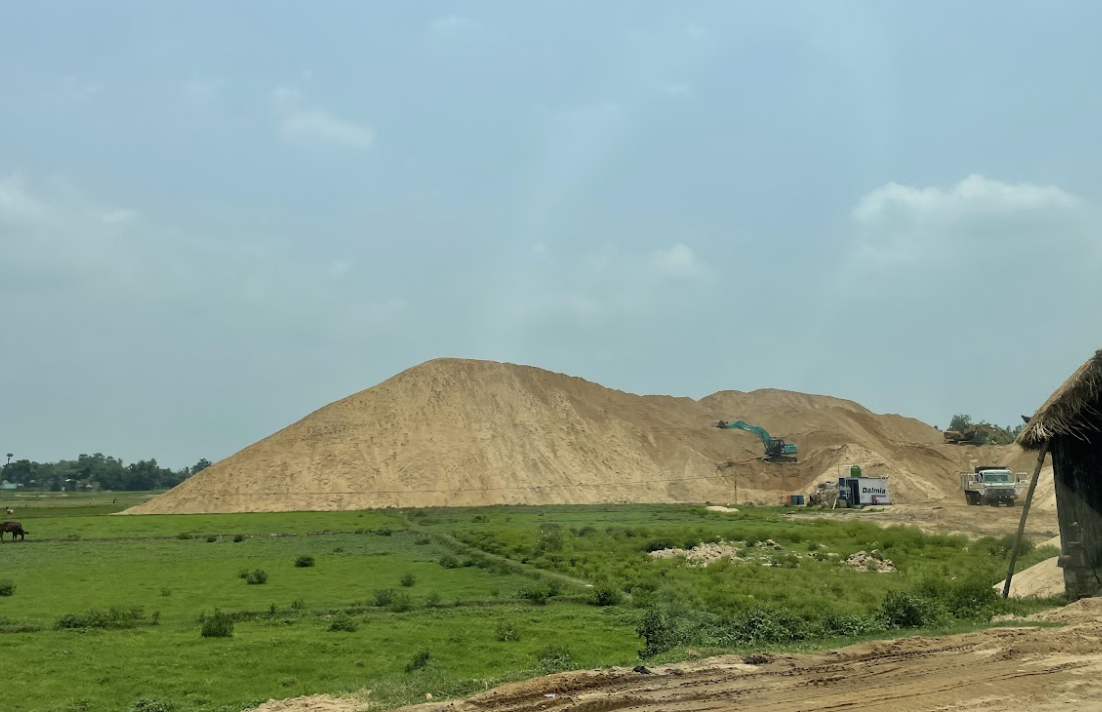
STF investigations have revealed that cash from overloaded sand and stone trucks and fake or forged delivery challan receipts is being funnelled to powerful figures in Kolkata, with arrested suspects under questioning. Photo: Joydeep Sarkar.
Behind the statistics lie the environmental costs. Across villages, riverbeds are gouged open by mechanical suction pumps that dig 70 to 150 feet below natural levels. Tractors and trucks carve temporary ramps into fragile embankments, loosening the soil and priming them for collapse.
In North Bengal, farmer Mrinal Roy pointed to a breached Jaldhaka river embankment, saying, “The trucks climb the same spot all day. The soil weakens. One flood and the whole wall collapses.”
Illegal mining of sand, gravel and pebbles is rampant across all of North Bengal’s river systems, drastically altering river flow, accelerating erosion and flood risk and destroying farm fertility. This was evident during recent floods in the region, which breached embankments and wreaked devastation downstream. Despite the escalating human and ecological toll, these operations persist, largely tolerated because the entire value chain, including the government, profits from the construction-driven demand.
“The normal course of the river is being disturbed by sand being lifted at various points in the riverbed, creating pits and obstructing the river’s natural flow. This is affecting the ecosystem. Sand can certainly be lifted, but the government should discuss with river researchers first,” said Maloy Majumdar of Visva Bharati University.
The story repeats across South Dinajpur, Malda and Birbhum, where farmers watch helplessly as farmland is increasingly converted into makeshift sand depots.
Also read: The Critical Gaps in West Bengal's Sand Mining Reforms
The mafia’s staying power comes from the cunning strategy of weaponising poverty. Poor villagers are hired as diggers, machine operators, loaders, guards and night informers, earning Rs 1,000 - 1,500 a day, far more than farm wages. This income binds them to the trade, creating a dependent workforce that is then deployed during elections.
The threat, “If the ruling party loses, the quarry shuts down and your income ends,” locals report, is what dictates the voting behaviour of entire blocks.
“On the one hand, they are using poor people to loot sand and on the other, turning those same poor into attackers and using them for their own interests,” alleged veteran CPI(M) leader Amal Halder.
The sheer scale and impunity of the trade have turned Birbhum into the epicentre of West Bengal’s illegal sand economy. Since 2017, the district has witnessed a string of sand-linked bloodletting, from a crude bomb and gun battle between sand mafia linked to the Trinamool Congress (TMC) over the control of riverbeds, to the 2022 Bogtui killings, in which the Central Bureau of Investigation tied key accused to sand rackets and a 2025 clash between factions aligned to rival groups of the ruling party over control of an illegal ghat or riverbank.
The demand is driven by the Ajay river’s exceptionally prized sand, which is coarse and clay-free, enabling a booming industry on both sides of the river.
This high-value, unregulated business is sustained by political complicity. Locals allege that leaders from both the ruling party and the main opposition quietly share the spoils.
In response to years of controversy, the state government introduced a new sand quarry policy in July 2021. The State Mineral Development Corporation claims that royalty and cess from sand extraction and transport soared from around Rs 100 crore annually to more than Rs 400 crore in 2022-23.
Officials say auctioning quarries, shifting permits online, generating more than 27 lakh e-challans and digitising inter-state transport by rail and road have helped curb illegal smuggling. The government projects over Rs 1,100 crore in revenue over the next five years from auctioning more than a hundred quarries across 1,154 hectares.
On the ground, however, “sand loot” continues almost unabated, according to traders, local residents and even some ruling party insiders. Operators like Saraf, who allegedly moved sand worth Rs 130 crore, are said to distribute around 10% “down the chain” to secure silence at the lowest levels.
Smaller traders say they have been squeezed from both sides by the state and by big capital.
Also read: Sand Mining and Road Work Threaten World Heritage Site at Hampi
“The government has brought in big businessmen from outside the state. We, small traders, were being questioned again and again over sand lifting. Now big parties will use heavy machines to lift sand and send it by train to sell outside. Isn’t that also wrong?” complained Nasir Sheikh, a local-level Trinamool Congress leader from Bolpur and a sand trader.
The government maintains that the new policy will break the sand mafia’s grip. But those directly involved in the “illegal” trade say they are merely adjusting to the new rules. With e-auctions in place, they now strike “verbal deals” with leaseholders. Sand extracted beyond the demarcated area is split 60:40, with the larger share going to the leaseholder and the rest to illegal operators.
“We don’t gain anything by knowing where the auction happened,” another trader said. “Business has to be done at the local level anyway. Coal auctions are also central – has that stopped anything? Big companies may pay more money ‘upstairs’, but at the bottom, we handle votes and everything else.”
Despite the state projecting a tough law-and-order posture, in Birbhum, police statistics tell their own story. In 2023, the district registered 245 illegal sand theft cases, with 254 arrests and 443 seized vehicles. By the end of September 2025, those figures surged to 928 cases, 727 arrests and 1,506 seized sand-laden vehicles.
“Rows upon rows of sand-laden trucks are entering from Birbhum; they are collecting nine or ten thousand rupees per truck. If there are sixteen sand ghats in the district, only two or three are shown on official papers. It is not easy to understand the scale of sand loot!” admitted Humayun Leader, a controversial and outspoken MLA of the Trinamool Congress.
Yet district police sources acknowledge that in almost none of these cases have offenders faced serious punishment. Most secure bail and return to business. As confusion persists over who truly controls the quarries, the cycle of illegal extraction and social coercion continues, ensuring that the riverbeds of Bengal remain the most lawless and profitable ground in the state.
Translated from Bangla by Aparna Bhattacharya.
This article went live on December eighth, two thousand twenty five, at zero minutes past seven in the morning.The Wire is now on WhatsApp. Follow our channel for sharp analysis and opinions on the latest developments.


