

Seven Years of Clean Air Promises and Rs 12,000 Crore Later, India Is Still Eating Dust


Panjim: Seven years and thousands of crores in taxpayers’ money spent, the government’s National Clean Air Programme (NCAP) is yet to deliver cleaner air in most of the cities it was designed to help, a recent analysis has found.
An assessment conducted by Manoj Kumar from the Centre for Research on Energy and Clean Air (CREA) compares PM10 (particulate matter 10) levels to three different financial years and shows that while levels of particulate matter fell in some cities, they rose in others.
The analysis, released on October 25, also flags several shortcomings in the programme, including missed targets and an uneven distribution of funding. It also points to discrepancies between figures cited in government responses and official releases and those calculated from data on the Portal for Regulation of Air Pollution in Non-Attainment Cities (PRANA).
What is PM10 and PM2.5?
According to this research paper, PM10 is an air pollutant made up of tiny solid and liquid particles suspended in the air. These particles are 10 micrometres or less in diameter and small enough to be inhaled into the respiratory system. PM10 can include dust from roads and construction sites, as well as particles from industries and vehicle emissions.
Also read: National Clean Air Programme Flounders, 2026 Target Unlikely to Be Met
PM2.5 refers to even finer particles, measuring 2.5 micrometres or less in diameter. They can penetrate deeper into the lungs and enter the bloodstream.
A study published in The Lancet Planetary Health, an independent medical journal, estimated that exposure to PM2.5 was responsible for 3.8 million deaths in India between 2009 and 2019, equivalent to 5% of all deaths, when assessed against Indian air quality standards.
India’s flagship clean air programme
In 2019, the Union government launched the NCAP to tackle persistent air pollution in 131 ‘non-attainment cities’ – cities that had repeatedly failed to meet the prescribed limits set by the National Ambient Air Quality Standards (NAAQS) for major air pollutants such as PM10 and PM2.5.
The programme initially set a goal of cutting PM10 concentrations by 20–30% by 2024–25, using 2017–18 as the baseline. In 2023, the government raised this ambition, setting a revised target of achieving up to a 40% reduction in PM10 levels or bringing annual concentrations within the national standard of 60 micrograms per cubic metre (µg/m³) by the end of 2025-26.
Kumar, an analyst with CREA analysed 130 NCAP cities for three financial years: 2017-18, the original baseline; 2019-20, the programme’s inception year; and 2025-26, the end of the extended programme period. He used data from PRANA as well as responses provided by the environment ministry in parliament.
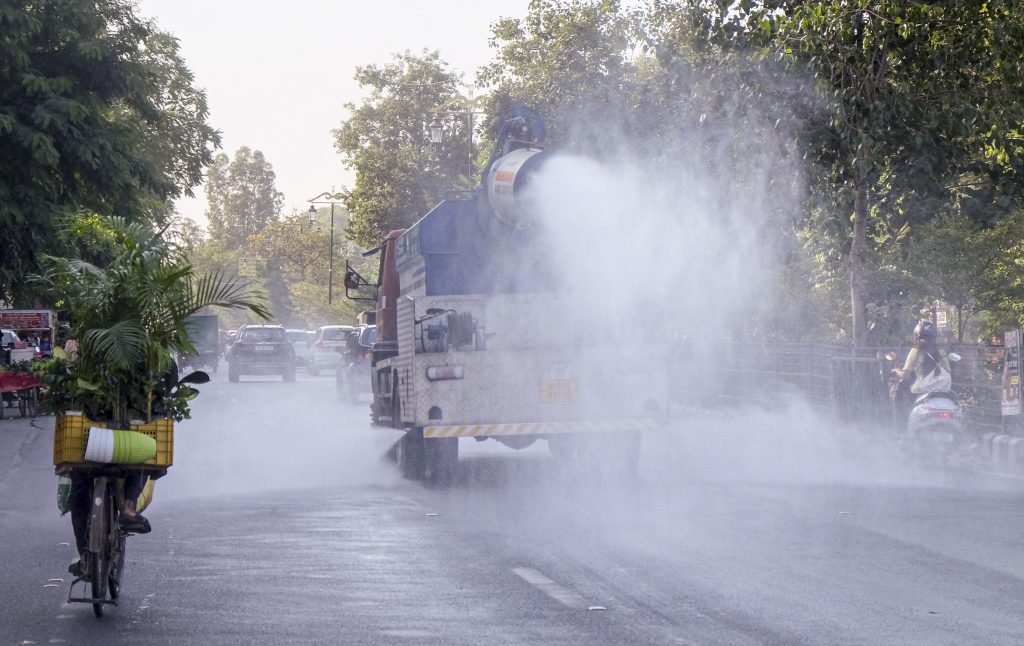
An anti-smog gun at work in Gurugram, Haryana, on October 6, 2026. Photo: PTI.
NCAP cities still exceed the PM10 standard
CREA’s analysis published this week highlights several concerns regarding the implementation and efficiency of NCAP so far.
Firstly, at the end of NCAP's extended implementation period (2025-26 financial year) 117 of the 130 cities assessed, that’s 90% in total, had annual PM10 concentrations above India’s national standard of 60µg/m³.
Before NCAP began, 125 cities exceeded the national limit. This number fell to 112 in 2019-20 but climbed to 117 by 2025-26, reversing some of the early progress. After seven years of the programme, the number of cities exceeding the pollution limit was only eight lower than before NCAP began and even now, most of the cities assessed continue to exceed the prescribed limit.
Secondly, in April 2023, officials revised the 20-30% reduction target to a 40% reduction and extended the programme’s deadline to 2025-26. Today, very few cities have achieved the revised NCAP target.
Compared with the baseline year of 2017-18, PM10 pollution fell by more than 40% in 21 cities and by more than 30% in 44 cities. But when compared with 2019-20, the numbers were much lower: only eight cities recorded a drop of more than 40%, while 25 saw a reduction of more than 30%.
The Wire previously reported that NCAP fell 465 stations short of its target to establish 1,500 manual air quality monitoring stations across the country by 2024. The shortfall remains the same today.
There have also been gaps in the installation of Continuous Ambient Air Quality Monitoring Stations (CAAQMS). Of the 130 cities covered under NCAP, only 102 had installed these stations at the time of the earlier report. The number has since increased to 113 cities.
Compared with 2019-20, pollution rose in 43 cities
Compared with 2017-18, PM10 pollution levels fell in 105 of the 130 cities assessed but the extent of the improvement varied. In 17 cities, pollution fell by up to 10%, while 44 cities recorded reductions of between 10% and 30%. Another 23 cities saw reductions of between 30% and 40%, and 21 recorded drops of more than 40%. Pollution levels remained unchanged in two cities and increased in 23 others.
This looked less promising when cities were compared with 2019-20. While pollution levels fell in 84 cities, the reductions were smaller in many cases. Only eight cities recorded a drop of more than 40%, while 43 cities saw pollution levels rise. In three cities, levels remained the same.
The comparison with 2019-20 is important because it shows whether cities have improved since NCAP began. Compared with 2017-18, pollution levels increased in 23 cities but compared with 2019-20, the number rose to 43. So essentially, more cities had higher pollution levels in 2025-26 than they did in 2019-20, the year after NCAP began.
Despite Rs 12,087 crore spent, pollution rose in several cities
The analysis also found “uneven” pollution outcomes despite Rs 16,824 crore being released under the NCAP fund. Of this amount, only Rs 12,087 crore, that’s about 72% of the amount released, has been spent. More importantly, spending money has not always translated into cleaner air.
Several cities recorded higher PM10 pollution levels despite using substantial amounts of NCAP funds, according to the analysis. Chennai used Rs 449 crore, the highest amount among the cities where pollution increased. Yet its PM10 levels were 9.1% higher in 2025-26 than in 2017-18, and 20% higher than in 2019-20.
It was similar in other cities too. Jaipur used Rs 353 crore, but PM10 levels rose by 14.5% compared with 2019-20. Bengaluru spent Rs 313 crore, while pollution increased by 6.8%. In Pune, Rs 289 crore was used, but PM10 levels rose by 24.7%.
The increases were even sharper in some cities when compared with 2017-18. PM10 levels rose by 31.1% in Meerut where Rs 191 crore was used. In Visakhapatnam, pollution increased by 67.1% despite Rs 74 crore being spent.
The figures raise questions about whether the money was spent on the right measures and why pollution continues to rise in some cities despite the funding.
So what’s next for India’s clean air mission?
With NCAP’s extended deadline now at its end, the focus is now on what comes next.
As per the analysis, “Air pollution crosses city and state boundaries, limiting what individual city action plans can achieve. Delhi, for example, is affected by pollution from across the National Capital Region and beyond.”
A previous study by CREA found that 1,787 of 4,041 cities assessed exceeded India’s annual PM2.5 standard in each of five selected years between 2019 and 2024, yet only 67 were covered by NCAP.
Also read: How Delhi’s Air Pollution Mirrors a Deepening Class Divide
The analysis calls for measures to expand coverage and adopt state-level, regional and airshed-based plans that address shared pollution sources across administrative boundaries, rather than relying primarily on individual city plans.
An airshed is a geographical area in which the air functions as a single or homogenous unit especially in terms of dispersion of pollutants, due to reasons including meteorological factors.
Speaking of a way forward, Sarath Guttikunda, a scientist who studies air pollution and is the founder-director of Urban Emissions previously told The Wire, “It is vital that the focus shifts toward PM2.5 and towards a multi-pollutant strategy.”
Guttikunda said PM2.5 pollution cannot be tackled in isolation as much of it forms when gases such as sulphur dioxide (SO2), nitrogen oxides (NOx), Volatile Organic Compounds (VOCs) and ammonia react in the atmosphere. He noted that PM2.5 is the pollutant most consistently found above safety limits across all measurements and said the next phase of NCAP must move beyond the broad term ‘PM’ and adopt a more rigorous ‘multi-pollutant’ strategy.”
CREAs’ analysis, too, states the importance of paying attention to PM2.5. “PM2.5 deserves particular attention because exposure is linked to a wide range of health effects, from respiratory irritation and worsening existing illnesses to premature mortality. Source assessments should guide interventions according to the major contributors to pollution in each region.”
Speaking to The Wire, Kumar said, “NCAP-2.0 must align funding with pollution sources and prioritise long-term emission reductions across industry, power plants, residential and other combustion sources. It must also place greater focus on PM2.5, given its wide-ranging adverse health effects.”
“The next phase must establish clear, source-specific emission-reduction targets, strengthen enforcement and ensure accountability based on measurable improvements in air quality, rather than expenditure or short-term measures that offer only temporary relief,” he added.
This article went live on October twenty-seventh, two thousand twenty six, at nine minutes past six in the evening.The Wire is now on WhatsApp. Follow our channel for sharp analysis and opinions on the latest developments.


