

The Himalayas Are Not a Blank Slate for Our Highways and Tunnels


The Himalayas are speaking and their language is fury. In Jammu and Kashmir, Punjab and other states in north India, rivers that once sustained life have turned into torrents of destruction, cloudbursts are swallowing villages, and landslides are burying pilgrims on sacred paths. These are not random acts of nature. They are the mountains’ response to decades of deforestation, blasting, tunneling and unplanned construction that have stripped the land of its natural defenses.
For Jammu and Kashmir, 2025 had already been a test with a relentless series of crises – terror attacks, drone strikes, hybrid warfare and heavy shelling along the borders. Yet, before the scars of conflict could even begin to heal, the mountains themselves have risen in fury. Torrential rains shattered a 90-year record, with rainfall touching close to 400 mm in Jammu division, rivers like Tawi swelled beyond danger marks, bridges were swept away, low lying areas were submerged, and cloudbursts in Doda, Ramban Kathua, and Kishtwar turned villages into graveyards.
The Jhelum in Kashmir too rose above the danger mark, evoking grim memories of the 2014 floods when Srinagar was submerged under its fury.
As the waters recede and communication and transport networks are gradually restored, the full extent of the damage across the Jammu division is becoming painfully clear. What is left behind is not just debris, houses filled with mud, fallen bridges and loss, but a persistent question: have we truly learned anything from our mistakes?
The tragedy of Chisoti Village in Kishtwar, where a flash flood claimed over 70 lives including pilgrims at Machail Mata, and the recent landslide that killed more than 30 yatris en route to Vaishno Devi, underscore a painful reality: the Himalayas are no longer merely responding to nature’s rhythm but to the pressures we have forced upon them.
J&K is not a blank slate for highways and megaprojects, it is a living, breathing landscape, where every slope cut and tunnel drilled destabilises the fragile balance between people and the mountains they call home.
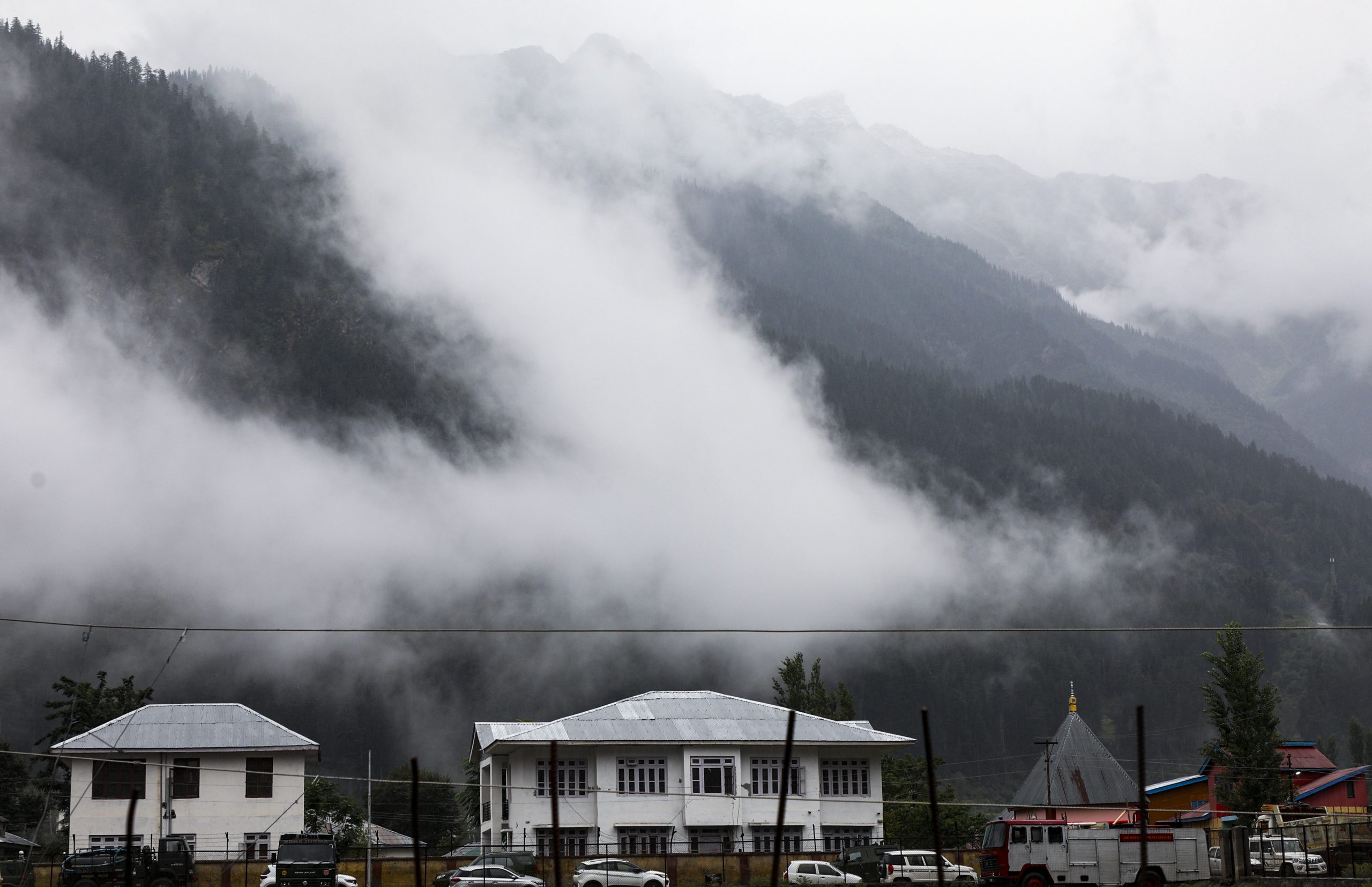
Vehicles pass beneath low hanging clouds at Chisoti village, in Kishtwar district, Jammu and Kashmir. Photo: PTI
The Himalayas, the world’s youngest and most fragile fold mountains, are constantly under immense tectonic strain. Every man-made intervention – bridges, tunnels, highways – add new stresses that can tip the balance and trigger instability in the terrain.
While development is essential in a region that has long lacked progress, it must be carefully planned and rooted in sustainability. And when climate disasters repeat year after year, we must ask: are these truly natural?
Warnings we ignore
Meteorological warnings of heavy rainfall, landslides and flash floods had been issued this year. Why, then, was the Machail or Mata Vaishno Devi Yatra not suspended? Could some of those lives have been saved if the administration had adhered to these warnings?
These are not merely questions but urgent reminders of how ill-prepared we remain despite decades of recurring tragedies, including the 2014 floods in J&K.
Since 2010, Jammu and Kashmir has experienced 168 cloudbursts, signaling rising environmental stress in its mountains as per the reports from IMD. These sudden cloudbursts, intensified by climate change, have caused deadly flash floods. Between 2010 and 2022, 2,863 extreme weather events claimed 552 lives, showing the Himalayas’ growing vulnerability.
It is convenient to call these events “natural disasters.” But experts have long warned that unplanned construction in flood-prone areas, deforestation and unchecked blasting of mountains for mega-highways are hollowing the Himalayas from within. Vast quantities of rock and soil are being torn apart to build roads, tunnels, and bridges with little regard for ecological balance. Natural springs have started drying up across Kashmir, and lakhs of trees have been felled in the past decade.
When the Raika forest, the green lungs of Jammu, was under threat, environmental groups like Climate Front raised the alarm. Few stood with them but many chose to remain silent. The Supreme Court in a recent observation warned that the fragile Himalayan belt could vanish in coming years if exploited recklessly. But every time warnings were drowned out by the rhetoric of “development.”
The devastation of recent years shows a hard truth: the more we disrupt, the more fiercely the mountains respond.
Environmentalists have warned that what was once occasional – landslides, cloudbursts, flash floods and subtle land shifts – has now become alarmingly frequent, marking a new phase in the region’s ecological history and rendering life ever more precarious.
Climate data and deforestation signal an ecological breakdown
A 2025 study in Springer Nature, drawing on data spanning 1970 to 2024, confirms that cloudbursts are rising in Jammu & Kashmir, alongside Uttarakhand, Himachal Pradesh and Ladakh. Scientific research underscores how the Himalayas’ topography, steep valleys, orographic lifting and narrow elevation bands (1,000-2,000 m) amplify vulnerability to such extreme precipitation.
In just two years (2021-23), Kashmir lost 40.6 square km of forest cover, including 952 hectares to fires. Between November 2023 and June 2024, 4,156 forest fires were detected, an average of 17 a day. In Gulmarg alone, 727 ha were diverted for 198 projects, felling nearly 1,850 trees. Across Jammu, 21,483 trees have been marked for removal to make way for highways and the Jammu-Katra Expressway. Experts estimate 60-70% of this loss is linked to infrastructure and tourism, releasing 68.8 kilotons of CO₂ .
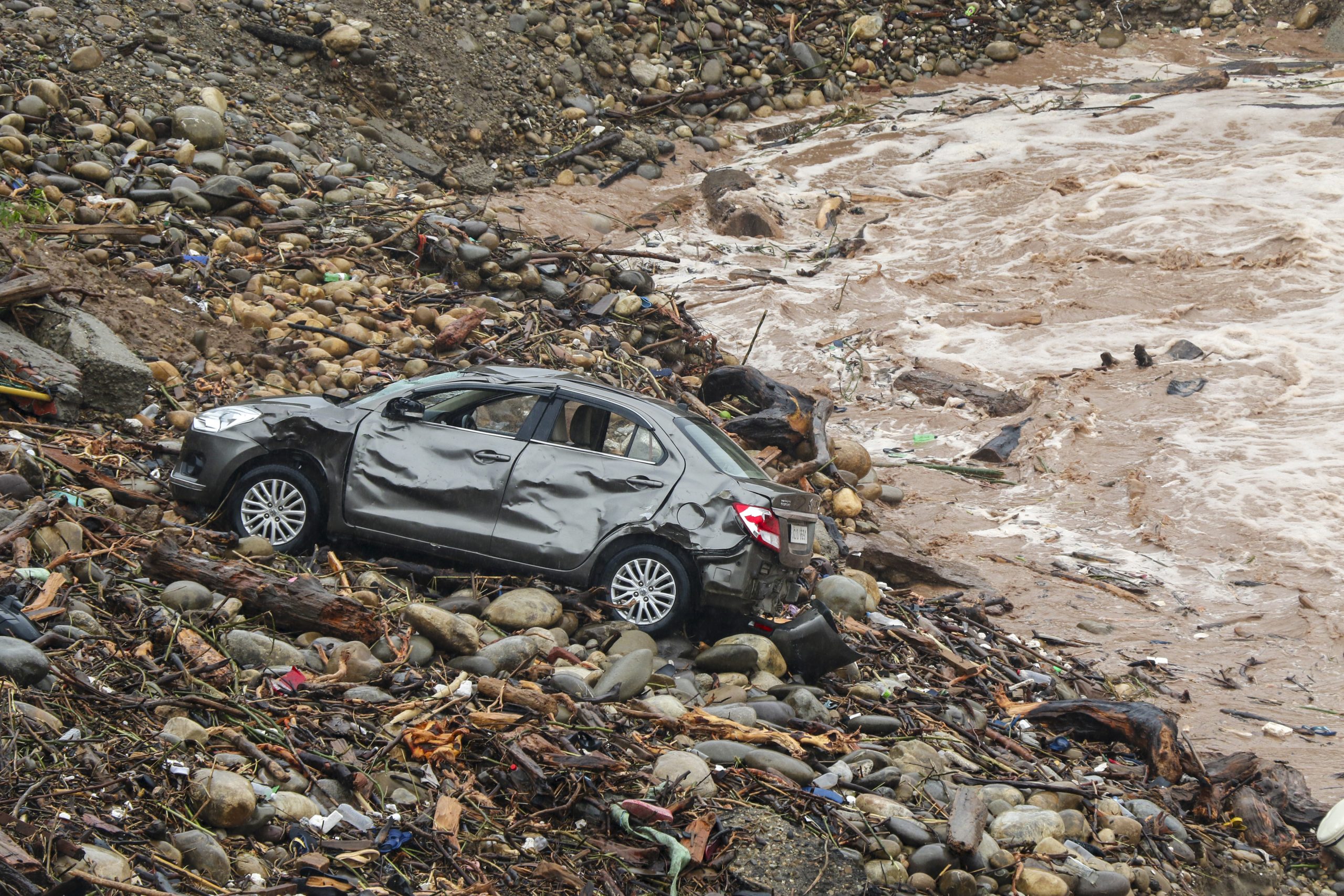
A car lies damaged amidst debris after a portion of a bridge was washed away, amid rise in the Tawi river water level due to heavy rainfall, in Jammu. Photo: PTI
Experts have warned that the number of dams and critical infrastructure in the Himalayas across Uttarakhand, Himachal Pradesh, J&K, and even Assam and Arunachal Pradesh, is at risk from glacial lake outburst floods (GLOFs), as rising temperatures fuel glacial melting.
These numbers are not mere statistics. Deforestation, highways carved into mountains, and unregulated projects have stripped the land of its natural defenses, while extreme rainfall and glacial melt only intensify the danger.
The much-hyped Tawi riverfront project in Jammu, modeled on Ahmedabad’s Sabarmati riverfront, ignores the fragile river ecology. Experts warn that concretising banks and altering the river’s course will choke floodplains, disrupt groundwater recharge and raise flood risks.
In a region already prone to cloudbursts, such projects risk turning Jammu’s lifeline into a looming disaster. This was the third time the riverfront was washed away by a swollen Tawi river in Jammu.
Governance in question
The recent flooding in Jammu has starkly exposed the cost of ignoring the Local Biodiversity Strategy and Action Plan (LBSAP), prepared by the Forest Department in April 2023. The plan laid out strict timelines for mapping catchment areas, managing rivers and canals, and conserving urban ponds.
However, it was left unimplemented by the very departments that were meant to act upon it: the Jammu Municipal Corporation (JMC), Urban Environment and Engineering Department, Irrigation & Flood Control Department and Jammu Development Authority.
Due to this inaction, coupled with excuses of inadequate funding, Jammu’s overnight rainfall, among the heaviest in nearly a century, neighbourhoods turned into waterlogged islands, proving that the real tragedy lies in the authorities’ failure to execute an existing roadmap.
The swift response of the SDRF, NDRF, local police, the Army and volunteers deserves recognition as without them, the toll in Kishtwar, Jammu and Kathua would have been far higher. But the larger question remains: why do we keep repeating the same mistakes?
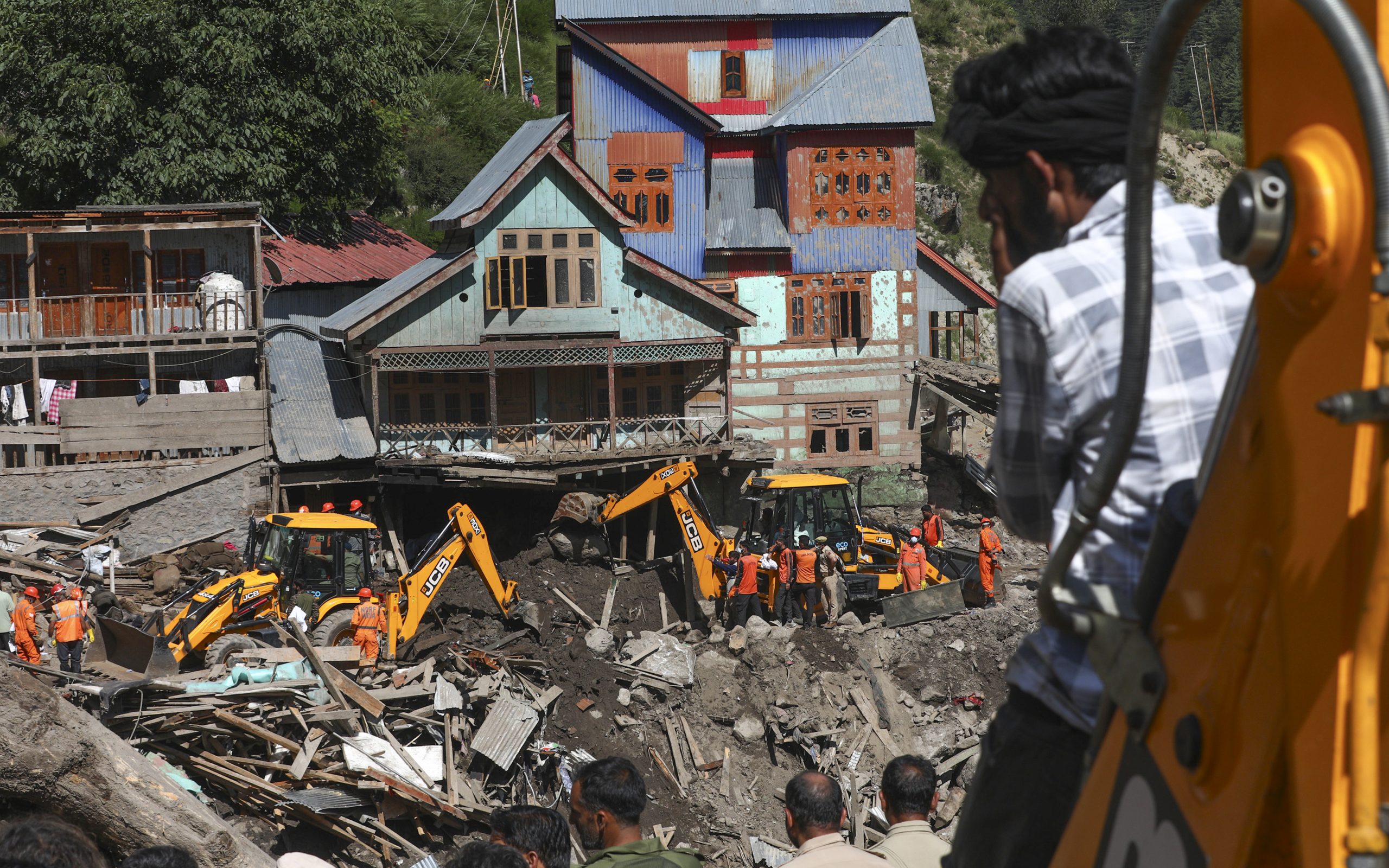
NDRF personnel during a search and rescue operation after flash flood triggered by cloudburst, at Chisoti village, in Kishtwar district, Jammu and Kashmir. Photo: PTI
The 2014 Srinagar floods killed over 500 people and displaced thousands. That tragedy should have been a turning point, yet more than a decade later, J&K remains unprepared. Since 2018, under direct central rule, the union territory’s disaster preparedness has barely improved.
In May 2025, during the military confrontation between India and Pakistan, border residents of Poonch, Rajouri and Uri faced relentless shelling without bunkers or shelters. Several lost their lives, casualties of neglect as much as of conflict.
Last month, in Kathua, survivors of the cloudburst endured the first critical hours alone until the Army and SDRF arrived. In Jammu, low lying areas were not evacuated despite clear cut warning from IMD of heavy rainfall. Today, there is nothing left to call home.
Jammu & Kashmir and the Himalayas are fighting an existential climate crisis but our disaster response remains largely reactive, dependent on outside agencies rather than built on strong local institutions. To truly safeguard lives and communities, the region needs a dedicated Multi-Hazard Research and Monitoring Centre, equipped with real-time early warning systems, trained local teams, and development practices designed with safety and sustainability at their core.
Only through proactive measures can the cycle of recurring, preventable disasters be broken, and lasting resilience be secured.
The way forward
The government must establish a dedicated Himalayan Disaster Risk Authority with the mandate to assess, monitor and mitigate risks from vulnerable dams and glacial lakes.
Such an institution, working alongside the NDMA, would ensure early warnings, pre-emptive evacuations and climate-resilient infrastructure planning in disaster-prone regions like Jammu & Kashmir, Ladakh, Himachal Pradesh and Uttarakhand. Urgent measures, stricter land-use policies, reforestation and disaster preparedness are essential to protect both lives and livelihoods.
If our leaders truly wish to prepare for the future, they must treat this not as an act of fate but as a man-made crisis demanding immediate policy action. Infrastructure holds the promise of transforming lives in this long-isolated region but such progress must be guided by ecological sensitivity rather than sheer ambition.
The young and fragile Himalayan slopes demand a careful approach – one that respects natural contours, safeguards water sources, and empowers local communities to coexist with the environment rather than struggle against it.
Kanwal Singh is a policy analyst and columnist From J&K.
This article went live on September thirteenth, two thousand twenty five, at thirty-one minutes past twelve at noon.The Wire is now on WhatsApp. Follow our channel for sharp analysis and opinions on the latest developments.


