

Vehicular Pollution Is Now The Main Cause of Delhi’s Poor Air Quality


New Delhi/Bengaluru: Despite the decrease in farm fires this year, air pollution levels in Delhi in October and November were still high. This was primarily due to vehicular pollution, a recent analysis by the Delhi-based Centre for Science and Environment shows.
Per the analysis, real-time air pollution data showed that the levels of fine particulate matter (or PM2.5, a major air pollutant) mirrored the daily dips and spikes in the levels of nitrogen dioxide and carbon monoxide – both pollutants emitted by vehicles – during peak traffic hours.
More ‘pollution hotspots’ have also emerged across Delhi-NCR over the years, and smaller towns such as Bahadurgarh are now part of this list because they witness more intense smogs unlike before, the analysis found.
Vehicular emissions mirror PM2.5 levels
For several years, air quality in the national capital has dipped as winter sets. This is quantified by the city’s Air Quality Index (AQI), which is a measure of levels of at least three major air pollutants, with particulate matter one of them.
Several factors play a role in this spike of air pollutants. One is farm fires in the vicinity of Delhi, in the adjoining states of Punjab and Haryana — a phenomenon where farmers set fire to stubble left behind after the post-monsoon harvests of paddy and wheat. Another is urban sources of pollution: emissions from thermal power plants, traffic and construction.
The meteorology during the winter months also plays a huge role in the poor air quality in Delhi-NCR, as slow wind speeds ensure that pollutants are not dispersed into the atmosphere.
Studies such as this one based on data for the year 2024 identify post-monsoon crop residue burning (or stubble burning) as a major ‘episodic’ pollution source in early winter. The Union government too has repeatedly insisted that stubble burning is the main cause of poor air in the capital city during this time, with the onus falling on farmers in the states of Punjab and Haryana.
Now, a new analysis by the Centre for Science and Environment (CSE) shows that this year, this does not hold: the air quality in Delhi-NCR has still been very poor despite a huge dip in stubble burning, and that pollutants from vehicular emissions are the major cause for this.
Due to the floods in Punjab that destroyed many standing crops of paddy and wheat in July, the levels of stubble burning was negligible in early winter this year, as several reports such as this one have already shown.
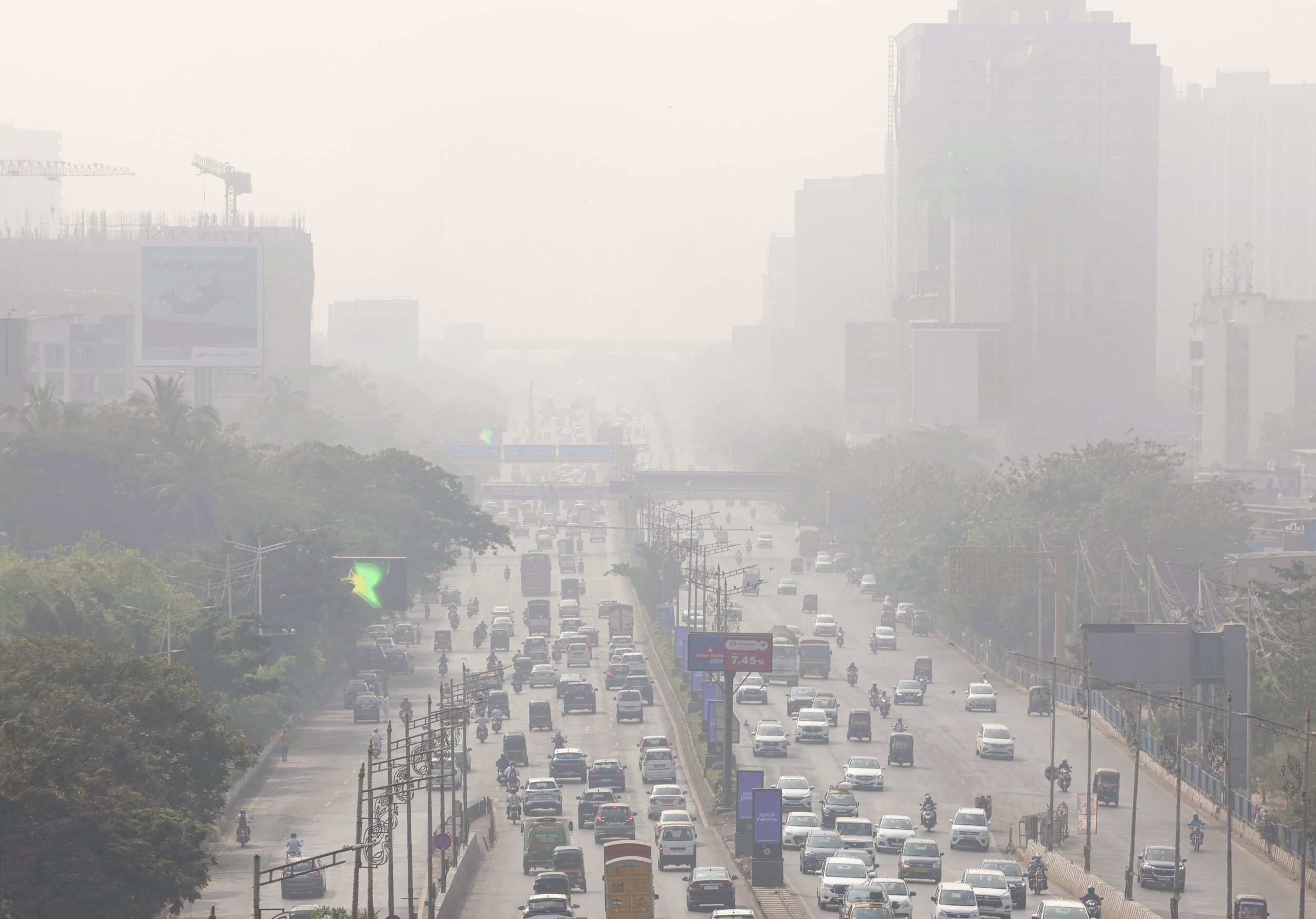
Traffic peaks in 2025 coincided with pollution peaks: CSE. Photo: PTI.
But despite this, Delhi still witnessed ‘very poor’ and ‘severe’ pollution days in October and November, scientists at the CSE found when they analysed real-time air quality data from the portal of the Central Pollution Control Board.
They found that the spike in PM2.5 in the city mirrored the rise in nitrogen dioxide during peak traffic hours (morning 7 to 10 a.m., and evening 6 to 9 p.m.)
Nearly 22 monitoring stations recorded carbon monoxide levels above the eight-hour standard on more than 30 of the 59 days, indicating persistent traffic-linked emissions, the report noted. Dwarka Sector 8 was the worst affected, with 55 exceedance days, followed by Jahangirpuri and North Campus DU, both reporting 50 days of violations each.
Both carbon monoxide and nitrogen dioxide, emitted from vehicles during fuel combustio,n are harmful to human health.
“Delhi and NCR cannot hide behind the smokescreen of farm fires any more as even with much lesser contribution to local air quality this time, air quality has turned ‘very poor’ to ‘severe’ exposing the impact of local sources,” Anumita Roychowdhury, executive director at CSE, said in a statement. “But more worrying is the daily synchronised rise of PM2.5 and other toxic gases of nitrogen dioxide (NO2) and carbon monoxide (CO) largely from vehicles and combustion sources, creating a toxic cocktail that has gone unnoticed.”
Last year too, an analysis by the CSE had found that vehicles in Delhi contributed more to air pollution (around 51%) than stubble burning did (around 8%) — but this analysis was conducted across a shorter time period (October 12 to November 2) than the recent analysis.
More pollution hotspots
According to the latest CSE analysis, new localities in the city have also emerged as pollution hotspots over the recent years.
Since 2018, many areas in north and east Delhi have recorded high concentrations of pollutants, often above the city averages. These areas, amounting to around 13 in number, were identified as ‘pollution hotspots’. They include Jahangirpuri (which is the most polluted hotspot with an annual PM2.5 average of 119 micrograms per cubic metre µg/m³), followed by Bawana and Wazirpur at 113 µg/m³, Anand Vihar at 111 µg/m³ and Mundka, Rohini, and Ashok Vihar ranging between 101–103 µg/m³.
While these areas continue to be hotspots of pollution, new ones have now emerged. Vivek Vihar recorded an annual PM2.5 average of 101 µg/m³, similar to Ashok Vihar this year; localities such as Nehru Nagar, Alipur, Sirifort, Dwarka Sector 8 and Patparganj also crossed 90 µg/m³, the CSE analysis found. Vivek Vihar and Nehru Nagar have remained pollution hotspots for four consecutive years now, and Dwarka Sector 8 and Sirifort are among the city’s most polluted locations for the second year in a row, it noted.
According to India’s National Ambient Air Quality Standards that set limits on the permissible levels of pollutants in the air, the concentration of PM2.5 should not be more than 60 µg/m³ for a 24-hour period and 40 µg/m³ annually.
Many smaller towns in NCR such as Bahadurgarh are now part of existing ‘pollution hotspots’ as they witness higher smog intensities, per the analysis.
“A region-wide smog episode affected NCR towns, but it was Bahadurgarh that endured the most persistent conditions, with the episode lasting a full 10 days, from 9 to 18 November… The town’s average smog intensity reached 343 µg/m³, nearly 1.2 times higher than Delhi’s,” the report noted. “This clearly demonstrates that the entire region now behaves as a single air-shed, where smaller towns are no longer cleaner gaps but hotspots facing equal or even greater pollution pressure,” it added.
This proliferation of pollution hotspots in the city is a concern, said Sharanjeet Kaur, deputy programme manager, Urban Lab, at the CSE’s Clean Air unit, in a statement.
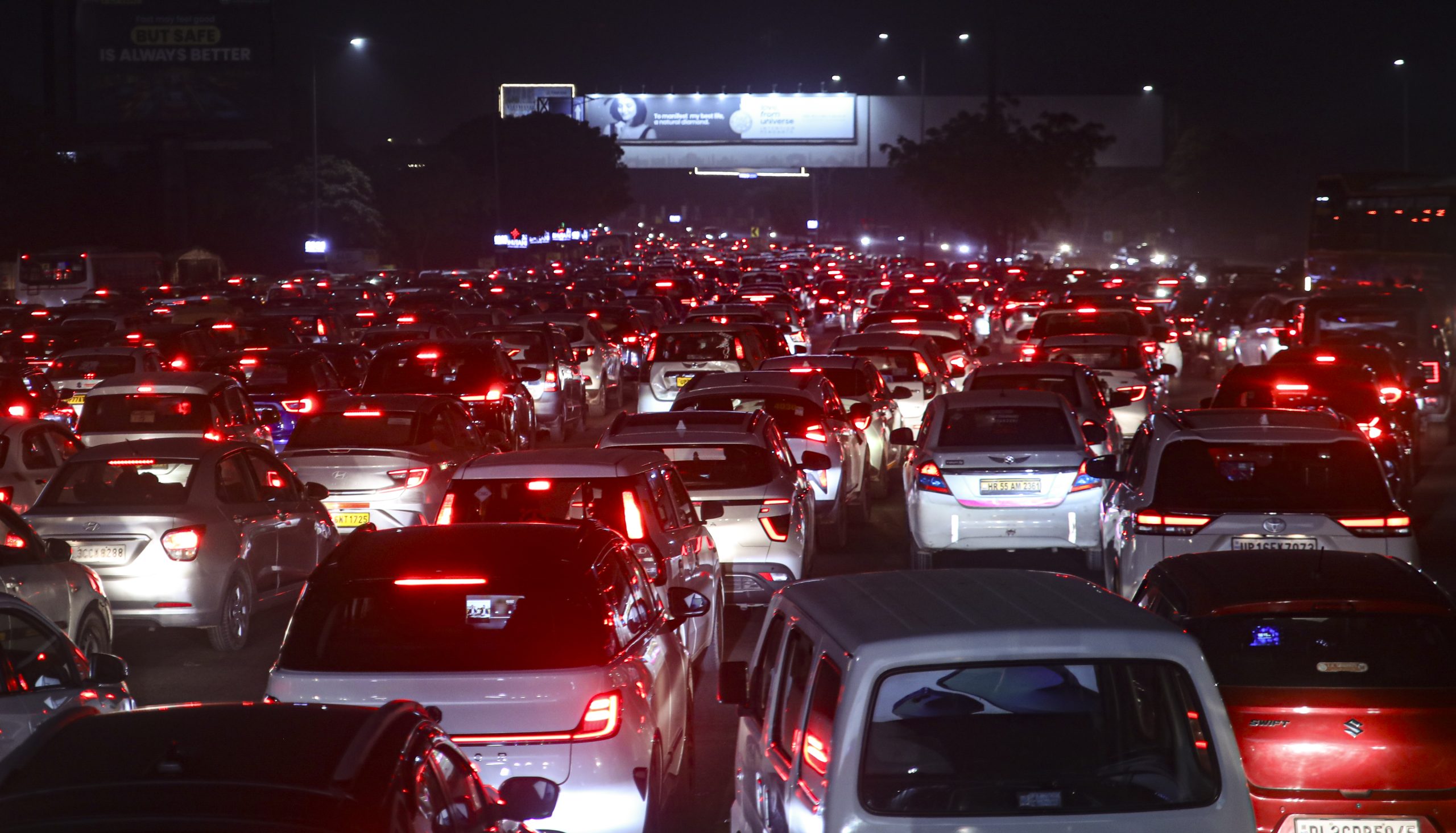
Gautam Buddh Nagar, to the southeast of New Delhi, has severe traffic congestion. Photo: PTI.
“The tinier towns in the region display more intense and longer smog build up. Even though the peak pollution spikes are lower this winter due to lesser contribution of farm fires, the airshed is getting increasingly more saturated,” he said.
A dangerous plateau
The pollution level in the region has plateaued at dangerously high levels, the CSE report noted, adding that small incremental steps will no longer help.
“This is the inflexion point. Either a leapfrog strategy across the key sectors of pollution can bend the curve again or the pollution trend can take [a] dangerous upward curve once again,” it read.
The longer term air quality trend in Delhi has plateaued without showing improvement, Roychowdhury added.
“This signals [an] urgent need for deep rooted shifts in infrastructure and systems to upscale action to cut emissions from vehicles, industry, power plants, waste, construction and household energy,” she said.
It is now also important that authorities scrap and replace older vehicles to cut down on their contributions to pollution levels in the city, the report noted. Other steps it suggested include ensuring that electrification targets are met for all segments of vehicles in a time bound manner for zero tailpipe emissions; upscaling the integrated public transport system with last mile connectivity as well as walking and cycling infrastructure to increase ridership and active commuting; and decrease the use of personal vehicles with parking caps and pricing and congestion tax.
It will also be crucial for industries to switch to cleaner fuels; authorities will need to ensure that they meet the caps on emission levels. Lowering taxes on natural gas will help here, as will electrifying industrial processes.
Among the other recommendations that the report made is that power plants meet emissions standards.
Incidentally, the Union government diluted these emissions standards this year. As reported by The Wire, the Union environment ministry announced on July 11 that nearly 80% of thermal power units across the country would be exempted from installing technology to limit sulphur emissions which would have helped reduce point emissions at source.
An air pollution scientist had told The Wire then that this move will take India behind by 10 years and aggravate the air pollution crisis in the country.
This article went live on December second, two thousand twenty five, at sixteen minutes past five in the evening.The Wire is now on WhatsApp. Follow our channel for sharp analysis and opinions on the latest developments.


