

What Good Can COP30 Do? Tuvalu Has the Answer.


Belem (Brazil): At this point, the COP30, which is the world’s largest platform to discuss climate change, invites as much derision as it does indifference.
As a Reddit commenter put it, part of it has to do with the fact that it is, “Basically important people saying nice things to a bunch of cameras and microphones.” There is news that fossil fuel lobbyists have turned up in the largest numbers ever, with more access to negotiation processes than many small nations.
The terms bandied about seem like mockery against the backdrop of the ferocious natural disasters that kill and displace more and more people each time they happen. The image of negotiators from various countries, locked in rooms cooled with air conditioners, discussing technicalities that many countries will never honour is an otherworldly one, especially considering that the US – the world’s biggest historical contributor to carbon emissions – is missing from the negotiations.
In the grand dystopian circus that is Donald Trump’s presidency, the US has slipped out of the global agreement that promised to attempt to keep global warming down to a limit that would not totally kill everyone. Emboldened, men and women have begun denying the very truths that they themselves had, until recently, believed was common knowledge.
If anything is worse than a ham-handed behemoth being obstinate about the collective loss of life, then it is the layers of hypocrisy that surround an effort like the COP. Since the UN began the meetings at the Brazilian city of Belem, it has had to send three press releases noting that the door leading to the main room for negotiations is going to be closed because of a protest being held outside it. On the day of filing this article, the protests were by the Amazonian Munduruku tribe who have begun seeing debilitating deformities in their children because of contamination from mercury that is used in gold mining.

Alessandra Koran, a member of the Munduruku Ipereg Ayu movement, spoke as Indigenous people held a protest blocking the main entrance to the UN COP30 climate summit in Belem, Brazil. Photo: AFP.
Then there is the fact that through successive COPs, countries like India have reminded developed countries to provide finance to developing countries – only for the developed countries to project an increasing reticence for any meaningful financial commitment towards the lands that were once the source of their vast wealth. There is also the fact that the very countries who demand accountability from richer countries, have turned these philosophies on their head, plundering their own forests, making way for mining for free, and penalising everyone who has had a problem with this system.
Can the rounds of legalese afoot at Belem save us? Will it make life easier in a sweltering kitchen in Delhi in the middle of summer? Will activists begging for some attention to the systems that sustain us be heard? Indeed, can COP help at all? If several people need hours of convincing of the fact that the global temperature cannot rise beyond a point, and if it does, some people will be very, very unhappy, then why bring them together at all?
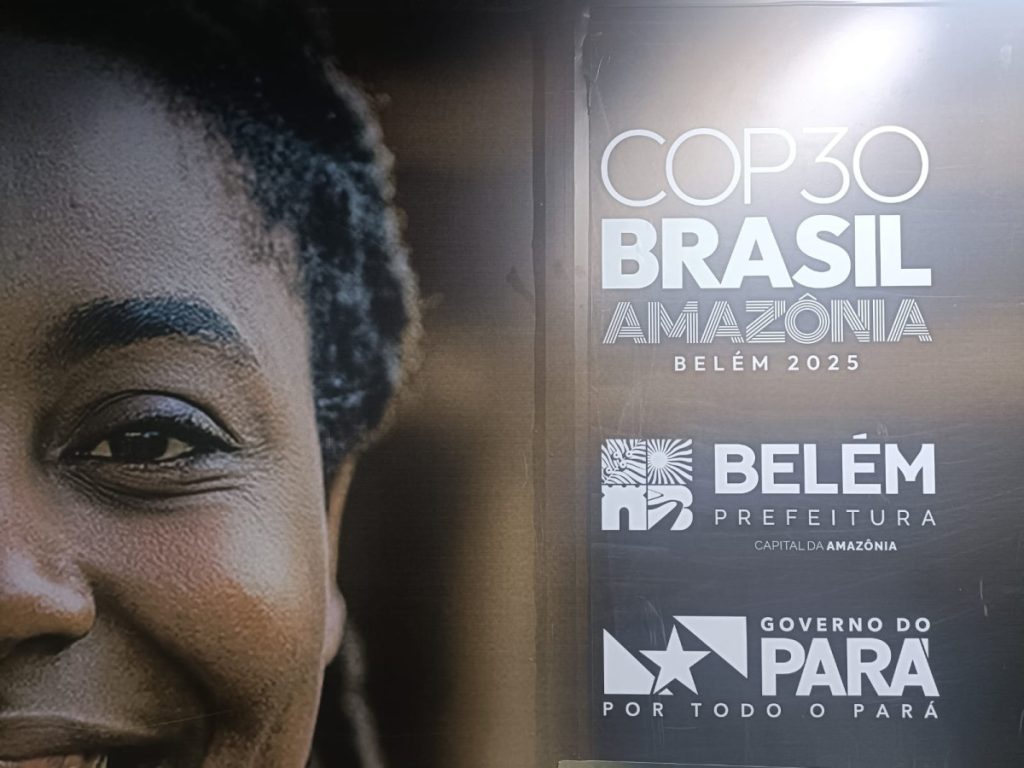
Caption: COP30 ads at the Belem airport in Brazil. Photo: Soumashree Sarkar/The Wire.
The answer, perhaps, lies in Tuvalu, the country with the third-least number of people in the world.
Ahead of COP30, at the leaders’ summit in Belem, the home minister of the islands took the system to task, mincing no words and issuing an honest cry of exasperation – the likes of which make the whole exercise seem worthwhile. This summit on November 6 and 7, that preceded COP and involved world leaders, has led to heartening photos, and cautious calls for less fighting and more understanding. Sentences spoken by leaders in such situations often end up doing no justice to the extent of the problem. While India itself said that global ambition is not enough, it did not say much else. Speeches by prominent powers across the world echoed this diplomatic pussy-footing.
 Addressing Trump
It is here that the short speech of Tuvalu’s home and environment minister Maina Vakafua Talia struck an essential chord, reminding the world that the smallest clusters of islands, who have had no role to play in this relentless loot of the earth’s resources, end up the most affected.
Talia began his by asserting Tuvalu’s role in the landmark understanding of a decade ago:
“Tuvalu was very active in formulating the Paris Agreement. We had high hopes that this new agreement would give us the necessary legal measures to protect Tuvalu from the worst impact of climate change related sea level rise.”
Then his language took a visceral turn.
“Ten years on from Paris, we have greatly and gravely concerned about the slow progress in delivering significant emissions reductions to ensure our survival.”
Talia said plainly that we are clearly not on the track to “keep the Paris Agreement's promise of stabilising global temperature at 1.5 °C relative to pre-industrial levels.”
Then, with seemingly nothing to lose – and at great odds with most countries across the world – he said:
“Tragically, the world's largest historical emitter of greenhouse gas emissions has withdrawn from the Paris Agreement. I was at the UN General Assembly when President Trump spent a considerable amount of his address to world leaders disparaging renewable energy sources and challenging the scientific consensus on climate change.”
It was the first time someone had mentioned Trump by name at the high-profile meeting. But Talia took it a step further and addressed him directly.
“Mr. President. This is a shameful disregard for the rest of the world. We only need to reflect on the recent impact of Hurricane Melissa that wreaked havoc on Jamaica and Cuba and Typhoon Tung-Fong that hit the Philippines to understand that climate change is here.”
‘Obligation to act’
Talia has a theology PhD and is a seasoned climate warrior. He is also the author of an academic book, the title of which says a lot about his philosophy: Tuvalu, Theology, and the Geopolitics of Climate Change: Am I Not Your Tuakoi (Neighbour)? It is an extraordinary marrying of faith and science – two things that one can argue make up the crux of how we view ourselves in nature.
At Belem, he said:
“The more we warm our oceans, the more intense these severe weather events are becoming. There is no time in human history where the world has faced such an enormous threat to our future. We must act now, and we must do it urgently.”
But Talia was not done. He continued addressing Trump:
“Mr President, there are clear messages that can be found in the International Court of Justice advisory opinion on climate change. It says every state has an obligation to act with due diligence and to use all the means at disposal to prevent harm to the climate system.”
He also appeared to tell Trump that signing out of a global understanding does not really absolve a historical culprit of its role:
“All states, even those not party to one or more of the climate agreements, are bound to take actions and have a duty to prevent significant harm to the environment and a duty to cooperate for the protection of the environment in line with the principle of good faith and due diligence.When states breach one or more of their international obligations, they have a duty to seize the wrongful conduct, provide guarantees of non-repetitions, and provide full reparations for any resulting harm in the form of restitution, compensation. and or satisfaction.”
Tuvalu, who many would struggle to place on a map, is a negligible force in the geopolitics of climate change. And yet the rising sea levels affect the three reef islands and six atolls as much as can be imagined. Small and vulnerable island nations are also left largely to themselves when it comes to mitigating climate change. Bodies like the Alliance of Small Island States and the Small Island Developing States have been saying this often but many say they do not even have a seat at the tables that take the decisions.
Talia’s concern is of an overarching lack of morality in this system. In his book, he takes recourse to Biblical wisdom to ask for compassion for Tuvalu. Incidentally, Trump and his MAGA support-base too would like to think that they are devoted Christians.
‘We will survive’
Relentless, Talia went on:
“These are strong words which must, we must take heed of, Mr. President. My country and my people in the future generations cannot continue to suffer the impacts of climate change, while the world's major emitters believe that they can continue to pollute the atmosphere with total immunity. This is immoral and unacceptable.”
Talia also said that the amount of money that has been earmarked for loss and damage is “tiny” compared to the actual costs incurred.
“Finally, I want to reflect on the fact that the Paris Agreements delivered a promise to ensure vulnerable countries like Tuvalu do not disappear. Mr. President, we believe in that promise. We believe that Tuvalu has a future, but we need the necessary support to ensure that we will survive.”
“And we will survive,” he said.
We do not know whether Tuvalu will, indeed, survive. Or what it will mean to survive in a changing climate. But in this kernel of audacity lies hope. A meeting which can host a speech like this can surely see bigger things.
This article went live on November seventeenth, two thousand twenty five, at zero minutes past eight in the morning.The Wire is now on WhatsApp. Follow our channel for sharp analysis and opinions on the latest developments.


