

In ‘Winkle-Twinkle’, Bengal’s Political Ironies Come Home to Roost


Bengal director Srijit Mukherjee’s Winkle Twinkle is an adaptation of theatrician and former Bengal minister Bratya Basu’s play of the same name, written and staged in 2002.
It’s a Bengali take on Washington Irving’s famous short story, ‘Rip Van Winkle’. Sabyasachi Sen faces a police ‘encounter’ in 1976 Calcutta, but his body mysteriously disappears. Taken as dead by family and fellow comrades – one of thousands to have a similar fate – he however reappears in 2002 Kolkata, still the young man he was 26 years ago.
His aging wife and grown-up children (a son who was little and a daughter who was not yet born when he vanished) are faced with a strange situation – they need to accommodate themselves to a spectre from the past. The wife, his true ‘comrade’ in life and ideals, is Penelope-like in her devotion: though she didn’t expect him back after having raised two children as a single mother, she is the most empathetic to his predicament. The daughter, though initially sceptical about the presence of this man who suddenly materialises as the father she never had, softens soon enough. But the son, who has grown up to be a Trinamool Congress party worker, simply refuses to accept Sabyasachi – both as his father and also his outdated ideology. He even calls the man by his name, to establish that he won’t budge from his position; an ironic repetition of what the Leftist Sabyasachi had himself done with his father – a second-generation Congressman and die-hard nationalist who was proud of his own his father’s association with Surendranath Banerjee.
While Sabyasachi’s grandfather is only a passing mention, we see him locked in argument with both his father and son – political adversaries in two timelines: in one, CPI(M) is pitted against Congress; in another, against TMC. We thus have the political history of Bengal – for the first half-century, post-Independence and Partition – played out through a single family’s political affiliations and beliefs. While at its heart the film is an elegy to the Left in Bengal, it’s also about a generational divide – made all the more dramatic because of the sheer conviction of the protagonist that Communism cannot die: “I believe if ever there was a sacred duty as a human being, it is to be a Communist”, he tells his father, with the arrogant confidence of youth; a quarter century later, he lashes out desperately at his son, “Until the world is destroyed… for as long as there is poverty and inequality (Communism cannot be irrelevant).”
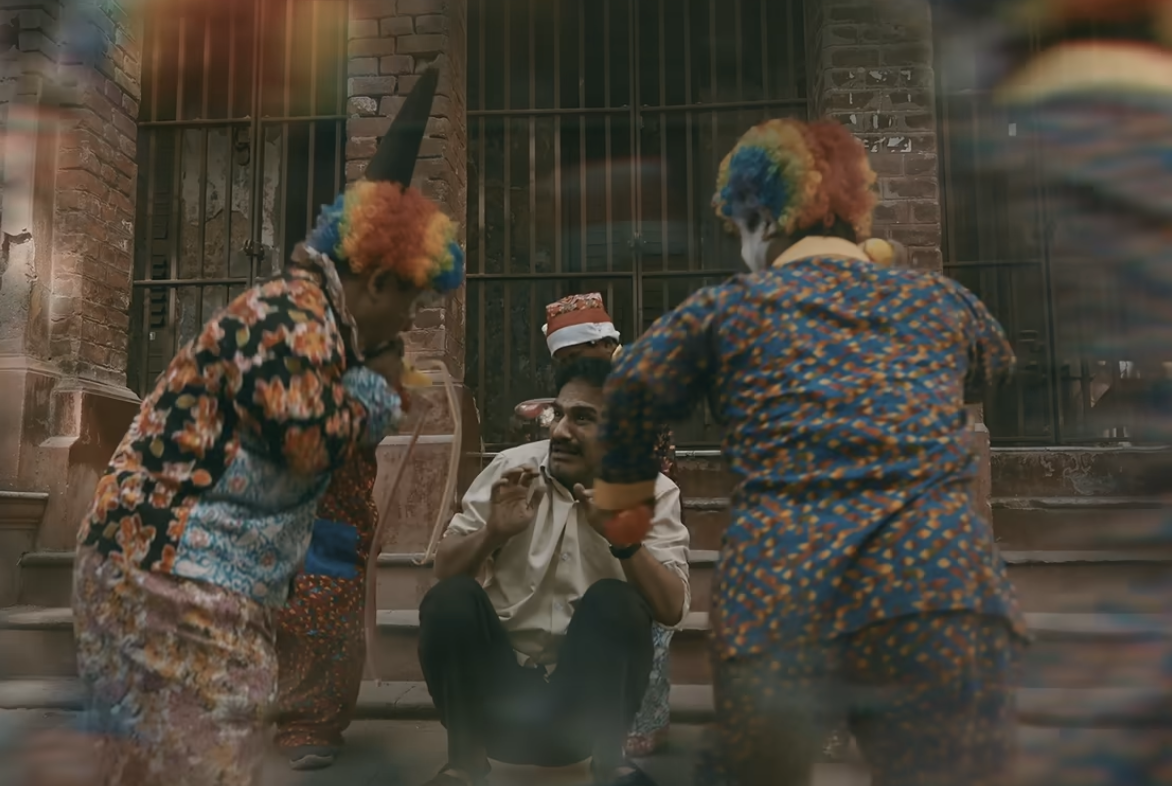
A screengrab from the trailer of 'Winkle Twinkle (উইঙ্কল টুইঙ্কল)'.
Ritwik Chakraborty is brilliant as Sabyasachi, bringing to it a raw vulnerability that is rare in male characterizations in contemporary Bengali cinema. It’s matched by Parambrata Chatterjee’s all-consuming rage as his son Indra, who couldn’t forgive a father he adored as a child for his inexplicable absence in his formative years, or the party that became a travesty of the ideals it once propounded. His joining TMC is a revenge against his abdicating father; and in the post-liberalized India and Bengal that he lives in, where the gulf between the haves and the have-nots have only widened, he has no qualms in declaring that he’ll do whatever it takes to survive: “Today I’m doing Trinamool; tomorrow, if it doesn’t work for me, I’ll do BJP.”
This statement is a loaded one, given that the actor who is mouthing it had campaigned for TMC – after a period of studied distance – before the state elections this year. The film itself is intriguing for another reason: the play on which it is based happens to be by Basu, once a celebrated theatreperson and also a former TMC education minister. In 2002, when Basu’s play was staged, the TMC was a decade away from coming to power and the BJP had not yet made its presence felt in electoral West Bengal. The realities now are, of course, different.
What Indra said, did happen: many did jump ship, leaving TMC for BJP.
Curiously, the film, says the director, was "stuck with Censors for the longest time."
Any film – or for that matter any work of art – should be evaluated for both content and form; Winkle Twinkle is thought-provoking in both. While the subject draws attention to the political context in which the play it’s based upon was written and the changed scenario in Bengal when the film released, for Bengali film-lovers, it is its intertextuality with Mrinal Sen’s Calcutta Trilogy (especially Padatik, ‘The Foot Soldier’) that makes for interesting viewing. (Incidentally, Mukherjee’s tribute to Sen in his centennial year is also titled Padatik). The protagonist of Sen’s Padatik, a political activist named Sumit (Dhritiman Chatterjee), having escaped jail and instructed to be in hiding by his party command in a posh apartment owned by a liberated single working woman sympathetic to their cause, finds himself questioning the dictatorial attitude of his leadership, and the revolution itself and its true objectives. It’s a hard look at an idealism already gone wrong, at the height of its manifestation. Ironically, while Sumit begins to doubt, his aged father, who was previously opposed to his politics, comes round to his side – when he refuses to sign a no-strike agreement at his factory. Though their confrontation scene is much milder, one sees it echoed in the flashback between Sabyasachi and his father in Winkle-Twinkle.
The family scenes in Winkle-Twinkle, the dinner-table explosions of the Sen family in particular (both before and after Sabyasachi arrives), are the best in the film. They are reminiscent of such meal sequences in Chitrangada: The Crowning Wish (2012) – where there's a confrontation between the protagonist’s character (played by Rituporno Ghosh) and his parents (played by Dipankar De and Anashua Majumdar). There, the problem was the son's sexuality; here, his politics. Anashua was a revelation in that film; she continues to impress after all these years. Shohini Sarkar, playing the younger Rajlokhhi, leaves a mark in just two songs; and Angana Roy as the daughter has a refreshing naturalness in her acting.
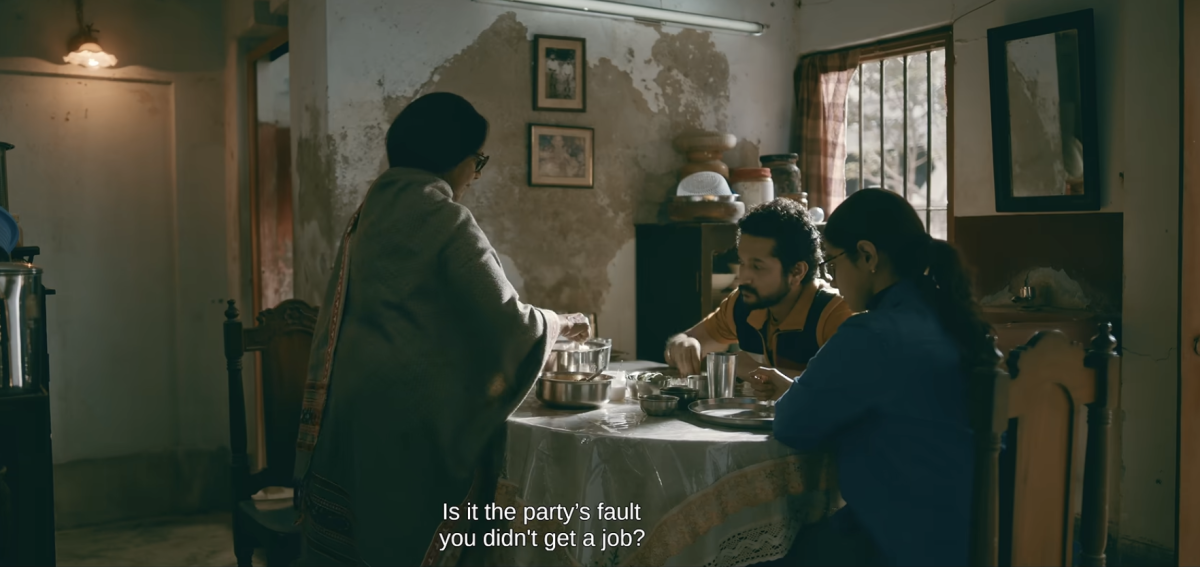
A screengrab from the trailer of 'Winkle Twinkle (উইঙ্কল টুইঙ্কল)'.
The first half of Winkle-Twinkle is far more engaging, the drama of conflict balanced out by the humour of a disoriented Sabyasachi, who thinks he was asleep for only an hour – wondering how the Birla Temple came up so soon, curious about a small device in everyone’s hands into which they spoke, staring long and hard at the name/face of Mamata Banerjee and the logo of her party on a wall, asking who ‘Sachin’ was in a commentary on cricket (the only Sachin he knew being the music composer Sachin Dev Burman), assuming the ‘Hrithik’ film his son went to see was that of the Bengali filmmaker Ritwik Ghatak. There are changes, though, that are not so humorous: an ex-comrade, Sanat’s transformation into a wily politician (played by theatreperson Debesh Chattopadhyay in a memorable cameo). Another’s miserable shadowy existence, post jail torture all those years ago, lived with his sister in a decrepit old house on the outskirts of the city. Through his interactions with them, we get a fuller picture of the disintegration of their dream of revolution – of police repression, of capitulation or escape by revolutionaries, or worse, their eventual co-option into the very system they took up arms against, and the sheer hypocrisy of Left intellectuals leading elite lives while paying lip-service to a classless ideal of society.
The reunion scenes fill in the gap in Sabyasachi’s lost years, but they (along with some sequences with his son) also turn the second part into a kind of discourse on the failure of communism, losing the momentum of the first. Against the verbosity of these scenes is the visual appeal of a word-less sequence, in which Sabyasachi, lying in bed, watches tumultuous scenes from his own past in the movie-theatre of his feverish mind.
If the chase sequence in the film – where Sabyasachi is hounded by the police through narrow alleys – is a nod to similar scenes from Mrinal Sen’s Calcutta 71 (1972) and Padatik (1973), and the use of red highlights in the flashbacks an echo of a little girl’s lone red coat in Steven Spielberg’s Schindler’s List (1993), the 3D immersion of the protagonist in his own past stands out as a striking representation of a tortured consciousness – totally out of place, out of time. The larger human cost of the revolution – of the impact of wasted and lost lives on deserted families – comes out in the most beautiful song in the film, ‘Na Thaka Priyo’ (Absent lover), sung by Rapurna Bhattacharya and composed by Tamalika Golder. It’s the best takeaway from the film.
Rituparna Roy is a writer based in Kolkata. She can be reached at royrituparna.com
This article went live on September sixteenth, two thousand twenty six, at nineteen minutes past one in the afternoon.The Wire is now on WhatsApp. Follow our channel for sharp analysis and opinions on the latest developments.


