

Hero-Actor-Leader: Vijay's Unseemly Quest for Power and the Loss of Innocent Lives


Last week, the Tamil Nadu government organised a moving and joyous event titled 'Tamil Nadu Excelling in Education.' It was a programme that highlighted how women and men from humble and disadvantaged family backgrounds have risen in education and in life with the help of government schemes such as Pudhumai Penn ('innovative woman'), Naan Mudhalvan ('I am the first'), and Tamil Pudhalvan ('Tamil son'). The event made various social segments and neutral observers feel elated.
That joy was completely shattered by the great tragedy that unfolded in Karur on September 27. Actor Vijay, as part of the campaign tours he conducts every Saturday for his political vehicle Tamilaga Vettri Kazhagam, had visited Namakkal and Karur that day. At around 7:30 pm, while he was speaking in Karur, an uncontrollable stampede broke out in the milling crowd, in which 40 people –men, women, and children – lost their lives.
Vested interests elsewhere, wary of the inclusive development paradigm and progressive political ethos of Tamil Nadu, at once began saying: “So this is the Tamil Nadu that excels in education? It is a land ruined by its obsession with cinema.” Another group, as usual, started insisting that it was the DMK that mixed cinema with politics. And some others raged: “Is this Periyar’s soil? People die after going to see an actor?”
No great prophet, saint, or thinker in the world has ever turned the land of their birth into utopia. It was in Gujarat, the land where Gandhi was born and lived for the most part, that the demon of religious violence danced most ferociously. But that does not mean we can deny Gandhi’s immense role in shaping modern India. It was Periyar himself who said on Gandhi’s martyrdom that India should be called 'Gandhi Desh.'
First, we must understand the connection between the Dravidian movement and cinema. Then we must see how leading actors came to be transformed into political leaders. Only after that can we discern the political inadequacy in actor Vijay’s launching of a party, and understand why this loss of lives occurred in Karur. If a genuine understanding in philosophical anthropology is to emerge, history must be approached with some patience.
Cinema and Politics in the 20th century
Across many countries of the world, cinema, from its very beginnings, has intertwined political discourses or has been used for shaping national identities. The United States, Russia, Germany, and Italy are some among them. In India too, anti-colonial nationalist sentiment played a key role in the emergence of cinema. Even in Tamil cinema, the ideology of national liberation was expressed – something that scholar Theodore Baskaran has documented in his book Message Bearers.
However, in Tamil Nadu, apart from the idea of national liberation, the concepts of social justice also permeated cinema. There were several reasons for this. At a time when both theatre and cinema were dominated almost entirely by mythological stories, there was a strong desire among many to stage and film narratives based on contemporary society. But Tamil prose, in its written form, was steeped in pedantry on one side, and heavily mixed with Sanskrit on the other, while in spoken form it was filled with casteist slang.
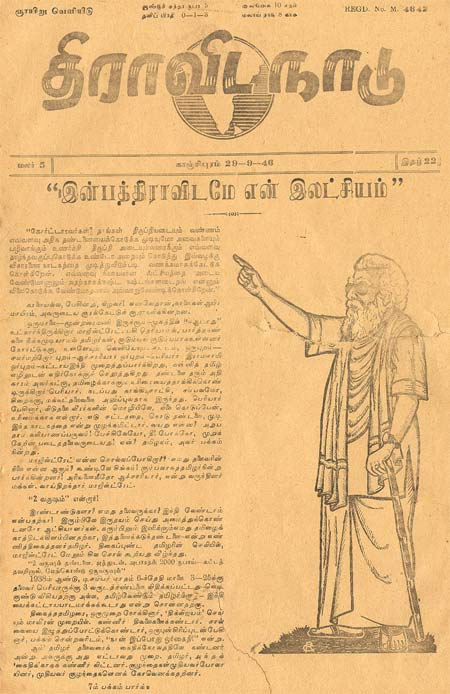
'Dravida Nadu' magazine owned and edited by Annadurai. Photo: Public Domain/Wikipedia.
It was in this context that Annadurai, Karunanidhi, and others created a new prose style in both speech and writing – one that was close to the people. They used this very style in plays and later as dialogues in films. Because this style of language was alliterative, rhythmic, and rich in cadence, it won wide influence among the people. When social justice ideas were woven into this language, both plays and films found enormous popularity.
The stars who emerged from this wave of Dravidian Tamil were M.G.R. and Sivaji.
Sivaji took shape as an actor of character roles, while M.G.R. became the transcendental action hero, the harbinger and custodian of just order. Together, they embodied the two halves of Tamil modern subjectivity and gained immense social significance. Sivaji, facing opposition from a section within the DMK, moved away and grew close to Kamaraj and the Congress.
M.G.R., on the other hand, became integral part of the mobilisation of Dravida Munnetra Kazhagam. He grew with the party which lent his film narratives a historically transformative significance. He translated the party’s historical narrative into allegorical film narratives. For two decades, as a hero closely bound to the party, he expressed its ideas through dialogues and songs, and fully identified himself with the party. In a society where literacy had not yet spread widely, films became a form of mass education in democratic citizenship. The films contributed to Tamil society’s emergent political consciousness.
Since M.G.R. himself grew up in poverty, he understood the lives of the underprivileged. After Annadurai’s death, when he clashed with Karunanidhi and split to form a new party, he immediately inherited statewide party structures and the strength of cadres. Several second-rung leaders, including V. R. Nedunchezhiyan 'Navalar', joined him, ensuring he had no need to build from scratch the scaffolding of party hierarchy.
Can leading actors be political leaders?
In the film world, Sivaji Ganesan, who equalled the popularity and success of M.G.R., could not become a successful political leader. This was because his heroic image was that of a character actor. Though he too acted in adventure films, his hallmark was that he transformed into whichever role he played. Unlike M.G.R., Sivaji could not turn himself into a vigilante prototype. This reality made it immediately clear that the semeiotic pathways through which an actor playing the hero like M.G.R. became a party leader and chief minister was not something others could easily follow.
Another person who, like M.G.R., successfully transformed into a party leader and chief minister was N.T. Rama Rao, known as N.T.R. In Andhra Pradesh, at a time when the Congress party had no rival and was rife with intense factionalism, he drew away many of its leaders to build his own party. His own son-in-law, Chandrababu Naidu, was then a Congress minister, close to Sanjay Gandhi.
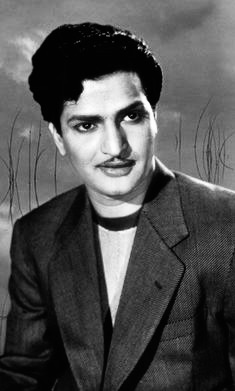
A still of N. T. Rama Rao from the film 'Missamma' (1955). The copyright of the film expired. Photo: Public domain.
N.T.R. had played divine roles, including Krishna, in mythological films, and like M.G.R. he also appeared as the vigilante hero in many films. In his youth, he had gained a deep familiarity with social structures. In a situation where Congress had no alternative in Andhra Pradesh, it was by gathering a section of its leaders that he was able to form the Telugu Desam Party. But later, Chiranjeevi – who had become the great action hero of Telugu cinema – could not succeed when he founded a party.
From these examples it becomes clear that for a star actor playing hero in films to succeed as a party leader and rule as chief minister depends on several factors: the nature of his screen image, whether a party structure is already available to him, and whether the political conditions are favourable. If not, one might form smaller parties, win a few constituencies in alliance with other parties – but to rise as M.G.R. or N.T.R. did and rule as chief minister is not possible. Jayalalithaa, having acted alongside M.G.R. and been brought into the party by him, was able to establish herself as his heir and take over the party organisation intact, successfully subduing resistance.
The fact is that none of the other popular heroes who tried to gain power like M.G.R. succeeded in doing so. Bhagyaraj, T. Rajender, Karthik, Sarathkumar, Kamal Haasan – all attempted it. None could build a durable party structure and grow into a major political leader or chief ministerial candidate. Even Vijayakanth, though he once could attract up to 10% of the popular vote, could not sustain his party. Within just 10 years, he lost even in the very constituency where he contested as a chief ministerial candidate.
Vijay: Unseemly ambition to rule
It is true that in a democracy anyone can start a party and seize power. It is also true that leading film actors can become leaders. But the question is: what groundwork must one do on the field to secure a place in politics?
The phrase I want to use — 'desire to rule' — refers to the belief that, without doing any fieldwork, without engaging people at the grassroots and building a party structure bottom-up, one can seize power directly by riding on the shine of one’s star image. In other words, thinking that politics simply means directly becoming the chief minister is not political engagement but naked ambition for office. Political engagement is about mobilising the people for their felt needs, not about acquiring power.
So, what must a popular actor do if he truly wishes to mobilise the people? He must visit every town and mingle with the people. He must understand their needs. He must participate in their struggles. He must create party branches through those who follow him. He must cultivate close ties with those grassroots functionaries. From among them, through their activities, he must let emerge a group of people who display leadership qualities and build the party hierarchy. He must address and mediate all the disputes and social conflicts that arise at every level within the party and in the social, and thereby establish his leadership. Only then are elections and governance possible.
If it is impossible to build a party from the grassroots in this way, then one must join another party and work within it. One should take on various responsibilities there and qualify oneself for leadership roles. Even if this requires a long period of gestation to mature a leader. But one must understand that it is impossible to assume a leadership simply because one is a famous film hero.
Dynastic leadership is not easy either. One must secure the support of party leaders. One must become familiar with the party’s organisational roots. One must develop the capacity to resolve various disputes and complexities. Because there is a high risk of being rejected, one must work with political acuity and focus. Not every heir apparent secures the backing of party members and, through them, the people. Succession is not a bed of roses.
The politics of crowd optics
It is not even clear whether Vijay has an interest in politics equal to his desire to rule. If he did, he would engage in political discourse. He would meet journalists. He would meet other political leaders. He would hold ongoing discussions with party workers and with different sections of the people. For 15 years now, Rahul Gandhi has been doing precisely this kind of work in earnest. Every grassroots activist or socialite who has had the opportunity to meet Gandhi says with surprise that he converses with deep attention and carefully analyses issues.
There is no sign that Vijay engages in any such activities. He does not meet journalists. No social thinker has ever claimed to have sat in consultation with him. On the contrary, it is said that he merely carries out what a few professional political consultants prepare for him in events they design. For example, when he went to the house of the Ariyalur student who took her life because of the NEET exam, he was instructed to sit on the floor, and to place his arm on Anitha’s brother’s shoulder, according to political commentator Manikandan Veerasamy.
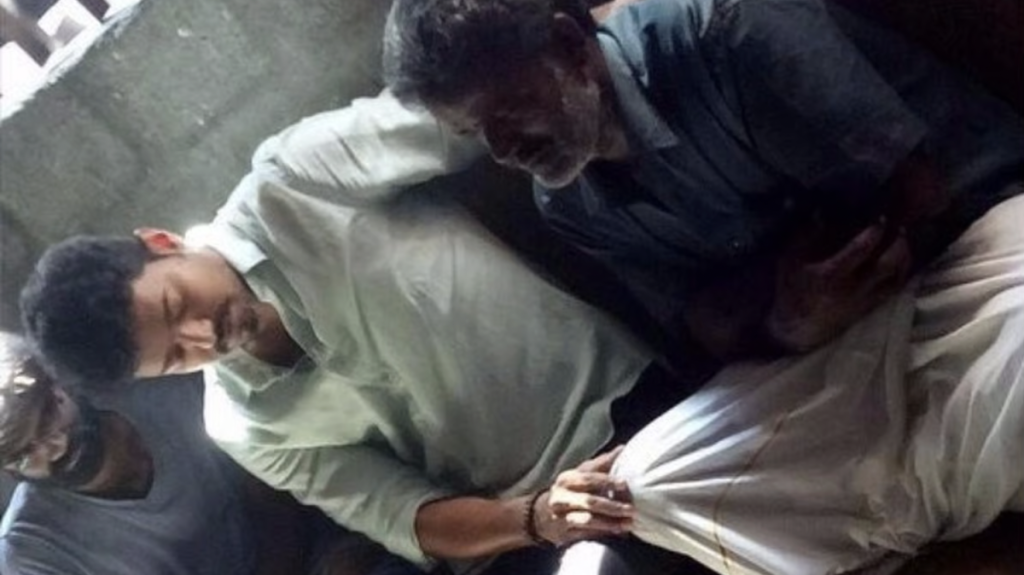
Vijay at the house of the Ariyalur student who died by suicide. Photo: The News Minute (https://www.thenewsminute.com/tamil-nadu/actor-vijay-visits-family-anitha-student-who-committed-suicide-over-neet-68217)
It appears Vijay has outsourced the very task of building of his party structure. He simply goes to events arranged by managers. He believes that if they manage to gather crowds and create the right optics, then people everywhere will vote for him and bring him victory. When such crowd spectacles are staged, he stumbles through prepared speeches and shows no concern when others point out the factual errors that crop up in those speeches.
Fans and common people
In such ungrounded politics, it is the fans who get caught and degraded, and that is painful. As far as they are concerned, they believe they are creating history. Those who have participated in college strikes will understand this mindset. In my own college days, when we once went on strike, a fellow student asked if we could set fire to the principal’s office. The strike was merely over the poor quality of the food served in the hostel, yet in the minds of adolescent youth, it could feel like revolutionary transformation.
Common people have always lived with the frustration that all their grievances are not addressed. The underprivileged have many problems, and so they may dream of a saviour who will bring deliverance unto just society Even in a politically aware society, some individuals will have such fantasies of revolution. These may take a religious form, a political revolutionary form, or simply follow some mirage of image making politics.
Among modern day republics, the United States is the oldest. There, a constitutional democracy has existed for nearly 250 years. In such an educationally and economically advanced society, we have seen Donald Trump – a real estate businessman who became famous through a television show – rise to the presidency with mass following and cause international reverberations that make many deeply worried. His mental stability has been questioned by his own former staff.
Italy, a country that has contributed greatly to republican thought – from the Roman Empire to the Renaissance of the 15th century – has repeatedly served as an experimental field for political ideas. In such a country, we saw Silvio Berlusconi (1936–2023), a populist authoritarian, gain mass support and consolidate power. Therefore, in Tamil Nadu, it is not surprising that some might follow an actor like Vijay.
Our political maturity must know when to confront and critique him to prevent such unfortunate events like the stampede from occurring. For this, there is no need to denigrate the progressive political society we have successfully built as Dravidian Tamils. Even when an undesirable incident occurs, we must learn from it and prevent the Brahminical social unconscious from misrepresenting Dravidian politics.
Rajan Kurai Krishnan teaches at Ambedkar University Delhi. His email is rajankurai@gmail.com.
This piece first appeared in Tamil in Minnambalam and has been translated and republished with permission.
This article went live on September thirtieth, two thousand twenty five, at thirty-three minutes past four in the afternoon.The Wire is now on WhatsApp. Follow our channel for sharp analysis and opinions on the latest developments.


