

A Corpse With Missing Eye and The Troubling State of Public Health System in Bengal


Barasat: The discovery that one eye was missing from the body of a road accident victim at Barasat Medical College has brought renewed attention to what experts have described as serious structural problems in West Bengal’s public health infrastructure.
While chief minister Mamata Banerjee, who also holds the health portfolio, was quick to offer a government job to the victim’s mother and promise an investigation, a deeper analysis revealed this is not an isolated crime but a symptom of a multi-dimensional crisis plaguing the state’s healthcare system.
On November 25, Kazipara resident Pritam Ghosh died after being struck by a vehicle. His body was kept in the morgue of Barasat Medical College, where his family later arrived to find that one of his eyes was missing. The shock quickly turned into public anger, spilling onto the streets and blocking the convoy of the chief minister as she returned from a political rally.
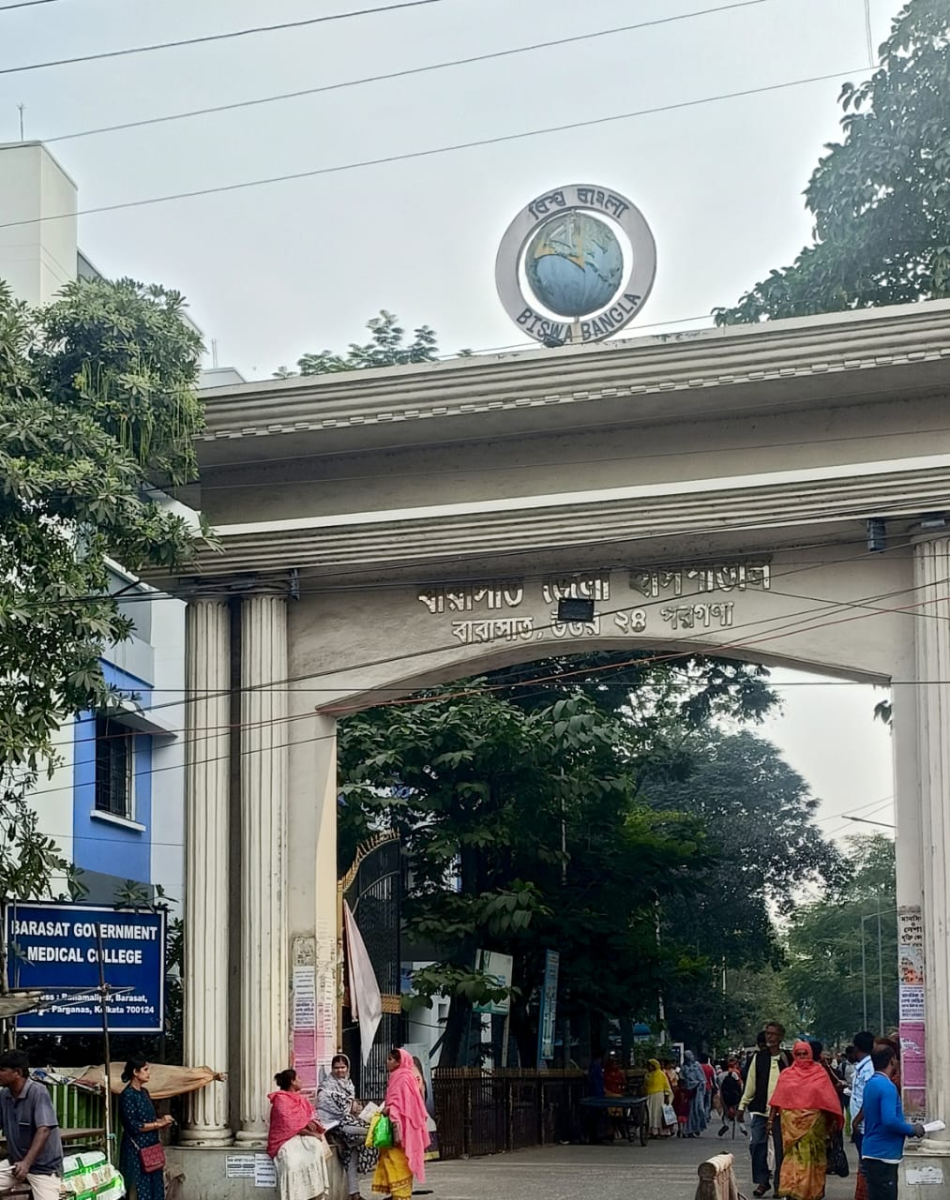
The main entrance of the Barasat Medical College. Photo: Joydeep Sarkar
Forced to halt for around 15 minutes, Banerjee addressed the grieving family and the crowd, saying, “When the family says it, there must be some truth to it. If the incident has happened, there will be an investigation. CCTV footage will be examined. Those who committed the crime will be punished.”
The family initially suspected organ trafficking. Forensic officials, however, have floated an explanation that is no less disturbing.
A senior doctor on the forensic team, speaking anonymously, said, “While many government medical colleges have been opened in West Bengal, none of them have modern, scientifically maintained infrastructure. Our preliminary assessment is that rats or similar animals may have caused the damage. Bodies are often left on the floor, creating conditions for such incidents.”
Locals say Barasat Medical College embodies the gap between optics and reality. The hospital complex has been expanded and painted in the state government’s signature blue-and-white colours, but inside, they say, conditions are dire.
“The chief minister herself admits that someone or some group committed the crime. Barasat Medical College has become large, painted blue and white all across, but you will understand the actual situation once you enter the medical college. Even a corpse is not safe here,” said Tapan Ghosh, a local resident.
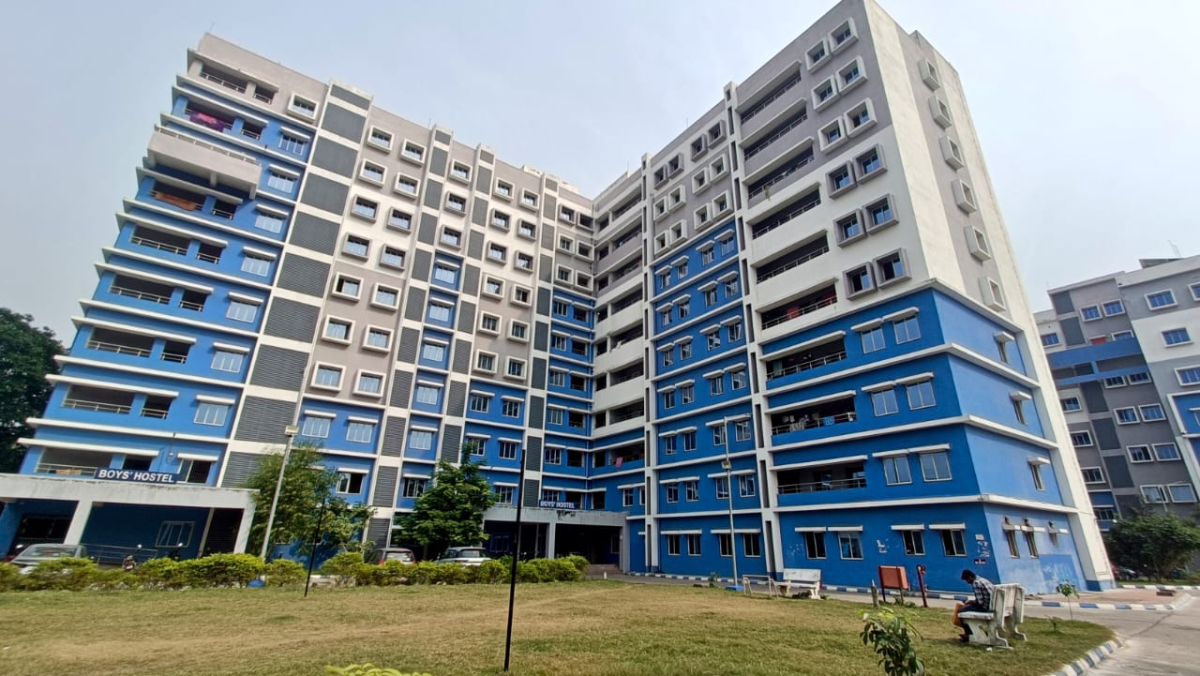
The buildings of Barasat Medical College painted in West Bengal government's signature blue-and-white colours. Photo: Joydeep Sarkar
Public health experts argue that while some primary health indicators have improved, like infant mortality and high institutional delivery rates, these successes mask a strategic failure at the tertiary level. The public system has effectively become a two-tier network, with relatively functional primary and maternal care on one side, and a “collapsed” emergency and tertiary care system on the other.
“Most hospitals lack proper infrastructure, and even when it exists, it is inadequate. When an incident occurs, there is a flurry of activity. For example, in Barasat, the deceased’s relative got a job. The cooler machine was started. Why wasn’t it running before?” asked Dr. Manas Gumta of the Association of Health Service Doctors.
The regulatory picture is equally stark. The National Medical Commission has issued 71 show cause notices to 36 government and private medical colleges across West Bengal in the academic years of 2024-25 and 2025-26. The warnings cite shortages of teaching faculty, poor physical infrastructure and substandard clinical parameters – all key indicators of how hospitals function on the ground.
State health expenditure is projected at about Rs 21,939 crore in 2025, a 2% reduction from the previous year, and amounts to only around 6.4% of the state budget, placing West Bengal in the middle-to-lower layer of Indian states by priority. Within that limited envelope, most of the money goes to salaries and routine curative care. Capital spending on new wards, equipment and basic repairs are declining.
In practice, that means rusting morgue coolers, broken ICU machines and overcrowded wards unable to meet modern regulatory norms.
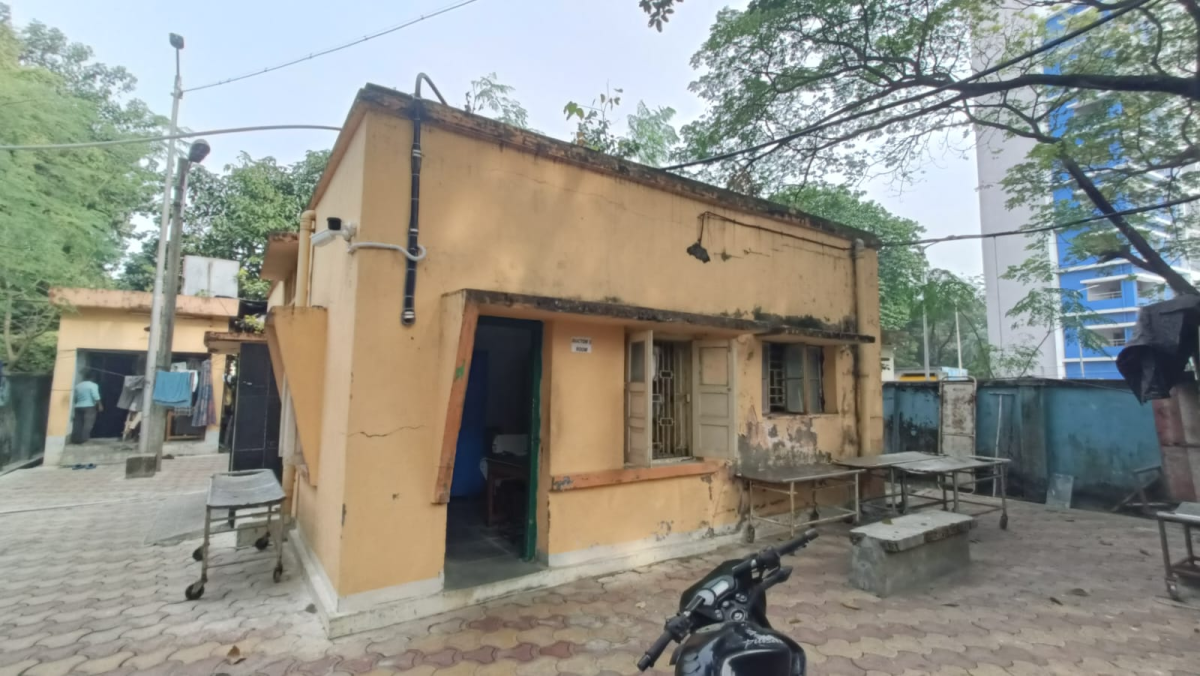
The morgue at Barasat Medical College, Barasat, West Bengal. Photo: Joydeep Sarkar
For citizens, structural neglect translates directly into high personal costs. West Bengal’s per capita Out-of-Pocket (OOP) health expenditure was Rs 4,010 in 2021-22, the second highest in India. Families often end up paying heavily when the public system fails during emergencies and, despite schemes on paper, they are pushed either into private hospitals that partially honour cards like Swasthya Sathi or into debt.
At Barasat Medical College, the gap between policy and lived reality is visible right at the gate. Two security guards stand watch while relatives of patients camp under makeshift tarpaulin tents in a small open space, wrapped in mosquito nets through the winter chill.

Relatives of patients camp under makeshift tarpaulin tents in a small open space outside the hospital. Photo: Joydeep Sarkar
“My sick father is undergoing treatment here,” said Reena, who has been staying on the premises. “Whenever any medicine or injection is needed, we have to buy it from outside. And there is no place for relatives to stay.”
Inside, a small informal market has sprung up where patients and their families buy daily essentials. That area too is packed with buyers and vendors.
Tucked behind the giant blue-and-white blocks is a small, dilapidated yellow single-storey building – the post-mortem room. The nameplate has fallen off.
A young man from Deganga, Anisur Rahman, said that a few months ago, a relative of his died in an accident. When the body was brought here for post-mortem, the money they had to spend on buying ice, along with various other unofficial expenses, left them exhausted.
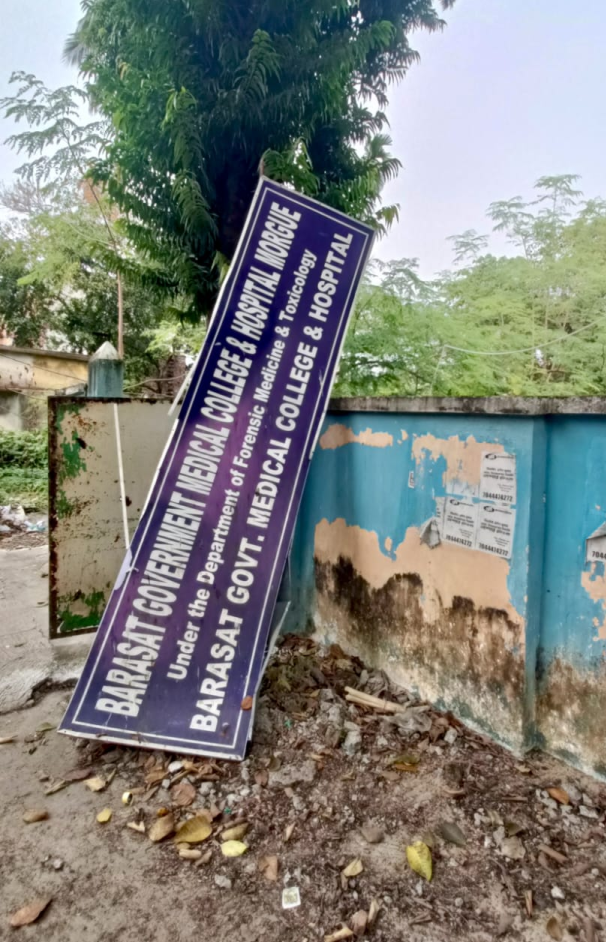
A fallen signboard of the medical college, Barasat, West Bengal. Photo: Joydeep Sarkar
“We wondered whether it costs more to keep a dead body preserved than to keep a person alive,” he said.
Dr Abhijit Saha, the medical superintendent-cum-vice principal of Barasat Medical College, the only official willing to speak on record, rejected allegations of institutional failure.
“We have a forensic team; they conduct the post-mortem. I would need to check documents to tell you how many are on the team,” he said. “There is a cooling system in that building for preserving bodies. However, when too many bodies come in, we sometimes have to bring extra ice from outside.”
His remarks only deepened the uncertainty. In a facility where the cooling system is supposed to regulate temperature and maintain sterility, the possibility of rodent intrusion points to serious lapses.
Regarding whether the cooling unit was functioning on the day Ghosh’s body was stored, no authority has offered a definitive explanation.
Following the furore, the body was sent for a second post-mortem. Both the chief minister and the medical college administration have announced an inquiry. Banerjee has also confirmed a government job for the deceased youth’s mother, who was promptly issued an appointment letter.
“Such incidents are not rare – similar cases have occurred at Kolkata Medical College and North Bengal Medical College, where animals have eaten parts of bodies, including the nose and ears. In those cases, bodies were handed back only after reconstructive work. But an eye cannot be reconstructed, which is why this case is so visible,” said the forensic expert in the hospital.
The case has already faded from public attention as the state moves into election mode.
Translated from Bangla by Aparna Bhattacharya.
This article went live on December eighth, two thousand twenty five, at five minutes past seven in the evening.The Wire is now on WhatsApp. Follow our channel for sharp analysis and opinions on the latest developments.


