

Bihar Assembly Elections: After Close Contest in 2020, SIR, Jan Suraaj Factor Can Spring Surprises


New Delhi: The Election Commission of India (ECI) on Monday (October 6) announced a two-phase Assembly election for Bihar on November 6 and 11, with votes to be counted on November 14, setting the stage for a high-stakes contest shadowed by a contentious revision of the state's electoral rolls.
Chief Election Commissioner (CEC) Gyanesh Kumar, addressing a press conference on Monday, confirmed the schedule for all 243 Assembly constituencies and also announced simultaneous bye-elections for eight seats across seven other states and union territories.
The announcement positions the election as the first major electoral test following the controversial Special Intensive Revision (SIR) of voter lists, and marks the political debut of strategist Prashant Kishor’s Jan Suraaj party.
Scale of the electoral exercise
The election will see approximately 7.42 crore voters decide the state's future. This electorate includes about 3.92 crore men, 3.5 crore women, and 1,725 transgender individuals. Notably, the rolls feature 14.01 lakh first-time voters aged 18-19, over 4 lakh very senior citizens above 85, and a remarkable 14,000 voters who are over 100 years old.
Voting will take place across 90,712 polling stations, the majority of which (76,801) are in rural areas. To ensure security and access in difficult terrain, the CEC noted that police will use horses for patrolling around 250 polling stations and boats for 197 others.
Schedule and new measures
The election will be held in two phases, a reduction from three in 2020. The first phase on November 6 covers 121 constituencies, and the second on November 11 covers the remaining 122.
The CEC detailed several new initiatives, including the first-time use of colour photographs of candidates on EVMs. Webcasting will be implemented in 100% of polling stations. Other measures include mobile phone deposit counters, a cap of 1,200 voters per booth, and a revised protocol to ensure postal ballot counting is completed before the final two rounds of EVM counting.
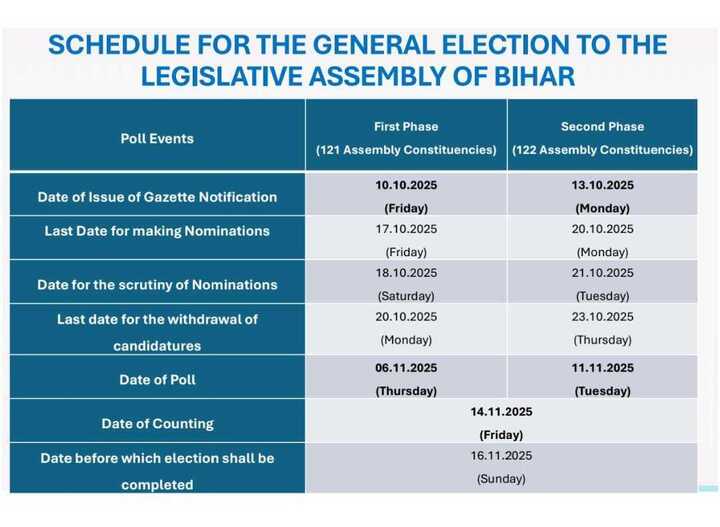
Photo: X.com/@ECISVEEP
Simultaneously, bye-elections will be held on November 11 for constituencies in Jammu and Kashmir, Rajasthan, Jharkhand, Telangana, Punjab, Mizoram, and Odisha, with votes also counted on November 14.
A controversial prelude
This election follows the first SIR in Bihar in 22 years, an exercise the ECI has termed a "purification" of the electoral rolls. The final list, published on September 30, contains 7.42 crore voters, a net reduction of 47 lakh from the 7.89 crore on the rolls in June.
While the ECI maintains the process has made the list cleaner, the SIR has been plagued by allegations of irregularities. The Congress party claimed the number of deletions in some constituencies exceeded 2020 victory margins.
Independent analysis of the commission's published data highlighted statistical inconsistencies, pointing to an "unexplained surplus" of additions and removals when comparing final figures to the number of applications received.
Further reports noted that women electors, particularly younger married women, were disproportionately removed under the "permanently shifted" category. Some analyses calculated a potential "democratic deficit" of 83 lakh people when comparing the final electoral roll against official population projections for the state, raising questions of potential disenfranchisement.
The Prashant Kishor Factor
Adding a potent layer of unpredictability is the entry of Prashant Kishor’s Jan Suraaj Party. Long a backroom strategist, Kishor has taken a frontline role, positioning his party not as an ally to the established blocs but as a genuine alternative.
Dismissing the label of a ‘vote katwa’ (spoiler), Kishor argues a significant portion of the electorate is disillusioned with both the NDA and the INDIA alliance. “When you say the two formations of INDIA and NDA, how much vote do they have? 72% adding both,” he said in a recent interview. “So, 28%, literally one-third of Bihar, has not voted for either… We are cutting so many votes of both sides that they will be finished.”
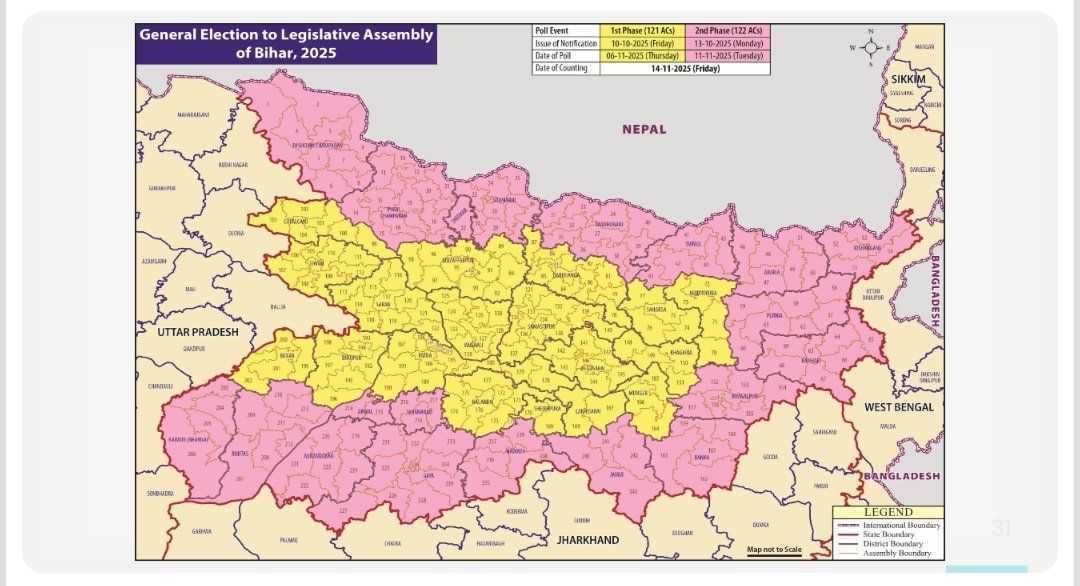
Photo: X.com/@ECISVEEP
His party aims to tap into this pool of unaligned voters, focusing on issues of governance, jobs, and migration, which he claims were exposed as hollow promises during the COVID-19 pandemic.
What happened in the previous election in 2020?
The 2025 contest will be fought in the shadow of the 2020 election, an incredibly close race that delivered a complex verdict. The NDA secured a narrow majority with 125 seats to the MGB's 110, despite both alliances capturing an identical vote share of 37.2%. The outcome was defined by several dynamics that remain critical.
- Low turnout, decisive gender gap: Bihar's reputation for low voter enthusiasm held, with an overall turnout of just 57.1%. However, the gender gap was decisive: 59.76% of registered women voted, a significant 5 percentage points higher than the 54.7% turnout among men. This gap was widely seen as a key factor in the NDA's victory.
- Alliance strike rate was key: The election was ultimately won and lost on the performance gap between allies. The BJP's stellar 67.3% strike rate (74 wins) compensated for the JD(U)'s poor 37.4% (43 wins). Conversely, the RJD's strong 52.1% strike rate (75 wins) was sunk by the Congress's dismal 27.1% (19 wins).
- Spoilers and new forces: The Lok Janshakti Party (LJP) played a decisive spoiler, costing the JD(U) an estimated 33 seats despite winning only one itself. The AIMIM established a five-seat foothold in Seemanchal, while a resurgent Left won 16 seats, proving its genuine grassroots support.
- A close and crowded field: The election was extraordinarily tight, with 40 seats decided by a margin of less than 2%. Although the field was crowded with a record 213 parties, the contest was top-heavy, with 86.7% of candidates losing their deposits. The 7 lakh votes for NOTA ("None of the Above") also exceeded the victory margin in 27 seats.
Given these razor-thin margins from 2020, the controversies around the SIR and the entry of a new political force like Jan Suraaj could have a profound impact on the 2025 results.
As the election process comes under scrutiny, read The Wire's coverage of the Bihar SIR, opposition's allegations and more, here
This article went live on October sixth, two thousand twenty five, at three minutes past seven in the evening.The Wire is now on WhatsApp. Follow our channel for sharp analysis and opinions on the latest developments.


