

Centre Releases New 'Blueprint' to Access Health Data 'Within Five Clicks'


New Delhi: For years, India’s health ministry has been trying to work out how they plan on incorporating technology into healthcare. The lowest hanging fruit has not been to increase access to healthcare via technology, but to collect massive amounts of health data and figure out how to use technology to harvest it.
One move in this direction is the government’s latest ‘National Digital Health Blueprint’ (NDHB) which is now open for feedback from stakeholders for a period of three weeks.
The government plans on using Aadhaar as a primary identifier here, and wants a citizen to be able to access their data “preferably within 5 clicks.”
Also Read: Govt Exploring Use of Artificial Intelligence in Public Health: Harsh Vardhan
One of the major triggers for this blueprint is the Ayushmaan Bharat health insurance scheme, which routinely generates “enormous amounts of health data” on Indian patients. Over 30 lakh patients have reportedly used the scheme so far, but the government has been reluctant to release any disaggregated anonymised data. The health minister said on Monday that the NDHB will “accelerate our efforts towards universal health coverage,” or the health insurance model.
The other health programmes right now which have been made dependent on technology include some reproductive child healthcare schemes, NIKSHAY for TB patients, the Hospital Information System and the Integrated Disease Surveillance Programme.
The #NDHB is set to accelerate our efforts towards achieving #UniversalHealthCoverage with complete transparency & accountability. India shall hence lead the world in digital healthcare revolution.@PMOIndia @narendramodi @AyushmanNHA @NITIAayog pic.twitter.com/F2NoQeaEKY
— Dr Harsh Vardhan (@drharshvardhan) July 15, 2019
The blueprint explains that technology will need to be used to create district-level electronic databases, establish registries for all diseases of public importance, promote the adoption of standards by different players, create a system of personal health records to be accessible based on “citizen consent” and “most significantly”, to develop a linkage across public and private health providers at the state and national-level.
It also plans to establish a ‘National Digital Health Mission.’
Aadhaar is going to be important to the digital health push of the government, with “identification” being listed as one of the building blocks of the blueprint. Aadhaar is the first suggested method for this identification under Section 7 of the Aadhaar Act.
Indian officials writing this report have studied a few global cases before formulating this blueprint, such as the UK’s National Health Services and the South Korean model of healthcare.
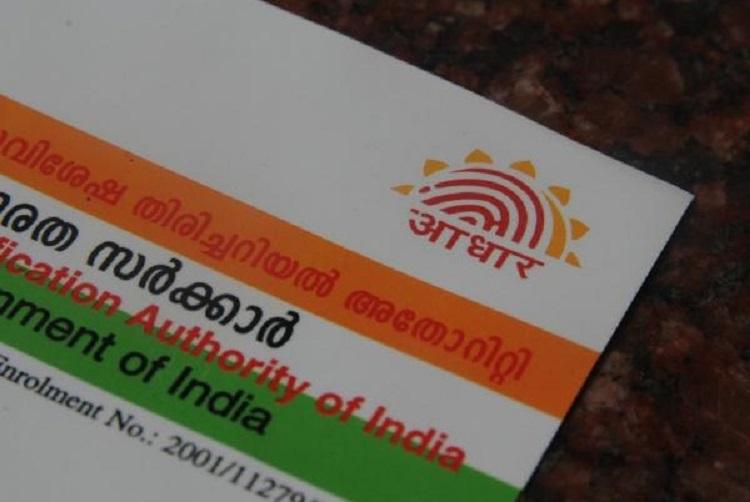
Aadhaar is the first suggested method for identification. Photo: PTI
Before the blueprint
This step on the road to “digital health” was recently preceded by the National Health Stack in July 2018, released by NITI Aayog. A committee was constituted to examine it, with officials from the Ministry of Electronics and Information Technology and the Unique Identification Authority of India (UIDAI), which manages Aadhaar. This blueprint is a result of the deliberations of the committee that examined the report.
But just a few months before the NITI Aayog released the blueprint, the health ministry also released a draft of the ‘Digital Information Security in Healthcare Act’ (DISHA), also inviting public comments. The Bill has not made it to parliament yet and no updated draft has been circulated. Its parent legislation, the Personal Data Protection Bill, 2018 has also not been passed yet.
In 2013, the government notified the Electronic Health Record Standards (EHR), updating it in 2016.
This article went live on July sixteenth, two thousand nineteen, at thirty minutes past three in the afternoon.The Wire is now on WhatsApp. Follow our channel for sharp analysis and opinions on the latest developments.


