

Speak Up, Veterinary and Animal Scientists, Against the Non-Science Surrounding the Cow


I am outraged and embarrassed at how much longer the community of veterinary and animal scientists to which I belong will continue to remain silent, passive and unquestioning of the utter non-science, falsehoods and irrationality being spouted by our country's top animal husbandry and veterinary science policy makers, in the name of ‘cow protection’.
The most recent example of this was the "appeal" from the Animal Welfare Board of India issued on February 6, to ‘hug cows’ and declare Valentine’s Day ‘ Cow Hug Day’, citing Vedic traditions allegedly being replaced by Western culture as the basis for this proposal. This was rapidly withdrawn on February 10. No reasons were cited.
Is it that the government was suddenly gripped by acute discomfort at having been swiftly and effectively exposed and torn apart by citizens of this country, in front of a galaxy of global dignitaries currently in different parts of India discussing the G20's “One Earth, One Family, One Future" plans for science, education, climate change, energy, agriculture, tourism and what have you?
Whatever the reason may be, it is completely condemnable that the Department of Animal Husbandry, of which the Animal Welfare Board is a part, far from promoting scientific temper and rational thinking amongst India’s citizens, uses its executive position to lend state patronage to fuel the growing Hindu right-wing vigilante groups' vicious annual attacks against Indian citizens celebrating Valentine’s Day (which they too consider to be Western culture invading and replacing Indian culture aka Vedic cow culture) and/or lynching citizens, invariably Muslims, Dalits or Adivasis, for being “anti-cow".
What do they so hate about Valentine’s Day? It has nothing to do with stopping Western culture, but everything to do with policing the defiant and brave young women of this country, whose decisions on love challenge the caste and patriarchal codes of the Manusmriti and the false boundaries of religion. Ironically, the latter was recently valorised by a high court judge, for being the only means by which women can advance in the STEM disciplines. Over a century ago, it was Dr B.R. Ambedkar who pinpointed how the reproduction of caste hinges on the strict Brahminical patriarchal rules of endogamy and control over women’s sexuality.
And as for the love of the holy cow via governments policies on cow protection – it’s the great unholy lie. Data, not cow-hugs, matter. Across the cow belt of India, which has stringent anti-slaughter laws, cattle populations are on the decline. Farmers have responded to the relentless focus on mechanising agriculture, coupled with strictures on slaughter and inter-state transportation of cattle, by letting loose onto the fields their unproductive bullocks and cows, preferring to restock with buffaloes. Burgeoning stray cattle populations invading farms and streets are chased away by harassed farmers, and these stressed usually docile animals are actually then in self-defence turning on humans.
The government’s ‘Atmanirbahar’ dairy policy is to double milk exports via expanding domestic milk production and processing capacity. It was recently given a fillip by establishing a national level multi-state cooperative export society. Nearly 95% of this year's animal husbandry budget is directed towards this industrialising dairy project. Farmers respond by shifting their production away from multifunctional cattle breeds to high milk producing crossbred dairy cattle. This spells bad news for cows and their welfare, as cows end up being reared merely as milk producing machines, without rest. Farmers, under pressure for their animals to produce more, end up also being pushed into adopting more harmful management practices. The higher producing animals are also genetically more susceptible to diseases such as Mastitis, resulting in increased antibiotic use.
As soon as cows cross their fourth lactation, they have to be replaced by younger stock. The illogical anti-slaughter laws force farmers to either turn their animals out on to the roads, or send them to overflowing and underfunded gaushalas, or ‘smuggled’ surreptitiously under horrific conditions via the thriving underground trade in cows destined for slaughter, handled in many instances by the self-appointed cow vigilantes. The governments extremely illogical and short-sighted technological solution is ‘same sexed semen’ to completely eliminate male cattle, and only have females. Once again they ignore the reality of the misery that awaits the unproductive cow, as also the foolishness of abandoning male cattle as a prime renewable and ecologically sustainable source of energy in farming.
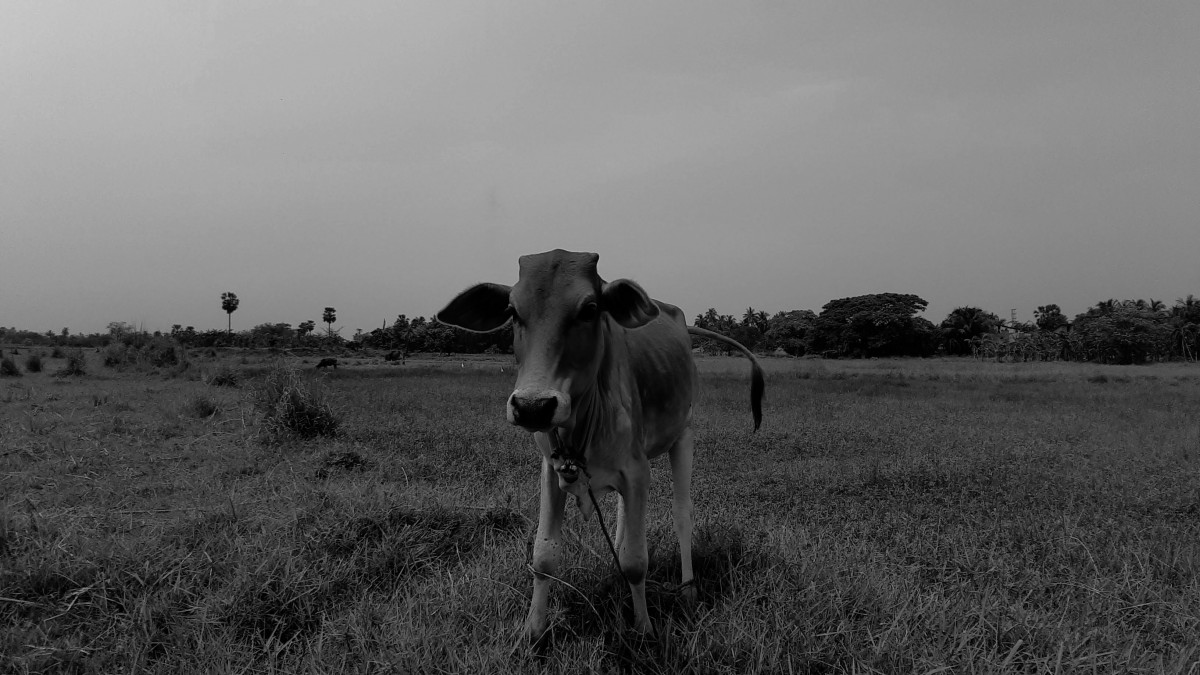
Photo: Titas Mallick/Unsplash
Of equal concern is how this policy reflects zero love for the environment, promoting the extraction and export of scarce primary and survival resources of citizens, namely precious water and energy, as also replacing vital lands which should be put to diverse food to feed our citizens, to animal feed to meet industrialising export driven dairying.
Higher and higher milk production can no longer be supported now by animals merely grazing on grazing lands and crop residues, but by feeding higher quantities of animal feed, and thus vast lands under animal feed crops. Intensification is contributing steadily to the climate crises, down the value chain, unrecorded and hidden from public scrutiny. Absolutely no data from India exists on the carbon emissions down the value chains of India’s top dairy processors that control the organised dairy markets in India, which in 2018-19 made up 50% of India’s dairy market, and are now poised to drive exports.
Finally, it reflects no love for the livelihoods, food and nutritional security of small and marginal producers, vendors, traders, transporters and consumers down the value chain of dairying. The overarching policy framework of the government to meet their export driven pathway to ostensibly double farmers’ incomes is to aggressively ‘organise’ the so-called ‘unorganised’ sections of the animal/animal products value chain and facilitate its capture by the private-corporates and/or cooperative agribusiness.
The acute problem with this way of organising the unorganised framework is that it displaces those millions of small players who populate the ‘unorganised’, further adding to the rising unemployment figures of India, something the budget fails to acknowledge. Consolidation of the supply chain happens at the production end, with production moving from the 1-2 animal owning marginal farming households to larger producers, organised through FPOs/cooperatives, and distribution and sales getting monopolised and controlled by fewer and fewer bigger hegemonic agribusiness corporate cooperative players down the value chain. Studies have clearly shown how the capitalisation and ‘organising’ of the sector has thrown the really small producers and other small actors out or production, processing and distribution.
True love for the cow demands a total reversal of this cow-love horror reality show – something which has been analysed in these and other columns.
But in this country, love has to struggle to survive, whilst it’s so easy to hate. Fellow veterinarians and animal scientists of India: in-service, retired, government and private and future vets – the veterinary and animal science student community… It’s time to break the silence and speak truth to power, to counter the politics of hate with the politics of love.
Happy Valentine’s Day.
Sagari R. Ramdas is a veterinary scientist associated with the Food Sovereignty Alliance, India. She can be reached at sagari.ramdas@gmail.com.
Edited by Jahnavi Sen.
This article went live on February thirteenth, two thousand twenty three, at thirty minutes past two in the afternoon.The Wire is now on WhatsApp. Follow our channel for sharp analysis and opinions on the latest developments.


