

Delta, not Delta Plus: Mix-Up Causes Tripura Government to Misclassify Numbers


Agartala: An apparent communication gap between the Tripura government and the Centre has left the state wondering if it has cases of the ‘delta plus’ variant of the novel coronavirus.
On July 9, the Tripura government imposed a weekend curfew and extended restrictions across the state until July 17, after it reported 138 cases of the delta plus variant, causing serious concern.
Health officials in a press conference said that a total of 152 samples were sent for sequencing at the National Institute of Biomedical Genomics, Kalyani, in West Bengal. Among them, more than 90% of the samples were reportedly of the delta plus variant. The variant was found not just in West Tripura, where a large number of COVID-19 cases have been reported, but even in other districts, the officials said.
Dr Tapan Majumder, head of the microbiology department of Agartala Government Medical College, had said that a total of 138 cases of the delta plus variant, 10 cases of the delta variant and three cases of the alpha variant had been identified among the samples.
And of the 138 instances of the delta plus variant, 115 were from the West Tripura district, eight from Sepahijala, five from Gomati, four from Unakoti, two each from South Tripura and North Tripura, and one each from Khowai and Dhalai districts.
Soon after the announcement was made, revenue secretary Tanushree Debbarma imposed a ‘weekend lockdown’ until 6 am on July 12.
Centre's clarification
Two days after the state announced 138 cases of the delta plus variant, the Ministry of Health and Family Welfare said in a July 11 press release that the delta plus variant had not been identified at all in samples from the state.
The release said that while three cases of the alpha variant (B.1.1.7) and 11 cases of the Kappa variant (B.1.617.1) had indeed been found among the Tripura samples, it said 138 samples had tested positive for the delta variant – not the delta plus variant. The delta variant is B.1.617.2. The delta plus is B.1.617.2.1, a 'descendant' of the delta variant.
A health official from the Tripura government told The Wire on condition of anonymity that an earlier press release issued by the Press Information Bureau (PIB) had caused the confusion.
“On June 28, the PIB issued a press release on the delta plus variant, where they had mentioned ‘B.1.617.2’ as the nomenclature for the delta plus variant. After our samples came, the same nomenclature was used. But now they have informed us that this is not the delta plus variant and is instead the delta variant.”
The June 28 press release from PIB called B.1.617 the delta variant (note the missing '.2').
Tripura chief minister Biplab Kumar Deb, who is also the health minister, had said from time to time "the parameters of the virus change". He added, "On this basis, the government of India has clarified the matter through PIB. The Government of India is monitoring the whole COVID-19 situation and we are unitedly following it."
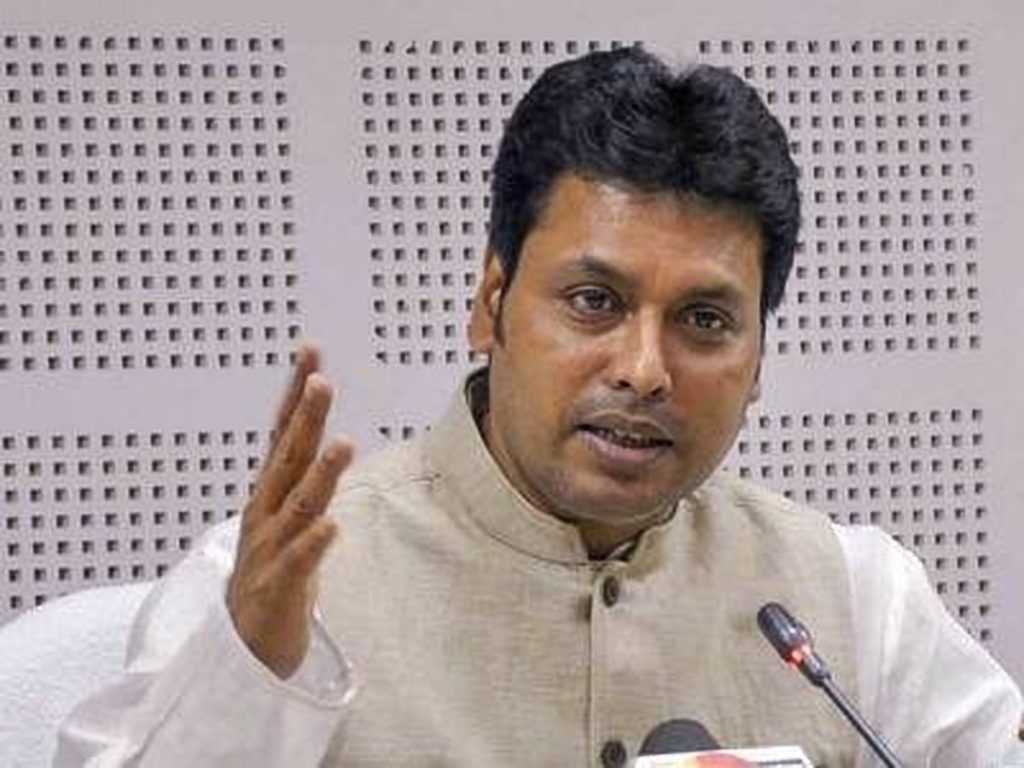
Tripura chief minister Biplab Kumar Deb. Photo: PTI
Inaccurate data on vaccination
But while the BJP-led Tripura government effectively blamed the Centre for the confusion, it hasn't been able to escape the Tripura high court's consternation over faulty vaccination information.
The government had claimed several times that among all states in the country, Tripura had the highest fraction of population inoculated with at least one dose of the vaccine – 98% of those older than 45 years and 80% of people across all ages.
Hearing a suo motu case on the state government’s preparedness, the high court questioned these figures on July 9. A division bench of Chief Justice A.A. Kureshi and Justice Subhasish Talapatra heared the case after the Tripura government filed an affidavit before the court.
The court order reads that on June 25, Siddharth Shiv Jaiswal, mission director of the state's National Health Mission, had told journalists that around 80% population of all eligible age groups and 98% people above the age group of 45 have been vaccinated (with the first dose). But the division bench said that from any angle, neither of these two claims could be accurate.
It said that on the date Jaiswal made the claim, the state had administered 14,36,595 doses to the 45-plus age group, of which 5,66,458 were second doses.
"This would mean that around 9 lakh people got the first dose – which would not come up to 98% of the eligible 12.36 lakh population," the court said, asking Jaiswal to clarify whether he had made an error or the press had misunderstood him.
A senior health department official told the Indian Express that the state’s actual target for the 45-plus category is just under 10 lakh and not 12 lakh. “There seems to be some miscommunication between the court and our office. We are sticking to our figure of 98% coverage in the 45-plus category. We will be submitting an affidavit soon,” the official said.
However, the official admitted that when Jaiswal had made the claim, the percentage of people who had been inoculated across all age groups was inaccurate. “The vaccination figure was somewhere between 70-75% at the time the claim was made… the figure is 80% in the 18-plus category now, but it wasn’t when the reports came out,” the official told the newspaper.
This article went live on July thirteenth, two thousand twenty one, at six minutes past four in the afternoon.The Wire is now on WhatsApp. Follow our channel for sharp analysis and opinions on the latest developments.


