

Fact-Check: Are Claims of IDEA Chairmanship as Endorsement of Election Commission and CEC Correct?


New Delhi: The Election Commission of India’s (ECI) portrayal of India’s assumption of the chairship of the International Institute for Democracy and Electoral Assistance (International IDEA) has led to questions.
While the ECI described the move as a unique global accolade recognising the “successful conduct” of Indian elections, official documents and International IDEA statutes confirm the position is a standard, rotational responsibility decided years in advance.
The claim
On December 3, 2025, the ECI released a press note announcing that Chief Election Commissioner (CEC) Gyanesh Kumar had assumed the Chairship of the Council of Member States of International IDEA for 2026.
In a video statement on social media, Kumar said: “The world recognises the successful conduct of free, fair and transparent elections in India. Therefore, for the first time in its history of 30 years, the group of 37 democratic countries of the world have invited India to chair [International IDEA].”
He described it as a moment of “immense pride for the citizens of India”.
The reality
However, critics challenged this narrative of a merit-based “invitation.” A “community note” – something that appears when X users dispute information shared in a post – attached to a news agency's post of the CEC’s statement on X pointed out that the chairship is rotational and pre-decided.
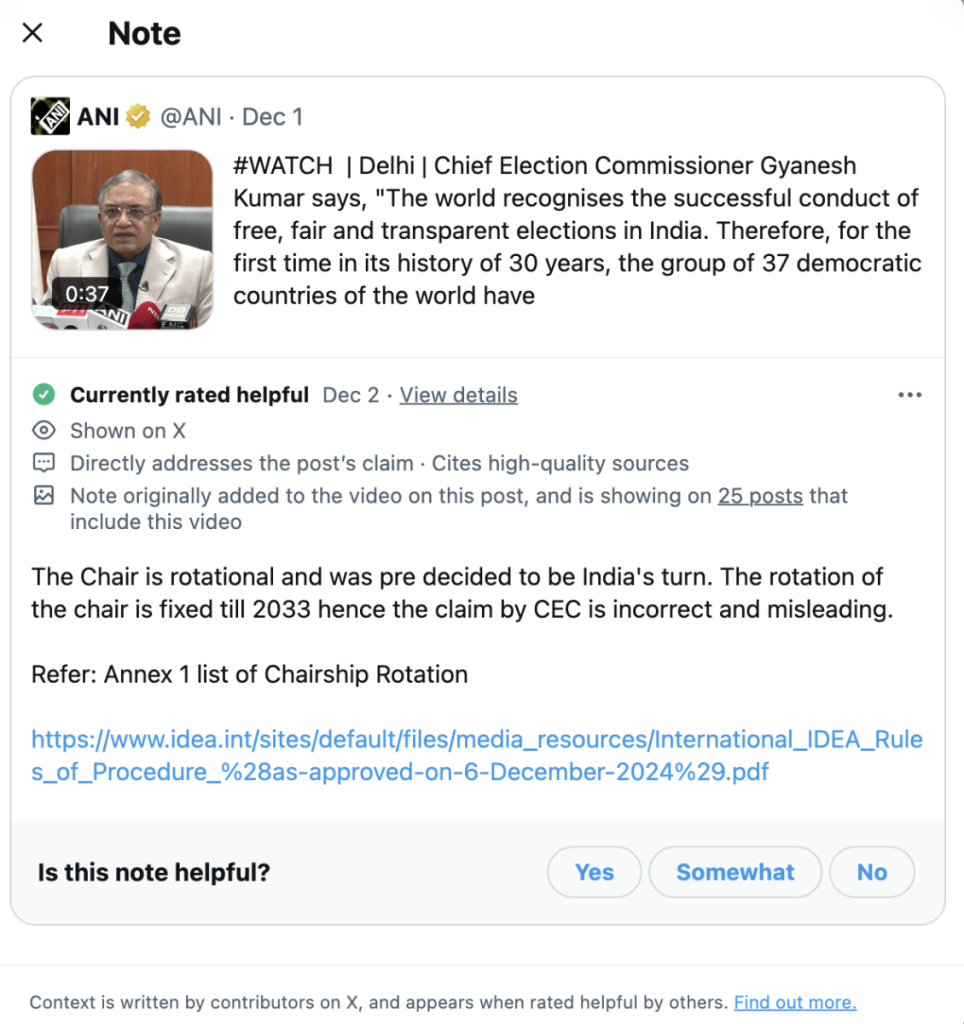
According to International IDEA’s statutes, the Council has an “annually and regionally rotating Chairship”. India’s turn in 2026 was fixed years ago, following Switzerland in 2025.
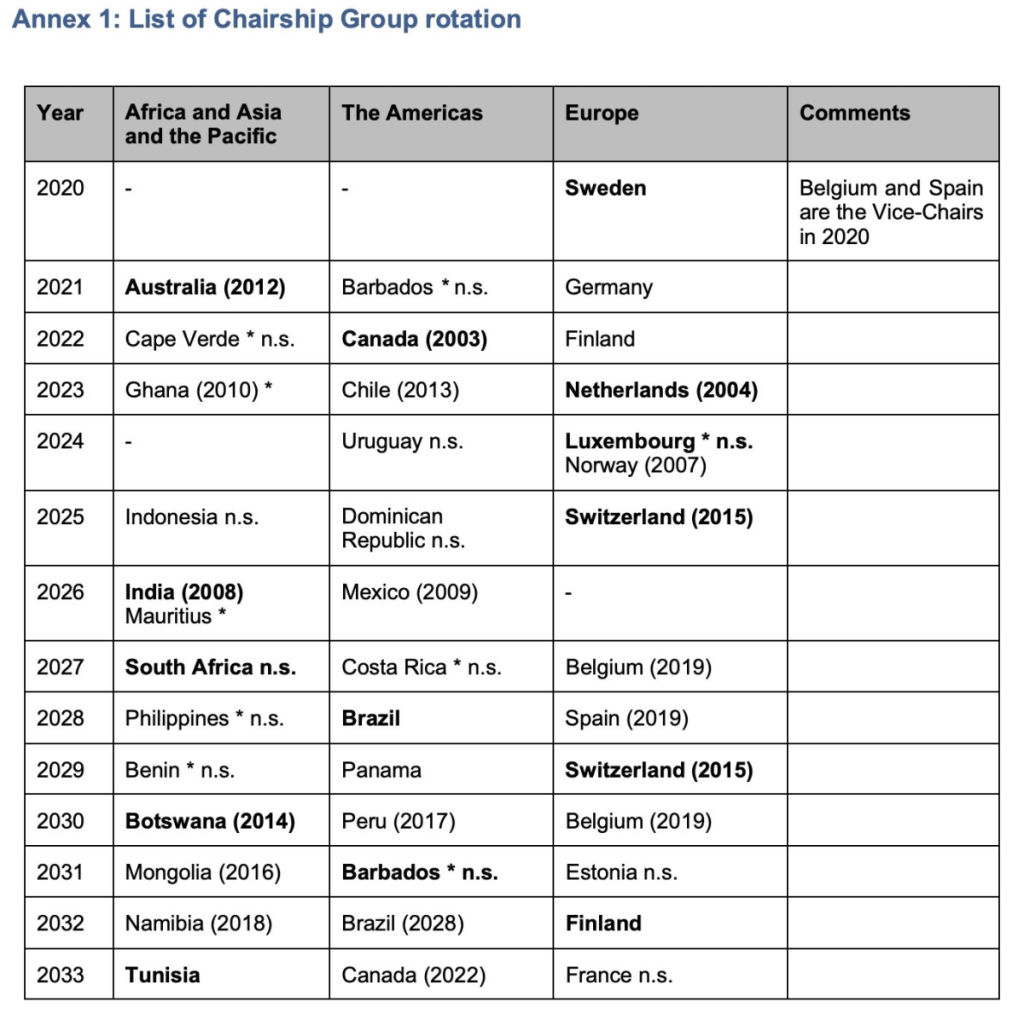
Source: International IDEA Rules of Procedure (As approved by the Council of Member States on 6 December 2024)
Observers note the position is a function of the calendar, not a qualitative judgment of the ECI’s performance. Presenting a pre-fixed bureaucratic turn as a spontaneous global ovation attempts to convert an administrative event into a moral certificate.
The G20 playbook
Analysts argue the CEC’s rhetoric adopts the “G20 playbook” – rebranding routine rotational responsibilities as diplomatic conquests to generate domestic support.
This pattern emerged during India’s G20 presidency. While previous hosts treated the presidency as a diplomatic duty, the Indian government treated it as a nationwide political campaign. The parallels are striking. Just as the G20 was used to project India as a “teacher to the world (vishwaguru)," the CEC is using the International IDEA chairship to claim global leadership in democracy.
Observers warn this risks collapsing the distinction between an independent institution and the ruling executive. When the CEC adopts the ruling party's rhetorical style – inflating achievements and erasing context – it signals that the Election Commission may be aligning psychologically with the executive.
The ECI recently faced scrutiny regarding its impartiality, from questions on poll scheduling to the handling of Model Code of Conduct violations, electoral bonds and the Special Intensive Revision (SIR) exercises in states. By claiming an international body “invited” India based on performance, the CEC was perhaps attempting to import legitimacy to silence domestic scepticism.
The domestic reality
While the ECI seeks global applause, former Election Commissioners flag serious issues at home. Writing in Frontline last month, former Election Commissioner Ashok Lavasa highlighted a shift in how the ECI handles the electorate.
Lavasa pointed to the SIR of electoral rolls, which began in Bihar and has expanded nationwide. He noted the ECI has effectively “shifted the burden” of proof onto the voter. Criticising the Bihar exercise as “exclusionary”, he warned that the contentious issue of citizenship remains implicit in the process. He argued this lays the ECI open to charges of “conducting an NRC (National Register of Citizens) through the backdoor”, especially given the lack of transparency on the number of people “excluded” in Bihar.
“The ECI seems to have seen the Bihar SIR through... even though the last word has not yet been pronounced by the Supreme Court,” Lavasa wrote.
The incident suggests that the image of global leadership often rests on verifiable half-truths. As the ECI prepares to “teach democracy” to the world in 2026, its domestic record – and its adherence to basic truthfulness – remains under a cloud.
This article went live on December fourth, two thousand twenty five, at fifty-nine minutes past two in the afternoon.The Wire is now on WhatsApp. Follow our channel for sharp analysis and opinions on the latest developments.


