

The Lack of a Legal Status for the Model Code of Conduct Leaves Room for Ambiguity


For the past few months, the Election Commission of India (ECI) has been brought under increasing scrutiny for its diffidence and deference to the ruling regime. The ECI’s deferral of announcement of dates for the state assembly elections in five states in October last year, was largely construed as giving time to the prime minister to complete his public address in Ajmer, before the Model Code of Conduct (MCC) kicked in.
More recently, the charges of EVM malfunctions and the ECI’s reluctance to check a more substantial proportion of VVPATs, and what appears to be its helplessness in restraining political parties – especially the ruling BJP – from violating the MCC, have diminished the stature of the ECI.
The diminution of the ECI is worrying, especially since over the years it had evolved as a protection against self-destructive tendencies within democracies. The unfettered use of divisive tropes, the unprecedented invocation of the armed forces to garner votes, the rampant use of technology to circumvent and bypass election rules to give a free run to propaganda machines on television, and failure to curb excessive expenditure by political parties, have distorted electoral competition.
The rules and procedures for administering elections emerged piecemeal after independence. Successive court decisions have made Article 324 of the constitution – the source of the ECI’s authority – a ‘reservoir of powers’, giving the ECI residuary powers in a variety of situations.
Within the framework of ‘electoral integrity’, the ECI is expected to ensure procedural certainty in order to affirm democratic outcomes. The MCC is an important mode through which procedural certainty and deliberative content of elections are assured.
Also Read: Editorial: The Election Commission’s Silence Is Complicity
A ‘firmed up’ MCC authorised by the ECI came into force in 1979. Its antecedents can, however, be traced to the consensus over norms of behaviour during election time drawn up by the government of Kerala before the general elections of 1960. The ECI buttressed it in 1968 in consultation with political parties.
Despite the fact that it emerged as a moral code for voluntary adherence, over the years the MCC has acquired ‘supplementary legality’, filling up a vacuum that has existed in election law. Since the MCC itself does not have the force of law, it is enforced through executive decision-making. It remains, therefore, ambiguous and uneven as far as the modality of implementation and certainty of execution, are concerned.
Unlike the attention ECI as received in the recent past, it did not always dominate the newspaper broadsheet during election time. In the months leading to the first general election, reporting on different aspects of the electoral contest, the newspapers were silent on the ECI itself.
In the ECI’s first narrative, CEC Sukumar Sen appears to interpret the ECI’s constitutional role in conducting election as one of meticulous and efficient bureaucratic administration. Writing after the mid-term elections of 1968, CEC S.P. Sen Verma highlighted the importance of a deliberative space during elections, ensuring that opposite views are heard.
For Sukumar Sen, the problem of ensuring procedural certainty was paramount at a time when procedures were at an incipient formative stage. For S.P. Sen Verma, the problem of persuading political parties to submit to the ‘moral order’ of a code of conduct assumed primacy. For Sen Verma, the importance of MCC lay in providing the unconstrained space for prior discussion, so that the vote – when it was finally cast – had the quality of intelligent consent.
It may be recalled that the 1967 general elections were the last in India where the Lok Sabha and State Assembly elections for all states were held simultaneously. It was also the election where the Congress’s stronghold in the states weakened with seven states including Gujarat, Orissa, West Bengal and Kerala slipping out of its control.
Watch: Is the Election Commission’s Credibility in Question?
The idea that free and fair elections required strict adherence to rules was, however, being presented through different platforms by political parties in the first general elections. Indeed, political parties addressed the electoral bureaucracy, reminding them of the importance of bureaucratic neutrality to ensure that the party in power was not placed at an advantage.
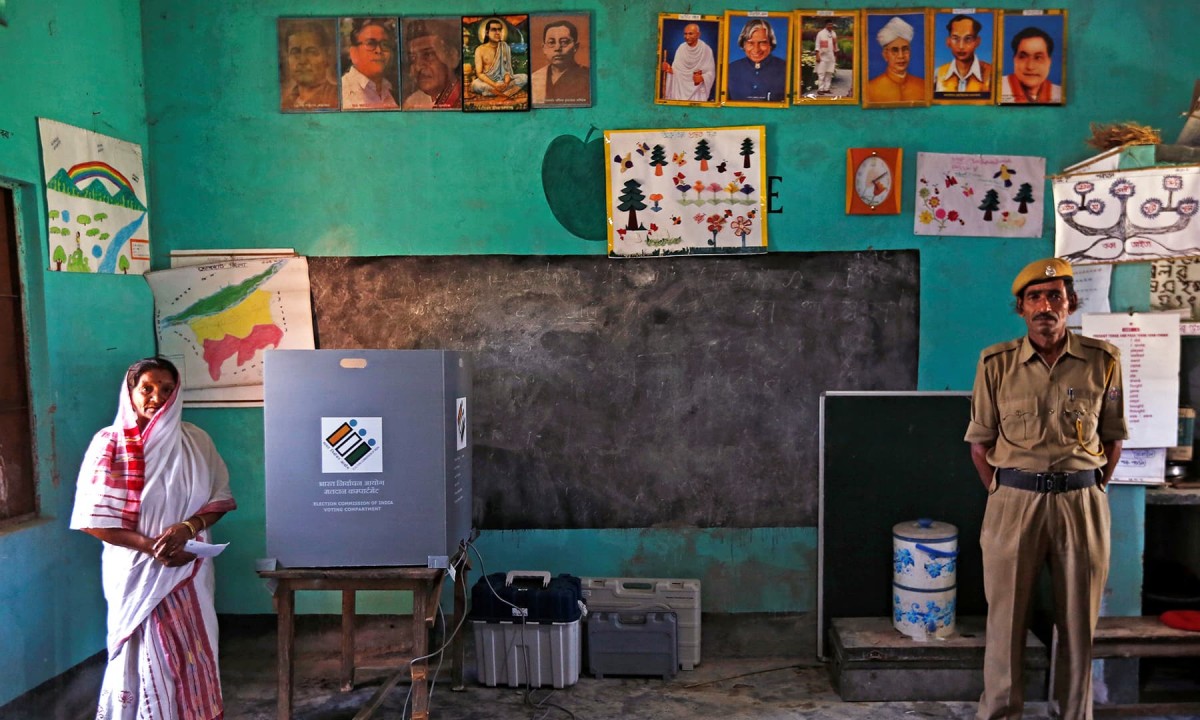
A woman leaves after casting her vote at a polling station during the first phase of general election in Majuli, a large river island in the Brahmaputra river, in the northeastern Indian state of Assam, India April 11, 2019. Credit: Reuters
Amidst allegations of misuse of official machinery by the ruling party, Nehru reminded all political parties to adopt the right means, in order to ensure fairness in electoral outcome. Speaking in Akola, in Maharashtra, Nehru reminded public servants to stay neutral. Nehru’s statement was, however, in the nature of what he called a ‘warning’: ‘It had come to his notice’, he said, that ‘officials here are trying to create trouble and are taking sides in election matters. I warn them this is not a threat that a full inquiry will be instituted against any officer who does an improper thing or interferes in election matters. Officers all over India have been given strict instructions to keep away from electioneering and if any official is found guilty of misconduct, he will be severely dealt with’. Nehru’s warning was received with prolonged cheers from the crowd, to which he responded: ‘From your cheers it is clear that you also feel that officials are creating trouble here’.
The Bharatiya Jana Sangha addressed itself to the party in power, through the idiom of civil liberties. Speaking at the All India Civil Liberties Conference in Nagpur on 25th August 1951, Syama Prasad Mookerjee claimed that the protection of civil liberties was a component of free and fair elections.
Speaking in the context of the first constitutional amendment, Mookerjee linked free and fair elections with freedom of speech, and warned against ‘bogeys of upheavals and perilous consequences raised to justify the arbitrary exercise of power by government’. He exhorted the press, the bureaucracy, and the judiciary to be free, and independent of the party in power, and made a case for freedom of expression as the ‘test issue’ in the coming general elections.
Since 1991, the Model Code has come to be seen as an integral part of elections. It was also during this period that the MCC experienced its passage from an ‘agreed set of dos and don’ts’ among political parties, to a measure directed at restraining the party in power.
James Lyngdoh, the CEC of India from 2001 to 2004, describes this transition as ‘pitching into the party in power’. The possibility of transition to a pitcher’s role in preference to a referee’s role, vis-à-vis the ruling party, emerged in the 1970s when electoral competition started becoming more plural. It is at this moment perhaps that the Election Commission may be seen as having put in place more assuredly than ever before the process of ‘institutionalisation of democratic and electoral uncertainties’ through the establishment of procedural certainty.
Also Read: The Election Commission Must Do Much More to Live up to Its Mandate
The ECI has remained averse to giving the MCC a statutory character, preferring the advantage of ‘quick’ executive action and also to retain Article 324 as the source of its authority rather than re-assign it to a pre-existing parliamentary statute.
The compliance deficit being witnessed in the 2019 elections reflects the political parties' disregard towards the MCC, as well as the inability of the ECI to retain its constitutional advantage through constant vigilance and stern action.
In the past, successive ECIs have elicited compliance by public censure and invoking sections of the IPC and the Representation of the Peoples Act. Elections have become the site of unprecedented display of money, muscle and technology as power. Its concentration in any party gives it extraordinary and unfair advantage in electoral competition.
The ECI appears to have become increasingly cautious and even diffident in the exercise of its constitutional powers. This is especially true for cases where firm and quick intervention is required. The ECI must guard against ceding the space which it has extracted and affirmed by innovatively enhancing the residuary powers given to it in Article 324 of the Constitution of India.
Anupama Roy teaches political science in JNU and Ujjwal Kumar Singh teaches political science in Delhi University.
This article went live on April eighteenth, two thousand nineteen, at thirty-three minutes past ten in the morning.The Wire is now on WhatsApp. Follow our channel for sharp analysis and opinions on the latest developments.


