

Govt Held Back Rs 9,222 Crore Cess Funds Meant for Health and Education, Says Parliament Panel


New Delhi: The Union Finance Ministry has failed to transfer Rs 9,222 collected via cesses and levies to four designated funds in 2024-25, the Public Accounts Committee (PAC) of parliament has noted in a recent audit. The PAC, as per a report in the Hindu, notes a failure to transfer funds meant for school education, health services, investor protection and oil industry development.
The PAC has also rejected the explanations supplied by the Union Finance Ministry for the huge short transfers, the Hindu has reported, citing sources. A similar situation arose last year as well, when the Comptroller and Auditor General (CAG) had not found the Union finance ministry's explanations satisfatory and asked it to reconcile what it claimed to have transferred to three of the four funds and its findings during the audit.
The latest observations of the PAC, headed by Congress leader K.C. Venugopal, are also based on CAG's audit. Cess collections are not shared with state governments although the amounts are collected from all individuals and taxpayers across the country.
The greatest shortfall in 2024-25 was in transfers of cesses meant for the Pradhan Mantri Swasthya Surksha Nidhi (PMSSN) run by the ministry of health and family welfare. PMSSN includes schemes related to the National Health Mission, and all education and health cess collections are supposed to be transferred to it since 2021.
While the cess collected was Rs 21,085 crore, the transfer to PMSSN was Rs 6,646 crore short, at Rs 14,439 crore. The PMSSN is a non-lapsable fund, meaning that funds unspent in one year are supposed to carry forward into the next financial year. It was exclusively set up to receive health and education cess collections.
At present, the government of India levies a 4% flat cess on income tax for health and education, amongst taking other measures like customs duty on imported medical devices to fund the PMSSN. This levy ranges from 5% as the health cess itself and 10% as a social welfare cess on the duty.
Also read: In India, a Cess a Day Keeps Governance Away
The 4% cess on income tax is also sub-divided, as a 1% levy each for health and education, and 2% exclusively for supporting primary education.
In December 2025, the Modi government also passed the Health Security se [to] National Security Cess Bill, which levies a production-linked cess on mechanised manufacturers of "demerit" goods such as pan masala and tobacco. The proceeds would be used for "health and national security".
The second-largest short transfer in 2024-25 was in respect of those collected for school education schemes under the Prarambhik Shiksha Kosh (PSK). The PSK, managed by the ministry of education, runs schemes related to the National Education Mission, including PM Poshan (nutrition awareness) and Samagra Shiksha Abhiyan.
Whereas Rs 42,170 crore was collected under PSK, only Rs 40,900 crore was transferred to its various components in 2024-25, the PAC notes.
There was also a short transfer of Rs 1,105 crore to the Investor Protection and Education Fund (IPEF), which conducts activities related to education and awareness of investors. The oil industry development fund or OIDF saw a Rs 201 crore short transfer in the same year. These two funds are managed by the ministry of corporate affairs and petroleum ministry, respectively.
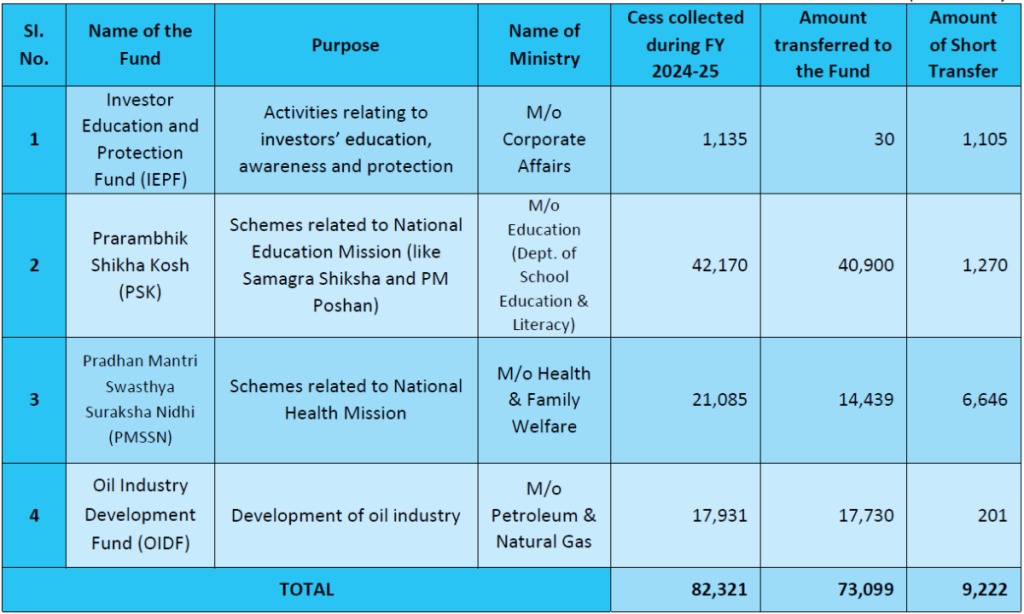
Statement showing short transfer to Reserve Funds during FY 2024-25 in rupees crore. Source: Comptroller and Auditor General, Union Government Finances, Report No. 6, 2024-25.
Finance ministry's explanation
To explain the discrepancy between cesses and levies collected and deposited, the Union Finance Ministry reportedly told PAC that in the account of the Madhyamik aur Ucchatar Shiksha Kosh or MUSK, meant to support secondary and higher secondary schooling, it had made an excess transfer of Rs 1,681 crore.
It also said, as per the Hindu report, that the revised (budgetary) estimates for the financial year after 2024-25 would make up these shortfalls in the previous year.
Also read: Fuel Dealers Oppose UPI 'Tax', Opposition Flays Govt Over 'Foreign Pressure' Behind MDR
Lastly, the finance ministry said that it did not wish to maintain idle balances in the CFI because the Indian government had made borrowings worth Rs 15.74 lakh crore in 2024-25 in order to finance expenditure worth Rs 46.53 lakh crore.
In other words, the minstry felt that instead of transferring the cesses collected from individuals including taxpayers in 2024-25, it could keep a certain proportion in the CFI, where it would appear to shore up the deficit.
Earlier, too, the government's approach towards accouting has been questioned, when it appeared to misclassify pension shortfall as saving.
Cess collections over the years
Cess (including surcharge) collection grew in 2024-25 to Rs 3,89,220 crore, accounting for 10.25% of the Union government's gross tax revenue.
In its 2023-24 report, CAG had highlighted that the shortfall since 1974 in transfers of cesses collected amounted to Rs 3,69,307 crore.
However, the same CAG report also pointed out that in just 2023-24, the government of India collected Rs 3,79,598 crore as cesses. That is, the cess collected in just one year was more than the total short transfers since inception of cesses.
In 2025-26, the total cess collection rose to almost 14% of gross tax revenues. The CAG reports shows the trend in cess and surcharge collections since 2020-21 as below:
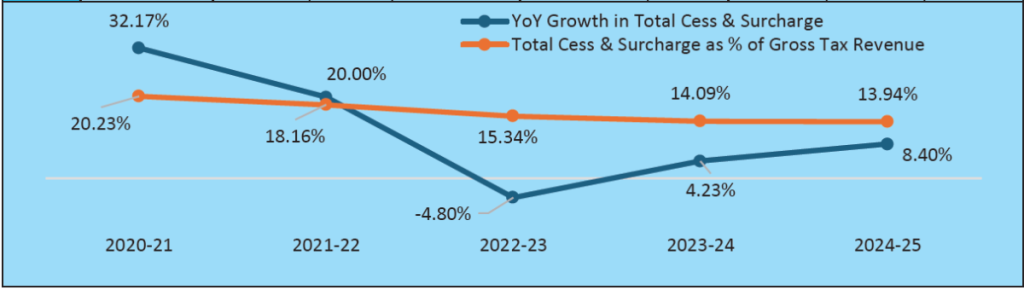
Union Government Finance Accounts for FY 2020-21 to FY 2024-25, as reported by CAG in Report No. 6 of 2026.
Cesses collected for health, education and oil industry development have historically suffered from poor transfers, with the problem snowballing over the years as cesses occupy a greater share of the revenues.
The CAG audit for 2024-25 notes, "In respect of PMSSN, Ministry of Health & Family Welfare replied (January 2026) that the MoF[finance ministry] is the nodal ministry responsible for collection of cess and allocating the same into the respective Reserve Funds. However, a specific reply for short transfer to reserve funds is still awaited."
The Hindu reports Venugopal's observations in the PAC that cess collections should be utilised for the purposes for which they are raised and not to finance the government’s budgetary deficit. He said that the funds are not shared with the state govermnments, making it incumbent for the Union to ensure proper allocations to benefit people.
This article went live on September thirtieth, two thousand twenty six, at two minutes past three in the afternoon.The Wire is now on WhatsApp. Follow our channel for sharp analysis and opinions on the latest developments.


