

How is Collective Punishment Shaping Kashmir's Identity?


What has changed in Kashmir since the onset of armed conflict? A lot, probably. The conflict started in the 1990s, though some academicians or historians might situate its roots in pre-independence history. We, however, want to locate the genesis of the current spree of death and destruction in the period that structurally changed the contours of the region.
Kashmir, to be perfectly honest, has never been a normal state. Therefore, trying to treat it at par with other federal units would be disastrous – like the disaster that occurred on August 5, 2019. Let us be brave and politically honest in calling out the events that have followed the unilateral downgrading of the erstwhile state of Jammu and Kashmir into a centralised Union Territory.
Since then, any spaces for expression that were still available have been choked, politics has been held hostage by bureaucracy, the economy by political whims, and the state apparatus has hardened – so much so that even Machiavelli wouldn’t have wanted his king to be this brutish.
Under such circumstances, how do you imagine the local population would act or react? Would they be submissive, apologetic, anaesthetised, or forcibly ever-grateful?
With the recent Red Fort attack, a familiar ache returns, an ache that travels with Kashmiris – once again, every Kashmiri stands under the glare of suspicion for a crime they had no connection to.
With one death, he killed many innocents. And we mourn every innocent life lost and denounce the hand that carried out this horror – with both our grief and our condemnation unstitched from the cloth of identity.
We live in a thriving democracy, a prosperous nation that is holding stardust, aiming for the sun, the moon and the unachievable. Yet Pulwama, Pahalgam, Red Fort happen. Do we dare ask why? We ought to, for we are not mere bystanders but the architects of this republic. Therefore, we ask why these shocks continue to pulse through the country, reaching even the capital’s fortified heart? Perhaps the answers exist, the truth may be known yet unacknowledged, understood yet unspoken.
And what of the state’s strategy? A panopticon ever watching, never hearing, where choked voices ferment into the very storms we fear.
Also read: Pahalgam Attack and the Impact of Populism on National Security
In Kashmir, democracy has turned into competitive authoritarianism. There exists an elected government, but only on paper. So much so that an elected legislator, a member of a national party, was detained under the notorious Public Safety Act, purportedly due to a conflict with the bureaucracy. The irony is that even the chief minister of Jammu and Kashmir, after extending all possible help, could not secure his release – the bureaucracy doesn’t listen to him.
Imagine, then the political agency of the ordinary people of Kashmir. The asymmetry in power distribution, heavily distorted towards the unelected, is glaring.
In the aftermath of the Pahalgam terrorist attack, Kashmir witnessed a rare, organic wave of solidarity. There were spontaneous shutdowns and marches, motivated by empathy and a yearning for peace, rather than provoked by political outfits. It was an unprecedented development in the turbulent political history of Jammu and Kashmir.
A top security official, reflecting on those days, described the response as a watershed moment in its political history. We were successful in de-hyphenating the Pakistani sentiment in Kashmir. Amidst the terror that struck us, we saw unfiltered condemnation of terror associated with Pakistan.
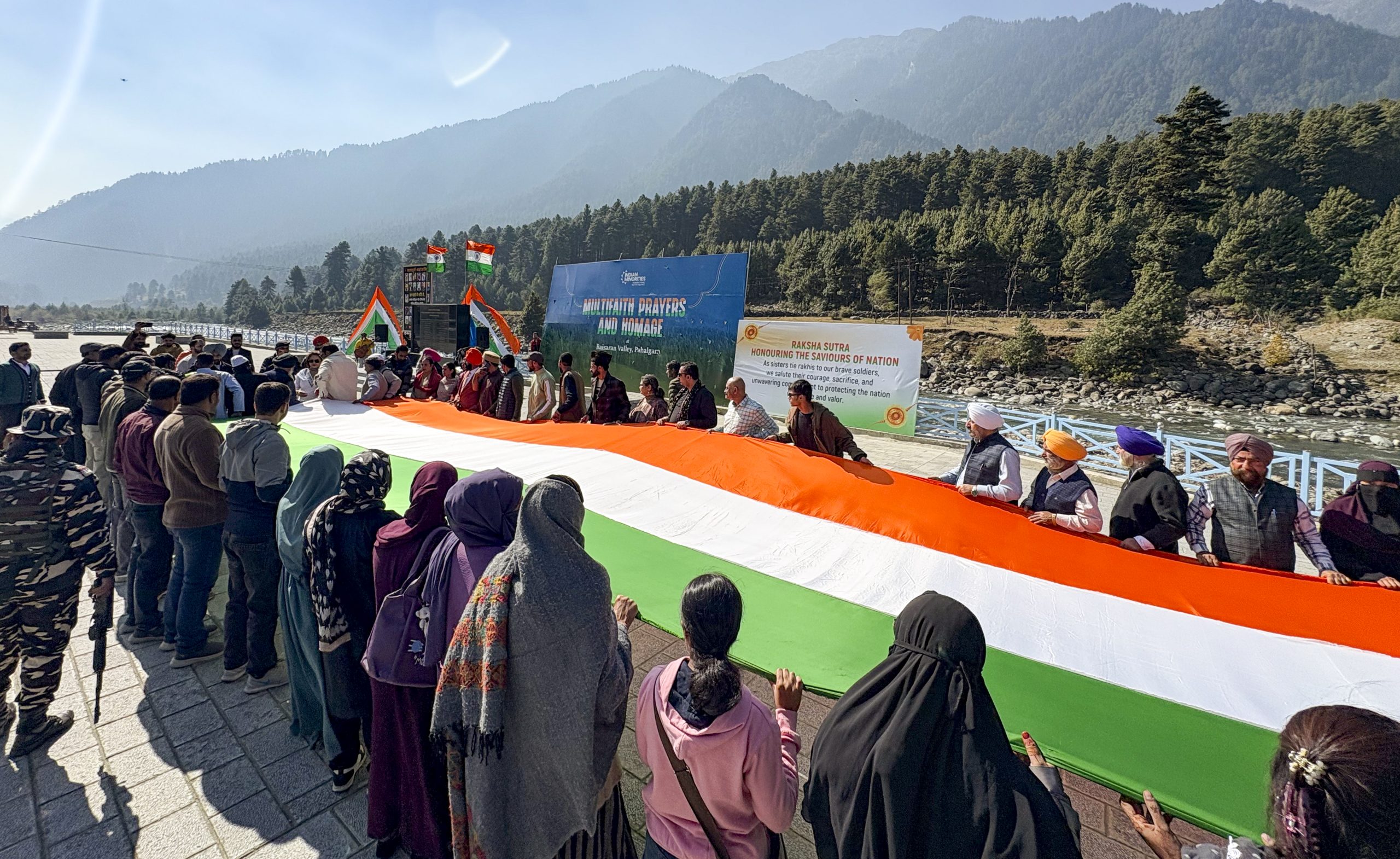
People hold the tricolour to pay tributes to the Baisaran terrorist attack victims in Pahalgam, Thursday, October 30, 2025. Photo: PTI.
Despite this, the state’s response was brute, nasty and poor. Instead of sustaining the organic protest or capitalising on the sentiment, the state demolished numerous homes in Kashmir, including homes belonging to families unconnected to the Pahalgam attack.
Also read: Despite SC Ruling, J&K Authorities Demolish Homes of Pahalgam Suspects, Others, Without Notice
Such measures raise critical questions about proportionality, due process, psychological impact and the ethics of assigning collective punishment to families who may lack agency over an individual’s violent choices. Collective punishment may be a tempting instrument of statecraft, but it corrodes the moral legitimacy democracy thrives on.
While we are writing this, a father of a youth accused of involvement in a recent terror attack succumbed to injuries sustained due to self-immolation: an act allegedly precipitated by being denied access to his detained son. He appears to have chosen the certainty of death over the uncertainty of waiting.
What message does such an event send to young onlookers? It normalises despair, making death appear ominously close and worryingly accessible. For younger observers, repeated exposure to extreme forms of despair can normalise self-harm or fatalistic thinking.
It is unbecoming of a state to rely merely on brute measures. I am sure security experts on Kashmir also wouldn’t approve of such actions. They, however, are justified as policy, inadvertently cultivating the very alienation the state seeks to prevent. A great nation must not become the tinderbox it seeks to extinguish.
Peace in Kashmir appears far from achieved. But death has become certain, despair has become achievable. Dystopia is the new normal. All of it seems impervious to change. Instead, inside Kashmir, another storm is brewing. Communities are being pitted against each other, forced into a contest none of them chose to participate in.
Political parties are trading accusations at each other from the towers they once inhabited. For all its tall promises, the winning manifesto remains untouched and gathers dust, while the opposition presses its fingers on the tender scars of the Kashmiris – essentials of soft separatism we have all grown wary of.
Amid these many clouds, perhaps the issue of reservation looms the darkest. The current dispensation has offered no dialogue or discussion on distribution or redistribution, allowing frustration among those who feel left behind to grow. The issue has the potential to tear apart the social fabric of an already fragile region. Yet it goes unheard and unrepresented.
Also read: The Reservation Tug-of-War in J&K Puts Political Parties in a Tight Spot
The brand of politics here swings between currying favour with Delhi and recycling familiar separatist tropes, while, strangely, some politicians act as quiet bureaucrats rather than representatives. There exists a large-scale political orphanage in Kashmir. Even the political space is limited to two dynasties, and young voices in politics are either stifled or not allowed a level playing field.
Amidst the complex mix of unrest from within and without, this is the moment for a comprehensive policy recalibration. To revive channels of dialogue and rethink democratic engagement. There are multiple socio-political measures that can help restore a sense of normalcy, from preventing fatal attacks to establishing long-term peace. While security remains an important dimension of the region, socio-political processes can equally help promote peace and prosperity.
Delhi should work towards changing the political discourse of Kashmir beyond two dynasties. It is not merely about political preference: it has become a democratic necessity. Creating genuine space for young and alternative voices who can offer representation that resonates with an increasingly disillusioned population that has grown wary of recycled political rhetoric.
Policies like home demolitions as a form of collective punishment must end; a humane approach is urgently needed in Kashmir. Similarly, punitive actions such as denying passports, jobs or security clearances to individuals not connected with alleged cases should be an exception, not the norm. Else we not only risk creating a generation shaped by despair, but also one that loses faith in the principles of democracy and equality.
For this republic to move towards peace and prosperity, Kashmiris need to be recognised as equal stakeholders in policymaking and in the peace process. The future must be built on foundations of dignity and optimism, not fear or despair. The journey to a stable and harmonious India goes via Kashmir, and with it comes the promise of peace across the country and the collective advance of South Asia.
Peerzada Mahboob-Ul-Haq is a youth political activist and advisor to the Jammu and Kashmir Students Association. Nasir Khuehami is a political commentator and national convenor of the Jammu and Kashmir Students Association.
This article went live on December fourth, two thousand twenty five, at four minutes past seven in the evening.The Wire is now on WhatsApp. Follow our channel for sharp analysis and opinions on the latest developments.


