

After Police Admit Kashmiri Civilian Was Killed, Family Seeks Justice


Srinagar: Hundreds of slogan-raising youth had surrounded the house of Mohammad Yaqoob Malik of Noorbagh, Srinagar after personnel from the SOG, SSB and J&K Police had cordoned it off on the night of September 26, continuing it well into the wee hours next day. Some cops were still inside the house.
Outside, the situation was getting out of control. Protesting youth had formed a human chain, making it difficult for the cops to leave the scene.
“Desperate, they grabbed my 4-year-old grandson, Damin Ashraf and held a gun to his head,” said Malik. The stalemate continued for some time, until the last cop managed to leave. The child was left unhurt.
“They are shameless,” Malik scorned. “They used a child as a human shield to save themselves from public fury.”
However, what the raiding party had left behind brought Srinagar to a halt. The bullet-riddled body of a 26-year-old man was found near a sheep shed.
Also Read: The Army Has Bared Its Iron Fist in Kashmir – and Wants Everyone to Know It
The other Yaqoob Malik
On September 26, 55-year-old Mohammad Yaqoob Malik heard some sounds near the sheep shed. Yaqoob Malik is a distant relative of the other Mohammad Yaqoob Malik. Even their spouses have the same names and this has caused much confusion.
He wondered if his son, Saleem Malik, had kept the shed unlocked. Burglars had stolen their sheep before, so he got down from his second-storey bedroom, woke his son up and asked him to do a quick check. Yaqoob Malik went back to sleep. [In this story, Yaqoob Malik is used to refer to Saleem Malik's father and Malik to their neighbour and distant relative.]
Cops barge into Malik's house
The cops had barged into Malik's house. The divisional officer (DO) of the nearby police chowki, Ajaz Ahmad, asked Malik to quickly give the details of his family.
The details Malik gave confused the DO, who then asked him if there was another person living in the area with the same name.
“I pointed towards Saleem’s house, told him the namesake is my distant cousin and even our spouses have the same name,” Malik said.
“We’ve credible information that militants are hiding in that house,” the officer told Malik.
“Well in that case, I’ll personally go there and inform him what you are saying,” Malik told the DO. “If what you say is true, we’ll ensure the family leaves and the rest belongs to you.”
However, the cops asked Malik to sit tight. The police took up their positions on the attic of Malik's neighbour Abdul Rashid's house, pointing their guns in the direction of Saleem’s house.
As Malik watched, he saw Saleem walk towards the shed. Suddenly, a volley of gunfire ripped into his chest.
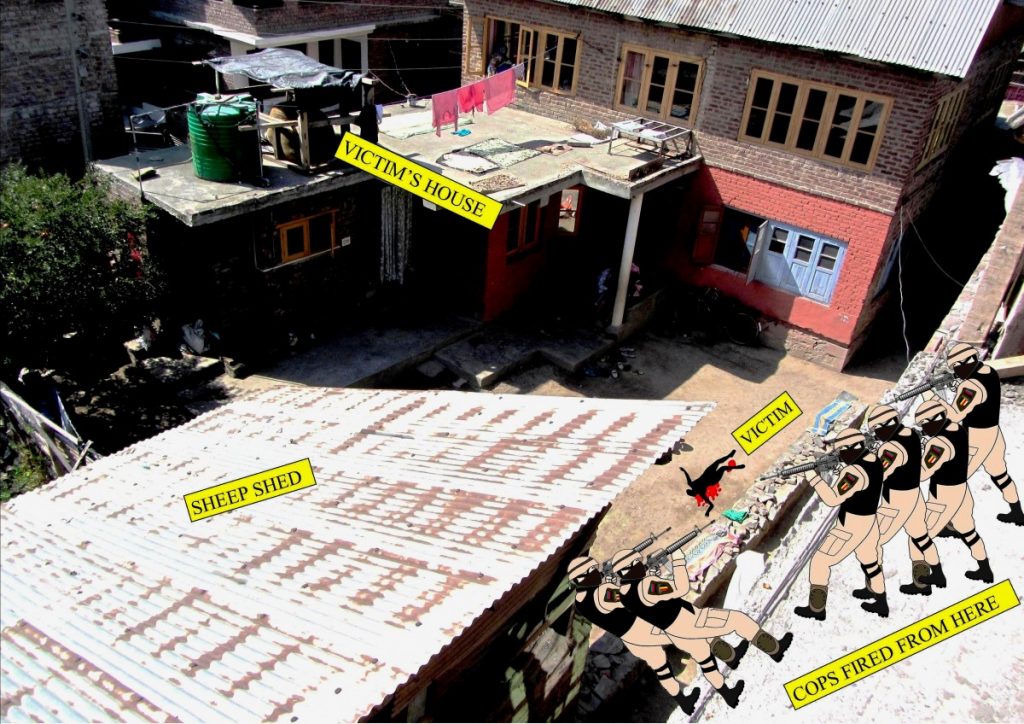
Illustration of the crime scene as described by the family. Credit: Farooq Shah
Neighbours later recollected the terrifying moment when they were woken up by the sudden sound of gunfire. However, no one dared to step out. Even Yaqoob Malik, Saleem's father, was woken up, but could not muster the courage to leave the house. "I prayed for the safety of my family," he said.
The closely stitched neighbourhood grew restless by the minute and an eerie quiet prevailed.
“Hum ne kis ko thoka (Who did we kill),” Malik heard the cops ask each other.
“They perhaps sensed that they had killed a civilian,” he said. “It looked like they were after somebody else.”
The cops, Malik said, retreated from the attic and ran out, firing several rounds towards the house indiscriminately. Malik confronted the cops as they left his house. “Are you trying to stage-manage an encounter?” he asked them.
The next morning
At the crack of dawn, Madina, Saleem's elder sister, peeped out through the glass window. She saw her brother lying there, face-down.
- “
Hum ne kis ko thoka
- (Who did we kill),” Malik heard the cops ask each other.
“They have killed my brother,” she screamed. Hearing her, the entire family came rushing to the compound where several cops had gathered around the lifeless body of Saleem. Seeing his son drenched in a pool of blood with his abdomen torn apart, ankles broken and right arm lacerated as if cut with a sharp weapon, Yaqoob Malik told the cops: “You’ve killed my son, now shoot me too.” One of the cops hit him with the butt of his rifle. Once a scuffle began, the panic-stricken neighbours came out running and screaming.
The news of the killing spread like wildfire and people began to pour in from all directions.
Chaos filled the air and the cops found themselves in a tight spot. They decided to beat a retreat as the public fury was beginning to grow dangerously hostile.
Meanwhile, Safa Kadal police station SHO Mohammad Rafiq and SP (north) Sajjad Shah arrived at the scene and met Yaqoob Malik and others. “Give us the body, there are some legal formalities to complete,” the SHO told the family. “I’ll stay here till the formalities are completed, if you so wish.”
Yaqoob Malik stood motionless, not knowing what to do. The crowd had swelled by the hundreds and the police thought it wise to leave for now.
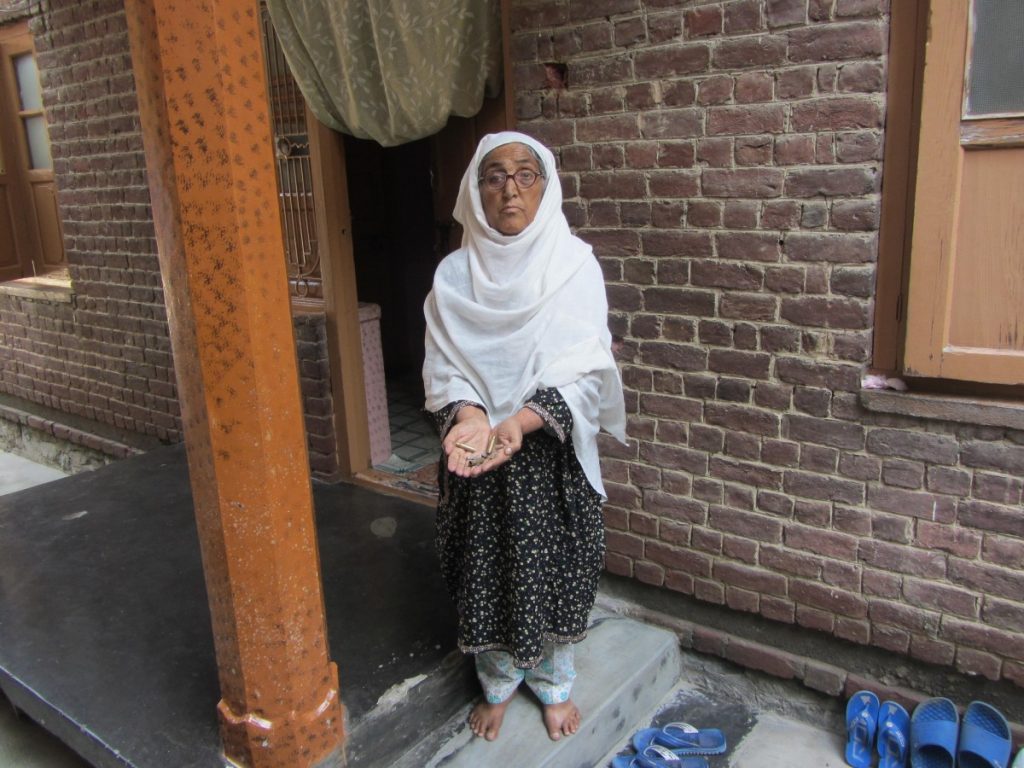
74-year-old, Raja, shows bullet shells that the fleeing cops fired upon her house. She lives in the neighbourhood. Credit: Farooq Shah
Confrontation between youth and security personnel
Wailing and grieving, the crowd wrapped Saleem’s body in a blanket, put it on a charpoy and carried it to the Eidgah graveyard nearby. The half a kilometre long stretch of road turned into a battleground. Clashes erupted between youth and paramilitary personnel, who fired several teargas shells into the crowd. At one point, the mourners had to leave the charpoy on the road as the teargas smoke made it difficult to breathe. At around 9 am, Saleem's body was finally consigned to the grave.
Also Read: From Torture Victim to Masood Azhar's Student to BJP Candidate – Mohammad Farooq Khan
The SHO bluntly refused to give any information about the case. “We’ve instructions not to talk to the media,” Rafiq said. He, however, confirmed the deceased was neither a stone-pelter nor a militant, but refused to comment on why the police had registered an FIR under sections 307 IPC and Section 27 Indian Arms Act.
Those who knew Saleem describe him as a playful young man who would spend most of his time tending sheep and pigeons. He was passionately fond of animals and kept a few rabbits too.
Family seeks justice
The family has knocked on the doors of Srinagar chief judicial magistrate (CJM) to seek justice. “We’ll fight tooth and nail to get the culprits booked,” said Ghulam Mohammad Wani, uncle of the deceased youth.
The State Human Rights Commission (SHRC) has issued notices to the Srinagar's deputy commissioner and senior superintendent of police to file a detailed report by October 17 to explain how and why an innocent man was gunned down by policemen.
The Armed Forces Special Powers Act (AFSPA), civil liberties activists have long held, gives armed forces unfettered powers to shoot a person if they have reason to believe that there is a threat from that person. The law also gives immunity to the armed forces against prosecution among various other protections.
“It has become a norm in Kashmir to kill innocent people during search operations conducted by the government forces,” human rights activist, Muhammad Ahsan Untoo, wrote in his petition before the commission.
AFSPA has contributed to the cycle of violence and unrest in Kashmir by allowing individual soldiers to act with impunity.
"Impunity for human rights violations and lack of access to justice are key human rights challenges in the Indian state of Jammu and Kashmir," notes a recently published report by the Office of the United Nations High Commissioner for Human Rights.
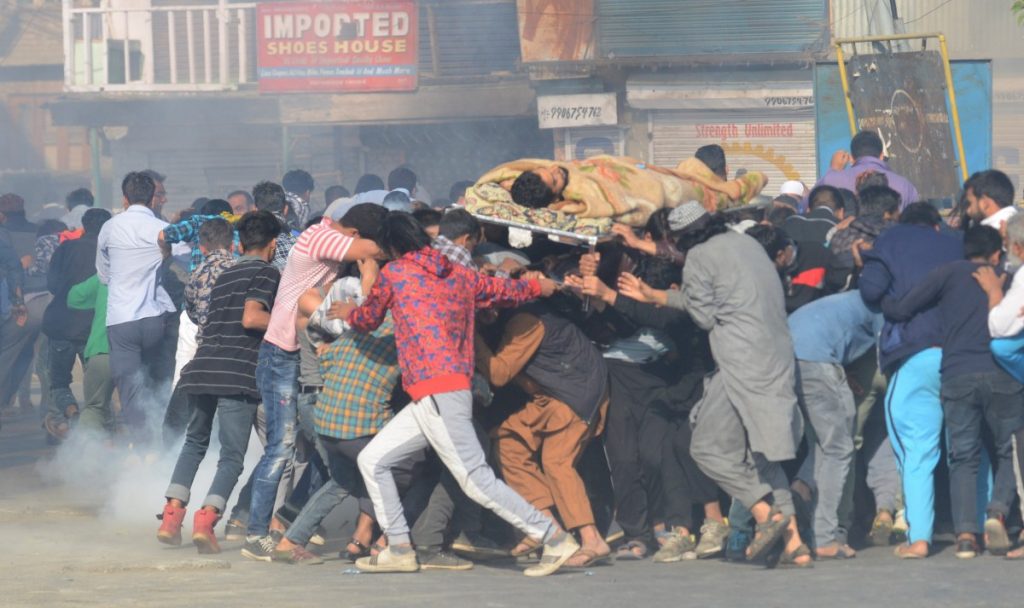
Mourners carry the body of Saleem Malik. Clashes erupted between youth and security personnel. Credit: Farooq Shah
Police admit Saleem did not have criminal record
Top police officers seem to have absolutely no qualms in admitting that the youth gunned down in Noorbagh was a clean man with no criminal record. “I say it with absolute authority the youth killed had no criminal background whatsoever,” Sajjad Shah, SP (north), told The Wire. “It needs to be investigated why an innocent man lost his life.”
Shah said until a thorough probe is conducted, nothing can be said about the incident. “I wouldn’t be able to comment right now,” he said. “We’ll constitute a team and I shall personally visit the deceased’s house, talk to the eye-witnesses and record their statements.”
The officer, however, maintained the police had ‘credible’ information about the presence of militants in Malik's house.
This article went live on October seventh, two thousand eighteen, at zero minutes past seven in the morning.The Wire is now on WhatsApp. Follow our channel for sharp analysis and opinions on the latest developments.


