

‘No Call Between Modi-Trump From April 22 to June 17’: Jaishankar in Parliament as Trump Repeats Ceasefire Claim


New Delhi: Amid US President Donald Trump’s continued claims of mediating a ceasefire between India and Pakistan following the four-day-long military confrontation in May, Union minister for external affairs S. Jaishankar, in his first remarks in the parliament on Operation Sindoor on Monday (July 28), said that there was no call between Prime Minister Narendra Modi and the US President between April 22 and June 17. Jaishankar also said that during the operation, India received calls from several countries in which it was made clear that “there will be no mediation”.
While Trump has claimed that he used trade as a leverage to bring the two countries from the brink of a nuclear war, Jaishankar said that at no point was there “any linkage with trade” in the conversations between India and US. His statement was backed by Union home minister Amit Shah.
Jaishankar’s remarks in Lok Sabha, during the special discussion on Operation Sindoor following the Pahalgam terror attack of April 22, came as Trump reiterated the claim that he had mediated the India-Pakistan ceasefire in Turnberry, Scotland, standing alongside British Prime Minister Keir Starmer.
“I’d like to inform the House that on May 9, Vice President JD Vance called the prime minister warning of a massive Pakistani attack in the next few hours. The prime minister, in his response, made it very clear that if such an attack occurred, it would meet with an appropriate response from our side. That attack took place and was foiled by our armed forces. I think the House should collectively appreciate the performance of our armed forces in preventing what was a massive attack on May 9 and 10. Our response, which the prime minister promised, was delivered with devastating effect,” the external affairs minister said.
He reiterated India’s earlier position that the move to stop hostilities had come from Pakistan and said that this had been communicated to other countries as well.
“On May 10, we received phone calls sharing the impression of other countries that Pakistan was ready to cease the fighting. Our position was that we need to receive this request from the DGMO channel. That is exactly how that request came,” Jaishankar said and added, “I want to make two things clear: at no stage, in any conversation with the US, was there any linkage with trade and what was going on.”
He added that there had also been no call between Trump and Modi between April and June. “Secondly there was no call between the Prime Minister and President Donald from April 22-when President Trump called to convey his sympathy to June 17-when he called the Canadian prime minister why he could not meet,” he said, referring to the G7 summit in June.
Jaishankar’s statement comes as Trump has by some counts made the claim of mediating the ceasefire between India and Pakistan 26 times since May 10. He has also said that he used trade as leverage, and that some Indian jets were lost in the fighting.
The statement saw interventions by Union home minister Amit Shah who accused the opposition for believing in another country and not the Indian external affairs minister.
Amid loud protests from the opposition benches, Shah rose from his seat and accused the opposition of trusting another country’s leader instead of India’s external affairs minister.
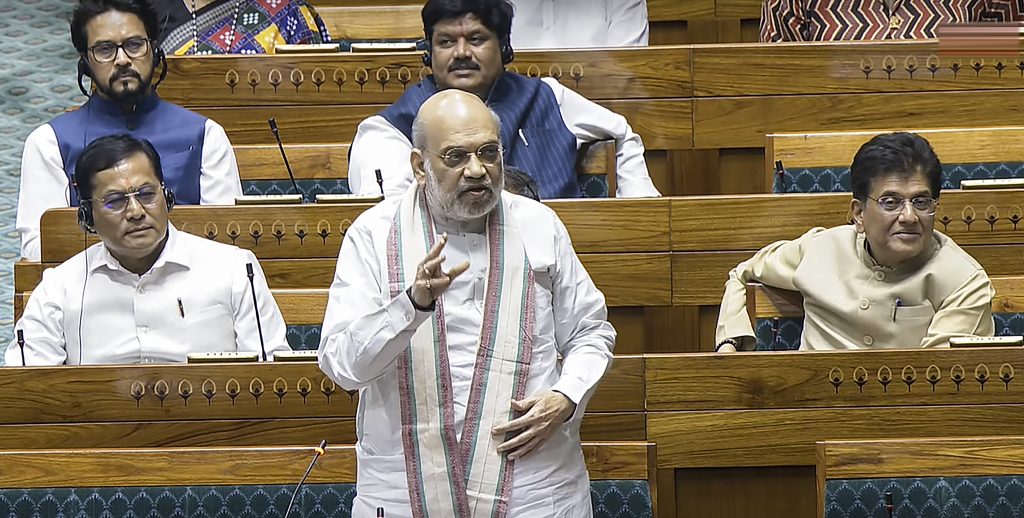
Union Home Minister Amit Shah intervenes during debate on the Pahalgam terror attack and Operation Sindoor. Photo: PTI
“I object to one thing, when India’s external affairs minister, who has taken oath, is speaking, they choose to believe someone from another country instead. I understand the importance of foreign countries in their party, but they cannot impose it on the House,” Shah said.
“You won't trust India's external affairs minister? He is responsible. It is precisely because of this attitude that they are sitting in the Opposition today, and they will continue to sit there for the next 20 years,” he added.
While opposition members had raised questions about what Operation Sindoor had achieved and the support India received from other countries, Jaishankar pointed to the UN Security Council statement following the Pahalgam terror attack.
“They affirmed that terrorism in all its forms and manifestations constitutes one of the most serious threats to international peace and security. And most importantly, the Council underlined the need to hold the perpetrators, organisers, financers and sponsors of this reprehensible act of terrorism accountable and bring them to justice,” said Jaishankar.
The Wire had reported that the statement, unlike after the Pulwama attack, stopped short of urging member states to cooperate specifically with India.
While opposition members had raised questions about what the seven multi-party delegations that fanned out across the globe had achieved, Jaishankar took a swipe and said that the question should be posed to opposition members who were part of these delegations and see their tweets for the activities that they did.
Facing questions about a two-front war with Pakistan and China, Jaishankar accused the Congress and said that this collaboration between the two had started 60 years ago.
“In 1966, the first Chinese military supplies went to Pakistan, nuclear collaboration started in 1976, when Bhutto arranged for China-Pakistan to get together. In 1980s, when PM Rajiv Gandhi was visiting China and Pakistan, that is when the nuclear collaboration was at its height; 2005, China-Pakistan Treaty of Friendship and Cooperation; 2006, Pakistan-China FTA; 2013, handing over of Gwadar port (Balochistan, Pakistan) to China; May 2013, announcement of China-Pakistan Economic Corridor (CPEC),” he said.
In response to Pakistan securing an IMF loan following Operation Sindoor, Jaishankar said that the country was a “serial borrower”
“The very people who are concerned today about a $7 billion package, should remember a $15 billion package went through for Pakistan during their tenure,” he said.
This article went live on July twenty-eighth, two thousand twenty five, at sixteen minutes past nine at night.The Wire is now on WhatsApp. Follow our channel for sharp analysis and opinions on the latest developments.


