

The Railways’ Rs 1.35-Lakh-Crore Betrayal of the Northeast: An Expert Speaks


Three decades of flawed engineering and bureaucratic hubris have produced the world’s most expensive and least functional mountain railways – none of which reach their destinations.
Indian Railways is on the verge of completing the Bairabi-Sairang line in Mizoram. Indian Railways expects to complete the other three lines – to Kohima, Imphal, and Gangtok – by 2030, while the Meghalaya line hasn’t taken off due to local opposition.
Collectively, these five Northeast railway projects are likely to cost over Rs 1.35 lakh crore, and yet, astonishingly, except for the Imphal line, none will reach their originally intended destination. The Imphal line was actually sanctioned to end at Tupul, short of the capital city as well, but in 2010-2012, an extension to Imphal was added in response to public outcry.
These five are part of seven major railway lines currently under construction in the Himalayas, including the Kashmir line and the Rishikesh-Karnaprayag line. Their combined cost is projected to reach Rs 2.5 lakh crore. This article focuses on the five Northeast lines.
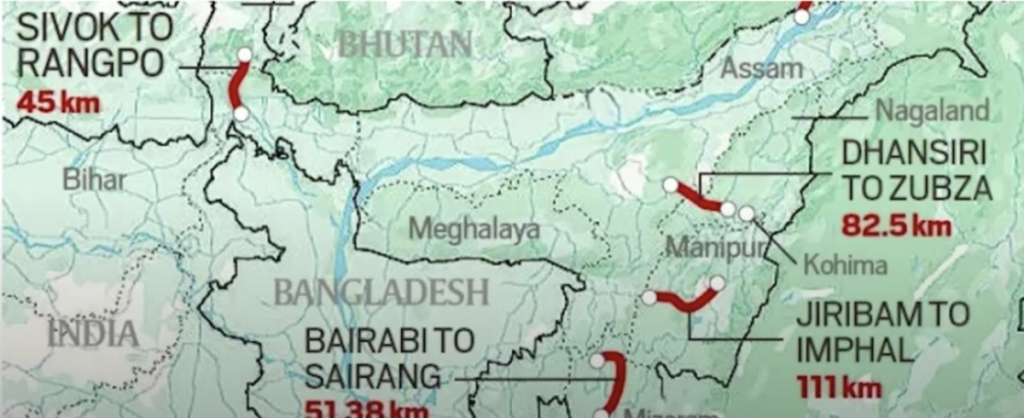
Illustration: Alok Kumar Verma.
I have worked on Railway projects in Kashmir and the Northeast and am now retired from the Indian Railway Service of Engineers. I developed the direct core alignment, which was recommended by the Sreedhran Committee for adoption in the Kashmir project in 2015. As such, I have had an insight into stated costs, real costs and certain unpalatable truths in the way the Railways' Himalaya project has unfurled.
How it went wrong
The root of this engineering debacle lies in a 1994 Railway Board decision to adopt a deeply flawed methodology for alignment planning. Departing from global norms, the Board approved a fantasy-driven approach: finalise alignments using only topographic data and digital terrain models, and defer geological, hydrological, and seismic investigations to the design and construction stages. According to officials, this "innovation" would reduce construction time to four to six years and enable operations at 100 kilometre per hour, which is equivalent to bullet train speed in the Himalayas (globally, lines in mountains run at 40 to 70 kilometre per hour).
Three decades later, the reality is stark: projects have been delayed for decades, costs have overruns by 10 to 15 times, slopes are collapsing, bridges are oversized, and train speeds are slower than those of century-old hill lines.
Lines that don’t reach state capitals
These lines were meant to connect five Northeast capitals – Aizawl, Kohima, Imphal, Gangtok, and Shillong – to the national railway grid.
But four of them fall short:
- Bairabi-Sairang: Terminates 818 m below Aizawl; requires a one to two hour drive.
- Sivok-Rangpo: Still 1,260 metres and two hours below Gangtok.
- Zubza (Kohima): 593 metres below Kohima.
- Byrnihat-Shillong: 450 metres below Shillong. Construction is stalled due to local opposition.
The planning and approval process for the last-mile links from Sairang, Rangpo, and Zubza to the capitals has not yet begun. Given the steep gradients and unstable terrain, any future extension would cost thousands of crores for just 10 to 15 kilometres, making them politically unviable.
Runaway costs and delays
Initially projected to take five to six years, these lines are entering their third decade of construction.
The Bairabi-Sairang line, sanctioned in 2008 at Rs 619 crore as per the Railways' Pink Book, will finally be completed in 2025. The Jiribam-Imphal line, approved in 2003 at Rs 728 crore, is expected to be ready by 2027. The Sivok-Rangpo, Dhansiri-Zubza and Byrnihat-Shillong lines are on similar 20 to 24 year timelines.
The total costs based on the sanctioned cost, the last officially reported costs, which appear to be two to three years old, and the projected completion costs are the author’s assessment based on his knowledge of each of these projects (please see the table below for detailed cost analysis):
- Total completion cost of all seven projects: Rs 2,93,200 crore (Rs 2,49,000 crore in current rupee value)
- Total cost of the five projects in the Northeast: Rs 1,76,200 crore (About Rs 1,37,000 crore in current rupee value)
Cost escalations are even more alarming: these range from 500% to 1900% adjusted for inflation.
Stunning increases of 1900% and 1000% are seen in the Jiribam-Imphal and Bairabi-Sairang lines, respectively. The Katra-Banihal Kashmir line, with a 1300% increase, has the second-highest increase among all the seven Himalayan projects. These lines may be the most expensive single-track lines constructed in the last century worldwide in terms of cost per kilometre.
The pattern is consistent: sanctioned costs are drastically underestimated to gain project approval. Once the alignment is staked on the ground – based on so-called “pre-construction surveys” – costs explode as real geological and structural challenges emerge. It reflects a systemic failure: poor planning, deliberate underestimation, and absence of rigorous alignment vetting.
Cost of the new Himalayan line rail projects
Construction Delays and Financial Impact Assessment
| Route & Length | Project Duration | Original Sanctioned Cost (Nominal / Inflation-Adj.) | Latest Official Estimate (Nominal, Year) | Projected* Final Cost (Nominal / With Interest) | Real Cost Increase |
| Katra-Banihal 111 km | 2002-2025 23 yrs | Rs 1,900 cr Rs 4,675 cr | Rs 35,000 cr (2024) | Rs 40,000 cr Rs 65,000 cr | 1,300% |
| Rishikesh- Karnaprayag 125 km | 2011-2028 17 yrs | Rs 4,295 cr Rs 8,375 cr | Rs 24,659 cr (2023) | Rs 37,000 cr Rs 52,000 cr | 520% |
| Bairabi- Sairang 51.4 km | 2008-2025 17 yrs | Rs 619 cr Rs 1,210 cr | Rs 8,200 cr (2023-24) | Rs 10,250 cr Rs 13,200 cr | 1,000% |
| Jiribam- Imphal 110.6 km | 2003-2027 24 yrs | Rs 728 cr Rs 1,864 cr | Rs 22,275 cr (2023) | Rs 25,000 cr Rs 37,000 cr | 1,900% |
| Sivok-Rangpo 45 km | 2008-2028 20 yrs | Rs 1,339 cr Rs 2,932 cr | Rs 12,132 cr (2023-24) | Rs 15,000 cr Rs 25,000 cr | 750% |
| Dhansiri-Zubza 88.4 km | 2006-2030 24 yrs | Rs 850 cr Rs 2,560 cr | Rs 6,663 cr (2021) | Rs 14,000 cr Rs 21,000 cr | 720% |
| Byrnihat-Shillong 108.4 km | 2010-2040 30 yrs | Rs 4,083 cr Rs 13,250 cr | No construction
| ₹65,000 cr ₹80,000 cr | 500% |
Key Definitions:
Inflation-adjusted cost: Original nominal cost adjusted for 4% annual construction cost inflation
With interest: Final projected cost including financing/interest charges at 6% per annum over project duration
Real cost increase: Percentage increase from inflation-adjusted original estimate to final cost with interest
Special cases: Byrnihat-Shillong project halted due to local opposition; costs are projected estimates
Engineering hubris over utility
The Bairabi-Sairang line runs through uninhabited trough basins in low-relief terrain, yet 96% of its 51.4 km length lies in tunnels, high cuttings, and bridges – a structural density comparable to the Kashmir line in the rugged Himalayas. It includes six bridges taller than 50 m, including a 106 m beam-column bridge – taller than any bridge of this type on the Kashmir line.
Similarly, the Jiribam-Imphal line, which traverses medium-relief terrain, includes dramatic structures like the Noney bridge, often touted as having the world’s highest pier.
Such overbuilt structures are out of proportion to the terrain. If not for the poor alignment choices, these lines wouldn’t have needed them. At this rate, they may one day be known more as a museum of spectacular viaducts than a functional rail system.
Speeds and safety
Despite their price tags, these lines will deliver glacial train speeds. The Lumding-Silchar line – converted to BG using the same flawed approach – operates express trains at just 21–26 km/hour, barely faster than the Kalka-Shimla narrow-gauge line built in 1903, which averages 18-20 km/hour despite more stops.
The delay is not due to congestion. Only five pairs of passenger trains and a few freight trains, on average, run daily on the Silchar line. Rather, drivers slow down due to speed restrictions, unstable slopes, and the ever-present risk of landslides.
Lumding-Silchar: A warning ignored
The Lumding-Silchar line exemplifies the risks. Opened in 2016 against the advice of the Commissioner of Railway Safety (CRS), the line saw two express train derailments and dozens of landslides within months, following which the line was shut for over three months – a record. In 2022, the line was shut for 48 days. This year, 2025, it was closed multiple times between June and July, including a seven-day disruption following a major landslide.
The CRS’s report had warned of “catastrophic disasters” and advised a comprehensive review by geotechnical experts. No action was taken.
Is safety merely a formality?
Instead of learning from the Lumding-Silchar experience, the Bairabi-Sairang project rushed through slope stabilisation in a region receiving 2,500 to 4,000 milimetre of annual rainfall. Future catastrophes are inevitable when excessive cuttings are made in unstable terrain.
A recently concluded statutory safety inspection by the CRS on the Bairabi-Sairang line appeared cursory – eerily reminiscent of the CRS clearances for the Kashmir line earlier this year that cleared massive bridges like Chenab and Anji without load tests or scrutiny of massive rock bolting and anchoring to stabilise the slopes at the bridge foundations.
Operation and maintenance
These railway lines meander through thinly populated regions, far removed from any major freight corridors or urban demand. Revenue from these lines would be meagre. Yet the government would be locked into a relentless cycle of spending – routine operations, nonstop safety patrolling, and frequent slope stabilisation in treacherous terrain – all demanding serious money year after year. The recurring annual loss across these five lines could balloon to Rs 8,000-Rs 12,000 crore, effectively sinking public funds into a bottomless pit with no foreseeable return.
Alternatives existed and were ignored
In 2015, the Sreedharan Committee endorsed a direct core alignment approach, developed by the author, with tunnels laid deeper away from the slope surface and smaller and fewer bridges and cuttings. The Northeast Frontier Railway briefly reviewed its lines in 2015-16, scrapping the original Nagaland alignment. But on the other lines, only token revisions were made.
Each of these lines would have reached the capital city while saving roughly 40% (Rs 54,000 crore) in construction costs if the author's direct core alignment had been used for all the five lines.
Even the new alignment for Nagaland is problematic: it adheres to a 1 in 80 ruling gradient, resulting in a serpentine 60 km section worse than the Kashmir line, with high safety risks due to poor visibility and frequent curves.
A long overdue policy reckoning
The Northeast deserves robust railway connectivity – but not lines that take 25 years to build, cost 10-15 times more than a comparable highway, and run at bullock-cart speeds while bypassing state capitals.
What India is building in the Northeast is not connectivity – it is a gallery of misplaced ambition and broken planning. If we don’t fix the process of alignment planning, cost estimation, and engineering oversight, the next wave of Himalayan railway projects will be even worse.
This article went live on July nineteenth, two thousand twenty five, at six minutes past nine in the morning.The Wire is now on WhatsApp. Follow our channel for sharp analysis and opinions on the latest developments.


