

The Social and Economic Dangers to the ‘Mother of Democracy’ if a Uniform Civil Code Is Implemented


The race to win over the public ahead of the 2024 general election in India has begun in full force. The unification of 26 opposition parties is a significant indicator of their efforts. Meanwhile, Prime Minister Narendra Modi's announcement of the Uniform Civil Code (UCC) appears to be a potential ‘magic bullet’ for the Bharatiya Janata Party's strategy to remain in power.
Nothing is known about the draft UCC, but the ‘hot potato’ in today’s Indian policy and judicial system’s concoction appears to be a desire to centrally legislate it.
Although the UCC is one of many directive principles listed in Article 44 of the Constitution of India, it does not impose a time frame nor does it provide for the overruling of Articles 25-28 that guarantee religious freedom to all citizens and allows them to maintain their own affairs.
Directive Principles do not carry the same legal weight as Fundamental Rights, which are the subject of Articles 25-28.
If the UCC must be codified, it can only be done after extensive consultations with the so-called religious leaders, experts, and the common citizenry across regions and religions of India. It cannot be a referendum, as a plural democracy is only as good as its many minorities feel it is!
Article 44 encourages the State to secure a UCC for all citizens, by eliminating discrepancies between various personal laws in use currently and treated equally through codifying civil issues. Various aspects of personal lives such as marriage, divorce, maintenance, inheritance, adoption, and succession of the property are the focus of such a code. It is based on the premise that there is no connection between religion and law in modern civilisation; matters identified as non-justiciable or not to be challenged in the court of law.
Since the Muslim law in India is not codified, and hearing whatever ruling party leaders, including the prime minister have said, the UCC proposition is likely to directly impact the Muslims and multitude of tribal communities across India, socially.
Additionally, India has a Muslim population of around 200 million, with approximately half, about 100 million, engaged in the labour force. A majority of these workers work under contracts set by a non-Muslim. Therefore, any policy change impacting the Muslim labour force will also affect the non-Muslim population, economically.
The focus on the Muslim law
Given the extremely complex diversity in religious ritual practices and innumerable sources of ‘community specific common practices’, arriving at one unified law for civil matters is difficult, if not impossible. There are several grey areas and making a judgment and authenticating a practice may not meet modern and global standards of civility.
There are essential parameters that define gender empowerment such as deciding the marriageable age, (widow) remarriage, practice of bride price or dowry, polygamy. However, there are other aspects which are also important to consider such as food habits, burial practices, rules of household, and family formation (matriarchal), and cohabitation.
While it is essential to ensure gender equality in succession of wealth and property, how can one enforce maintenance in the modern world where there is a possibility that a woman is an earning member, while men are out of employment and even the labour force.
The concepts and practices of Zakat (charitable distribution of a share of total annual wealth) and Wakaf (eternal bequeath of riches to the cause of human welfare) are the foundations of Islamic jurisprudence. Emulating these concepts formally can bring about a transformative infusion of finance to the Indian society's economic system that could ensure poverty alleviation and increase community level economic welfare.
The politics, policy framework, and its implications
The UCC poses a potential threat to specific communities and the entire citizenry of India. It also appears to be a precursor to the policy designs that would follow if the current Narendra Modi government wins the general election for a third term.
By using the UCC – which surrounds a hype of teaching the Muslims a lesson – the ruling party aims to consolidate the Hindu vote bank.
The ideal response to such overtures should be to legally challenge the contradictions and demand that the draft of the UCC must first be tabled in parliament for discussion and then enable the larger community organisations to comment on it. It is futile on the part of the judicial system to seek opinions on the UCC as a written draft is unavailable for the people to read, understand, and comment on it.
The ‘stealth’ passage of a law could create huge social furor in 2024.
After the 2024 general election, the new government will be empowered to design rules for the implementation of the Citizenship Amendment Act, 2019 (CAA).
CAA's implementation is anchored upon the preparation of a ‘national register of citizens’, which further entirely depends on the preparation of a ‘national population register' (NPR).
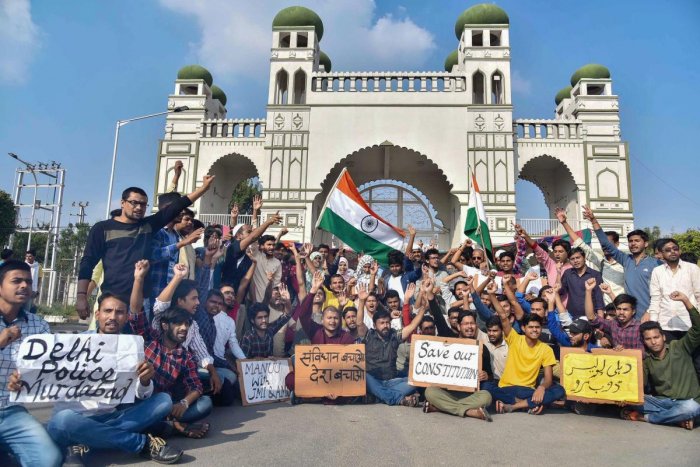
Students hold placards as they raise slogans during a protest against Citizenship Amendment Act (CAA) and National Register of Citizens (NRC) at Maulana Azad National Urdu University in Hyderabad, December 17, 2019. Photo: PTI.
As per the current design, the NPR will be prepared through and during the next round of the Indian Census.
It is important to understand as to why the decadal census has been delayed for more than two years since 2021 and despite the nation being declared COVID-free. And this has happened for the first time in 150 years.
Innumerable critical errors
A potential communal unrest looms if the NPR questions are canvassed during the next round of the Indian Census.
The inclusion of the NPR data, along with the Census, during the same visits is a critical error of administrative judgment and perceived as a political conspiracy against the Muslims of India.
The objective of the Census is to create a reliable source of general demographic information for the purpose of formulating government policies and academic research. It is not intended to provide individualised information to be used against respondents in subsequent proceedings that seriously jeopardise the individual’s life, liberty, and dignity, such as the creation of a citizen’s registry, omission from which may lead to statelessness, prolonged detention and deportation for a person who obeyed Indian law by responding to a census enumerator.
Under Indian law, the collection of data by the Census of India Act, 1948 cannot be used otherwise and cannot be presented for legal judgments. Thus, the NPR, if tagged along with the Census, could be termed as an "illegal administrative activity".
Note that Section 15 of the Census Act says that the Census data should not be used against a census respondent.
It provides, first, that “no person” has the right to “inspect any book, register or record made by a census officer in the discharge of his duty taking the census...”
The confidentiality of an individual’s census information cannot be protected if the information is to be transmitted directly into the NRC and then used against the individual in a Foreigners Tribunal proceeding.
Critically, Section 15 of the Census Act also provides that “no entry in any such book, register, record or schedule shall be admissible as evidence in any civil proceeding whatsoever” (emphasis added). This provision would necessarily have to be violated if purported evidence as to the citizenship of an individual were to be admitted in evidence in a Foreigners Tribunal.
Not surprisingly, the Census Act nowhere mentions the NRC since the Census Act was enacted in 1948, but the NRC, as it is currently contemplated, only came into conceptual existence through Citizenship Rules formulated in 2003. Significantly, while the Census Act has been amended on more than one occasion, it has never been amended to authorise the practice of using census officers, duly authorised under the Census Act, to collect data that will be used to create the NRC.
The immediate fallout of the NPR-linked NRC will be the exclusion of millions of genuine citizens from the electoral rolls. Yet the wildcard use of CAA can authorise even executed Hindus to vote; while only the Muslims who will be made ineligible to vote pending the Foreigners Tribunal authorisation. Even if the government carries out the joint exercise of NPR and NRC after proper legal amendments, it will still end up hurting the Muslims since all other religious communities will be rescued by the 2019 CAA.
The author, therefore, argues that as a first step in resolving the onset of serious social and economic disturbances, the Indian census operations must be delinked from the proposed collection of data for the preparation of NPR.
Also read: What the Proposed Uniform Civil Code Should – And Shouldn’t – Be
Other ground issues need to be solved
There are some major economic issues that need to be looked at if the UCC is implemented.
While the contribution of the multi-layer bureaucracy and administration such as the IAS, IPS and state-level services is the one sustaining the democracy and development projects of India, it is of utmost importance that Muslims, like all other identity groups, assert their rights as Indian citizens and ensure a close participation at the grassroots level institutions such as the panchayats. They should get connected and associated with the local (village and urban ward) level institutions and bureaucracy such as the ICDS, the panchayat, primary school, village accountant, small scale industries, public and private markets, local bank and police system.
It's crucial that the Muslim community finds easier access to mainstream schooling and the college system to be able to come out of the ‘exclusionary’ and poor-quality education system, managed by minority communities, which is so willingly promoted by the state and national governments.
But only 4% of Muslim children go to madrasa and maktab, according to the Sachar Committee report.
Labour market interdependence
India's Muslim population amounts to approximately 200 million, with roughly half, that is 100 million, actively participating in the labour force.
The majority of Muslim workers in India are either self-employed, engaged in managing their own businesses, or employed in manufacturing and manual labour. Each of these workers has employment contracts with at least one non-Muslim Indian, primarily Hindus.
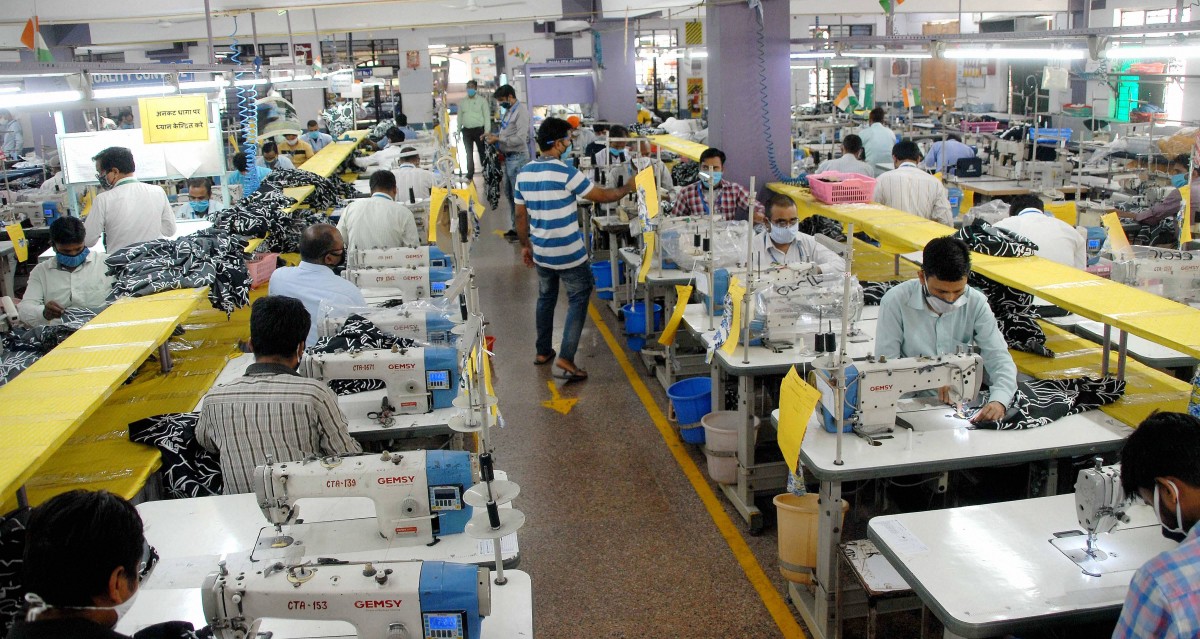
Representative image. Workers at an apparel manufacturing company in Noida during the COVID-19-induced lockdown. Photo: PTI
Therefore, any social, bureaucratic, or politically motivated policies that impact the Muslim labour force will also affect their non-Muslim counterparts, effectively doubling the impact on around 200 million workers across India.
This converts to about 32% of the overall labour force, directly affecting the GDP to the same proportion.
The overall transformative reduction, let's say about 10% decline in labour productivity, will amount to a huge decline of about 1% in the nation’s GDP, which would further impede future growth momentum.
[Note that all estimates mentioned in this article are based on 0nly 10% decline in labour productivity. If this percentage increases, the total impact will be much more than 1% of the GDP.]
The sociology of 'Hindu First' growth
The structure of modern labour supply in India is uniquely lopsided favouring the high castes who are socially and economically better-off. The so-called 'upper' caste Hindus are disproportionately represented in the organised sector jobs, both in the government and private sectors, and in higher-level education.
The system has excluded large proportions of the people belonging to the Scheduled Caste and Tribe community, the Muslims and certain ‘other backward classes’ from the modern labour market.
This situation needs to be transformed for a more socially inclusive labour market.
India’s ultra-right-wing groups, identifying themselves as a form of a social-civil society, often supported by the current national ruling party, fantasises India to be a 'Hindu Rashtra'.
The recent interventions by these groups have thrown off-gear the policy frameworks made by legal and civic institutions to regulate economic and social domains of millions of citizens.
It appears these groups can influence policy reversals in selected states and even at the Centre, such as the withdrawal of quota or reservations provided to Muslims, like the case in Karnataka and Maharashtra, banning the culling and consumption of livestock, altering the personal laws of a specific community, and even stalling and reallocating budgetary programme funds meant for the social and economic development of minorities.
In November 2022, the government withdrew pre-metric scholarships for students from Class I to Class VIII, and said that it would apply only to students from Class IX and Class X, inviting criticism from politicians and activists.
These scholarships helped students belonging to the minority community overcome their deficit in school enrollments and continuation of studies.
On the other hand, many compelling legal cases with respect to police excesses and motivated political threats are being withdrawn. Similar legal and political messaging could be found in instances where criminals serving life sentences for murders and gang rapes were released.
There are changes and revisions being made in school curriculum, promoting right-wing Hindutva ideology.
The scientific temper among the students and the population at large is being challenged in a manner that unsubstantiated beliefs are used as citations and theories to the dismay of modern thinkers, practitioners of reason and science.
Shockingly, Uttar Pradesh directed authorities to seize properties of those involved in the protests against the CAA; it later withdrew the notice.
The blatant majoritarianism and the impositions of the “Hindu-first” ideology, notwithstanding the pluralist ethos of India, will have an adverse impact on the lives and liberties of ordinary Indians and their capacity to contribute to India’s GDP.
India is a land of a million markets
The Indian economy is unique and highly complex. It is a mixed economy, as it showcases elements of both modernisation and traditionalism in the production and consumption markets.
Over 80% of the economy is unorganised with self-employed and unregulated production sectors. In 2018-19, only 19% of the total labour force had a written employment and work contract, and who could be classified as regular salaried employees. This calls for an opportunity to create new and innovative institutions to establish new markets, which are technology driven, thereby improving efficiency.
Multiple markets such as the local farmers' markets, providing a variety of products, rural markets (retail and wholesale), sub-urban thrift markets, urban markets, and online markets offer innumerable opportunities to consumers, producers, and suppliers. Nowhere in the world one can get essential medicine or even coffee packed in a small package sold for as little as Rs 2, or 2.8 US cents, as in India.
One can get a fully satisfying meal for as little as Rs 50, or about 55 US cents.
At the same time, India possesses huge markets, for example, over 800 million subscribers are registered cell phone users with an average monthly user bill of Rs 275 or just about $4.
Conclusion
While the idea of a Uniform Civil Code may have its merits, it must be approached with sensitivity, respecting the religious freedom and cultural diversity of the nation.
Additionally, the upcoming 2024 General Election and the potential implications of policies like the NPR, as discussed earlier, demand vigilance from all citizens to safeguard the principles of democracy and social harmony.
As India continues on its path of growth and development, it is crucial to embrace pluralism and foster an environment of mutual respect, understanding, and cooperation among different communities.
Rather than promoting divisive ideologies, the focus should be on creating institutions and policies that uplift all sections of society. This would ensure inclusive economic growth, and equal opportunities for everyone.
Abusaleh Shariff (ashariff@usindiapolicy.org) is chief scholar at the US-India Policy Institute. He was Member Secretary of the Prime Minister’s High Level (Sachar Committee) during 2005-07. He was also Chief Economist at the National Council of Applied Economic Research for about 20 years.
Views expressed are his own and do not represent any institution or organisation he belongs to.
This article went live on August ninth, two thousand twenty three, at zero minutes past four in the afternoon.The Wire is now on WhatsApp. Follow our channel for sharp analysis and opinions on the latest developments.


